A 19th century Philadelphia lamp maker took the world’s first selfie and turned the city into a hub of portrait photography
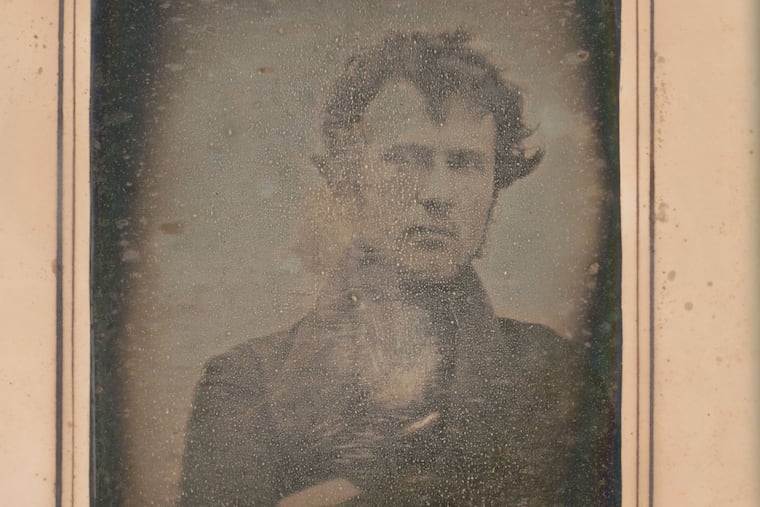
Robert Cornelius did not just take the world's first selfie. He opened the world's second portrait studio in our city.
French inventor Louis Jacques Daguerre introduced the daguerreotype — the world’s first photograph — in Paris in August 1839. By September, he produced a pamphlet introducing the technique to the world.
When the how-to-take-a-photo leaflets arrived in Philadelphia in late September, the city’s cultured men, scientists, and budding artists gave photography a shot.
But unlike today’s pointing and clicking, it wasn’t easy.
“All they got were the pamphlets,” explained Rachel Wetzel, senior photo conservator at the Library of Congress. “Nobody had a camera, plates, chemicals, or darkroom apparatus.”
The newly minted photographers needed paper-thin sheets of silver-plated copper, iodine, and mercury. The ratio of the chemicals needed to be exact, and the amount of sunlight needed for exposure to capture images varied wildly.
On Sept. 25, 1839, U.S. Mint employee Joseph Saxton, whose office was located on the northwest corner of Chestnut and Juniper Street across from Central High School, photographed the city’s first high school from one of his workplace’s top-floor windows.
That photo is the oldest existing photograph taken in America.
Saxton soon took up photography as a hobby but had a hard time getting his hands on the thin, silver-plated copper sheets needed to make daguerreotypes. He asked his friend, lamp maker and metal-plating expert Robert Cornelius, for help.
Cornelius, who had a connection with Scovill Manufacturing, then among the most prominent metalworking manufacturing firms in the United States, happily obliged.
And as it turned out, Cornelius was curious about photography, too.
A few weeks later, in late October or early November, Cornelius found himself standing behind his family-owned lamp-making shop at what is today Seventh and Chestnut Streets, experimenting with a camera he fashioned from a small metal box.
Instead of pointing his lens at a lantern, a cobblestoned street, or a traveling horse and buggy, Cornelius turned his camera on himself.
He opened his lens cover and stood still long enough in the sunlight for the exposure to capture his image on a metal plate.
The selfie was born.
That first selfie is housed in the Library of Congress.
And that magnificent moment — predating social media by almost two centuries — will be feted this Saturday at Franklin Square from 11 a.m. to 1 p.m. The selfie celebration is the Philadelphia Historic District’s 34th firstival, a weekly day party in honor of America’s 250th birthday, giving love to events and happenings with very Philly roots.
When Daguerre came up with his picture-taking method, he did not have portraits in mind, Wetzel said.
Historians aren’t sure why Cornelius decided to make a picture of himself, but in an 1892 American Journal of Photography article, he talked about what it was like standing alone on the streets of Philadelphia waiting for the image to happen, Wetzel said.
“When he stood in front of the camera, he wasn’t sure if he was centered or not,” Wetzel said. “That’s why he’s weighted to the right of the plate.”
The wonder surrounding taking the first selfie seemingly inspired Cornelius.
In May of 1840, Cornelius opened the world’s second portrait studio at Eighth and Lodge Alley (now Ranstead Street), not far from his family’s lamp-making shop.
Business partners Alexander S. Wolcott and John Johnson opened the world’s first portrait studio in New York a few months earlier, but only Cornelius’ 1840 portraits endured, explained Wetzel, who is also a leading historian in Cornelius’ work.
She began studying Cornelius’ work in earnest in 2015 while working in Philadelphia at the Conservation Center for Art & Historic Artifacts. Wetzel has studied upward of 70 of Cornelius’ portraits, thanks to plates that have survived more than 100 years.
Cornelius took portraits of prominent citizens — many of whom were Quakers — in their Sunday best because at $5 a piece, the equivalent of a week’s salary in those days, they were the only ones who could afford it.
The first portrait he took in his studio was of a man named John McCallister Jr., a wealthy optometrist who, coincidentally, supplied Cornelius with his camera’s lenses.
Cornelius moved his portrait studio to its second location on Market Street before closing the business in 1843, and returning to his family’s lamp business full time.
“While he’s operating the studio, he never quit working for his family,” Wetzel said. “He’s working the camera, but he had apprentices who polished the plates and did the behind-the-scenes darkroom work.”
As the mid-19th century approached, the Cornelius family’s lamp business began to boom. Street lamps became commonplace. Philadelphians began putting gas lamps in their homes. Cornelius formed a partnership with Isaac Baker and formed Cornelius & Baker, becoming a premier manufacturer of high-end metalwork, lamps, chandeliers, and gas lighting fixtures.
“Their hand railings, banisters, statues, and chandeliers became world-renowned,” Wetzel said. “Many of their pieces are still found throughout Washington, D.C., and the U.S. Capitol today.”
The Academy of Music’s massive crystal chandelier in the center of its auditorium was built by Cornelius & Baker for the opera house’s historic 1857 opening. (Yes, the guy who took the world’s first selfie also built the Academy of Music’s chandelier. Let that sink in.)
Cornelius’ portrait studio may have been short-lived, but his impact on photography is lasting. Wetzel suggests his apprentices went on to open daguerreotype portrait studios across the city, and by 1849, there were at least 100 in Philadelphia. By the end of the 19th century, the costs had come down considerably, and portraits could be purchased for as little as 25 cents.
“Philadelphians loved portraiture,” Wetzel said.
By the mid to late 1850s, daguerreotypes were replaced with the collodion process. But photographs — whether developed in a darkroom or a drugstore, taken on Polaroids, or shot on smartphones — endure.
And the selfie rules.
This week’s Firstival is Saturday, Aug. 22, from 11 a.m.-1 p.m., at Franklin Square, 200 N. 6th St. Firstival celebrants will meet under a tent, and the party will be held rain or shine.
Each week, The Inquirer is highlighting a “first” from the Philadelphia Historic District’s 52 Weeks of Firsts. A “52 Weeks of Firsts” podcast, produced by All That’s Good Productions, drops every Tuesday.