Philadelphia, home of the first U.S. Mint, is where the country’s first and last pennies were made
In 1793, the U.S. Mint pressed the first pennies. Three moves around the city and 232 years later, it stopped making copper cents.
On the advice of United States Treasurer Alexander Hamilton, Congress passed a law establishing America’s first federally funded bank on Feb. 8, 1791.
The bank — located inside Philadelphia’s Carpenters Hall — would serve as the primary fiscal agent for the federal government and one of its many jobs was to issue paper money that was printed by private banknote companies and local print shops.
Coins, though, weren’t in the mix yet.
On April 2, 1792, Congress established the United States Mint in Philadelphia with the adoption of the Coinage Act. The act set the dollar as the standard and set denominations — pennies, dimes, nickels, quarters — and their weights, compositions, and regulations.
The new law also required a symbol and inscription of the word “liberty” on each of the coins.
The first U.S. Mint will be celebrated Saturday at the United States Mint in Old City, from 11 a.m. to 1 p.m. as part of the Philadelphia Historic District’s 33rd “Firstival.” Firstivals are weekly day parties held in honor of America’s 250th birthday.
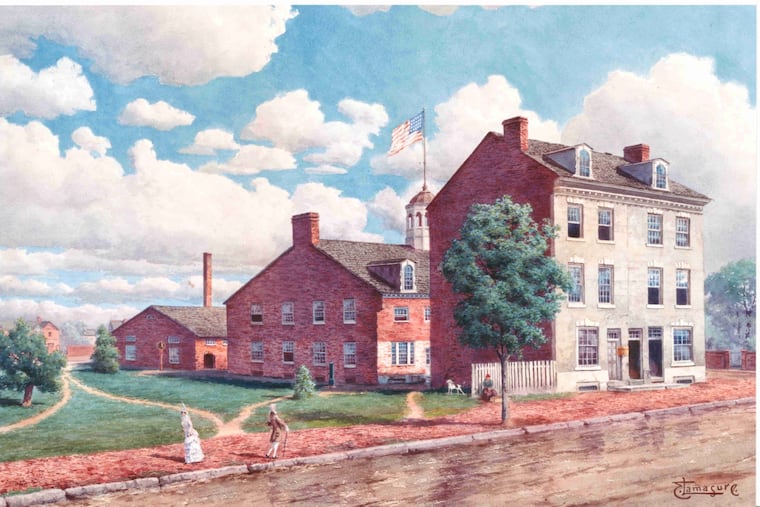
The first U.S. Mint — fondly remembered as Ye Olde Mint — was located on the east side of Seventh Street, just south of Arch, on land purchased by David Rittenhouse.
Rittenhouse, the well-heeled great-grandson of America’s first paper mill owner, William Rittenhouse, was an 18th-century astrologer and clockmaker who would serve as the first director of the U.S. Mint. Rittenhouse Square is named after him.
The first coins made after the Coinage Act were half dimes and fashioned off-site, according to Tim Grant, exhibits and public affairs manager at the U.S. Mint. “Made of silver, these half dimes were supposedly struck using silver donated by Martha Washington,” Grant wrote in an email.
The first coins fashioned at the actual mint building were 11,178 copper cents, or pennies, and were delivered in March of 1793. (The U.S. Mint stopped making pennies in November, ending its 232-year production run.)
During America’s early days in the late 18th century, work conditions at the U.S. Mint were grueling, Grant wrote. Employees worked 11 hours a day, six days a week, and earned $1 a day. It took workers three years to produce the nation’s first 1 million coins.
“Today we can produce one million coins in less than a half an hour,” Grant wrote.
As the nation grew, so did its demand for coins.
By the late 1820s, the U.S. Mint had outgrown its original buildings, and in May of 1828, Congress voted to keep the Mint in Philadelphia and erect a second building. The cornerstone of this new, larger U.S. Mint was laid on July 4, 1829, on the northwest corner of Juniper and Chestnut Streets. It opened in 1833. That building served as the U.S. Mint’s home for 68 years.
In 1901, the U.S. Mint moved to its third location, taking up the entire block of Spring Garden Street between 16th and 17th Streets. The building, with a lobby containing seven Tiffany mosaics, was its home through the mid-1960s. The Community College of Philadelphia occupies the site today.
The Mint returned to Old City in 1969, moving into its current building on five acres on Fifth Street between Arch and Race Streets. It has over 600,000 square feet of manufacturing space.
There are three other active U.S. Mints in America: the Denver Mint, the West Point Mint, and the San Francisco Mint. The San Francisco Mint is not open to the public and specializes in commemorative coins.
“The mission of the United States Mint has remained the same for over two centuries,” Grant wrote. “To serve the American people by safely and efficiently manufacturing, distributing, and circulating precious metal, collectible coins, and national metals.”
This week’s Firstival is Saturday, Aug. 15, from 11 a.m.-1 p.m. at the United States Mint, 151 N. Independence Mall East.
Each week, The Inquirer is highlighting a “first” from the Philadelphia Historic District’s 52 Weeks of Firsts. A “52 Weeks of Firsts” podcast, produced by All That’s Good Productions, drops every Tuesday.