We pick our favorite shows from this year’s big, bizarre, and bold Philly Fringe Fest
This edition was marked by nerdy love stories, live pottery, ICE agent mannequins, Larry Kramer, Anthony Fauci, and more
The Philadelphia Fringe Festival celebrated its 30th year with more than 338 productions across the city. Our reporters found shows that left us dazzled and confused, tearful but still laughing, and truly amazed by all the strange, weird, and delightful originality that artists from Philly (and beyond) had to offer.
These were some of our favorite performances, including solo shows, interactive experiences, immersive dance, otherworldly journeys, and incisive political explorations.
Most optimistic: ‘Lunar Retreat’
To enter this performance, you must prepare for take off: Grab a set of headphones specifically curated for your group (an audience of just a dozen or so, per entry time) and remove your shoes.
Past the doors lies a transformed Pearlstein Gallery, with different sections divided by flowing white curtains. The calm voice in your ears provides instructions, like a guided meditation for a winding path through a constellation of dancers before you arrive in a maze of tall, twisting cardboard adorned with twinkling lights and images of the moon’s various cycles.
After billions of years orbiting the earth, our moon has been slowly inching away from us, the disembodied voice explains. The show asks: What does it mean to enter someone’s orbit, to connect with another person, when we all drift apart eventually, inevitably? At its core, Lunar Retreat tackles grief, prompting the audience to imagine a loved one who is physically distant. What detail about this person do you never want to forget? After we write down our answers, we’re guided into the maze, where the answers from previous attendees dot the spiraling walls.
Fringe Fest regular Nichole Canuso’s dance company Branching Paths is renowned for immersive and interactive performances; here she worked with ocean explorer/artist Rebecca Rutstein, sound designer Bobby McElver, video designer Kate Freer, and set designer Anna Kiraly, among many collaborators. The projections were especially astounding: In one room, a dancer performed a series of moves in one place that were recorded and projected to the same location on a loop, allowing her to essentially dance with and embrace the projected version of herself. It was a mesmerizing collaboration between dance and technology.
At the end, the three audience groups gathered for the finale, when eight dancers (including the choreographer, Canuso) evoked ocean tides as they converged and separated, where they kept reaching for one another and then leaping apart. I was in awe not only of the performance itself but of my fellow audience members, who embraced the experience with open hearts and curious minds — leaving me surprisingly optimistic about the future of humanity.
— R.C.
Standout Solo Show: ‘Tuzluk’
This wildly inventive coming of age story follows Turkish Colombian American theatre artist izzy sazak as they deconstruct the heroes of their childhood. It’s a bold, imaginative examination of how we recontextualize the stories that we are told as kids. Throughout the piece, sazak examines their father, his Turkish heritage, and the Turkish mythos that they grew up instilled with. It is a magnificent look at the crossroads of culture, legacy, and family; while also being frankly honest about how many people idolize political figures.
sazak is an effortless performer, immediately engaging with the audience, establishing a welcome and safe feeling throughout the performance. They are also very adept at comedy: their timing is precise, and they can easily adapt and improvise.
The word tuzluk is Turkish for “salt and pepper shakers,” but it is also a colloquial name for the folded paper toys that kids use to tell their futures. This item is used both as a literary device, as sazak unravels their future through the show, and also as set pieces.
Several tuzluks of varying sizes are arranged on the stage, and are utilized as props. The final moments of the show, when the last tuzluk is opened, is one of the most cathartic, community focused finales I’ve ever experienced in a theatre.
— F.S.
Best true story, retold: ‘Kramer/Fauci’
C-SPAN isn’t usually the place where one might find dramatic inspiration. But for director/creator Daniel Fish, one hour of a televised debate in 1993 provided an insightful window into a painful history that still resonates deeply. His innovative verbatim play follows a contentious conversation between Larry Kramer, the fierce activist/playwright who founded ACT UP, and Anthony Fauci, head of the National Institute of Allergy and Infectious Diseases at the time, about then-President Bill Clinton’s new task force to address the AIDS crisis.
On the sparse stage only four actors appear, playing the moderator (Greig Sargent), Fauci (Pete Simpson), Kramer (Thomas Jay Ryan), and the callers who dial into the TV segment (Jennifer Seastone). There are no cameras, no desks or green screens to evoke the monotony of C-SPAN’s regular programming; instead, the moderator is seated and his guests move around freely while Seastone spins around on roller skates, occasionally donning a chicken suit. The pared down production allows Kramer and Fauci’s sparring to take the spotlight (literally) but also creates a dynamic movement that keeps the audience engaged in their hot-and-cold ping-pong match without feeling like we’re watching a live podcast taping.
It’s far from boring, no matter how wonky the dialogue gets. Ryan’s Kramer erupts on a dime, shouting and throwing barbs and teasingly threatening to slap Fauci, who deflects and delivers defensive, boilerplate responses typical of a bureaucrat, knowing that his answers are dissatisfying. Kramer is fuming and defiant, demanding urgency from a government and a public whose inert response to the epidemic was a systemic, fatal failure on an unimaginable scale. When the callers chime in, many express sympathy, but one chilling, virulently homophobic standout accuses him of infecting the nation’s bloodline.
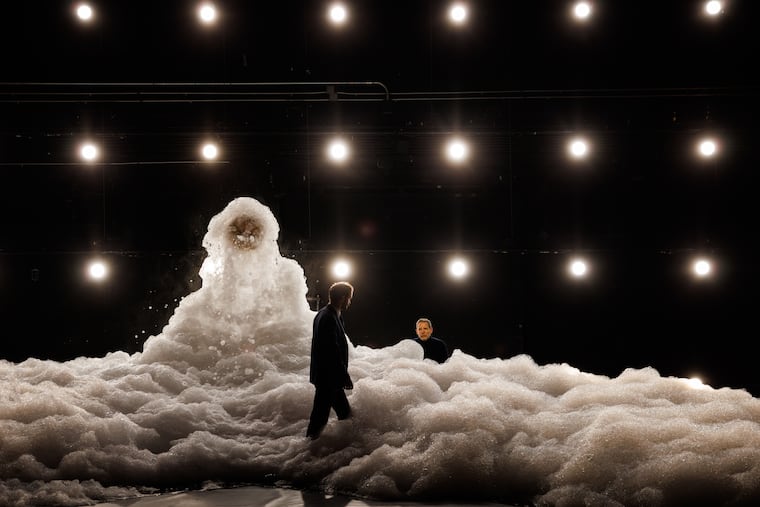
The most dramatic moment comes rather abruptly, when a towering bubble machine churns out a mass of suds that slowly takes over the stage. Kramer sits next to it, arms crossed, resigned as the machine whirs and the foam spreads.
Given the devastating subject matter, I didn’t expect to laugh so much. The pair at the center of the show hold profound respect for each other despite their disagreements and there’s a familiarity to their banter that underscores their shared goal; their debate is almost endearing to hear in retrospect today, if the reality wasn’t so infuriating. It ends with an epic line from Kramer when asked for his last word: “I want Bill Clinton to come out of the closet … and do something about this disease.”
— R.C.
Most Promising: ‘Returned, Iridescent’
There is a scarcity of narrative stories that showcase LGBTQ+ people growing up and living into old age. Oftentimes, these characters are burdened with struggle, defeat, and frequently, a tragic end; especially stories of trans people. Returned, Iridescent, the new work by playwright Rose Farrell, defies this trope by taking the audience on a beautifully poetic journey of two queer characters who constantly collide, combust, and separate, only to be drawn back together again and again. The text shifts between realism and poetry, allowing the characters to be both their true selves and romanticized versions. It is a beautiful story about finding yourself, loving yourself, and accepting the happiness that you deserve.
Breathtakingly nuanced performances from the two leads (Olive Gallagher & Gideon Caro McDonald) help ground this work in the moment. Watching the two of them effortlessly push, pull, and play with each other is a joy. I’m eager to see what these two talents do next. Strong design elements, with direction by Jack McManus, help this play to soar.
This play is an extremely timely one, given the current social and political discourse around trans people, which often serves to dehumanize or vilify them. I commend Theatre by Development for choosing to tell this story now, and hope that it is told many times more.
— F.S.
Nerdiest romance: ‘Wikipedilove’
A Newfoundland town called Dildo. The erotic novella A Billionaire Dinosaur Forced Me Gay. Eva Braun?
All are ripe for exploration at the love-and-sex-themed Wikipedilove, the lo-fi, musical PowerPoint presentation staged at West Philly Fringe hub Studio 34.
Writer, singer, and guitarist Noam Osmond — who moonlights as a “troubadour for hire” and can occasionally be spotted serenading strangers in Clark Park — and singer and accordionist Anna Apostolidis take the audience through a whirlwind of weird internet, told through screenshots, academic analysis, and cutesy folk songs.
In under an hour, we learn, for instance, that gray whales mate in threes (“#consensuwhale”) and that there’s a Wikipedia page of “List of sexually active popes,” among many other NSFW topics.
At the packed Friday night performance I attended, audience members were game to sing and sway along, emblematic of the participatory theatre that makes the Fringe Festival so special.
Two actors dressed as sparkly winged green and yellow bugs who appeared in the finale were a highlight of the show — luna moths, which live for just one week, solely to mate. Because who says science can’t be silly and sexy?
— J.Z.
Strangest existential journey: ‘Utopian Hotline’
A night at the museum is always a fun set up for a new adventure. This trip to the cosmos — courtesy of the theatermakers at Mitu, an experimental group based in Brooklyn — took place inside the Franklin Institute’s Fels Planetarium.
At the center of the room sat a round desk with a camera, turntable, microphones, and telephones. Audience members wore headphones and sat back as the domed screen above came alive with the trippy, philosophical show.
The titular hotline is real, inspired by the Golden Record that NASA sent to space that’s meant to represent earth, featuring sounds from voices to waterfalls to classical music. Mitu’s project imagines the messages we could send out into the universe if we created another record with people answering the prompt, “How do you imagine a more perfect future?”
Their respondents express variations of similar feelings: that it’s a hard question to answer, that it’s especially difficult to imagine a future when our current present time is so fraught, that we all want compassion and care and kindness no matter how far humanity travels from earth. (It’s an active hotline for anyone who’d like to add their voice.)
The show was part listening session (headphones required) and part strange story time as the performers at the center, akin to astronaut guides in matching gray suits, tinkered with the machines in front of them, sometimes taking over the mic to sing and other times recording with the camera so that their face would appear in the screen like a ghost. They posed existential questions about whether we’re alone in this universe or if we’ll ever truly understand the fickleness of time. The performance was somewhat disorienting, but the experience felt strikingly unique regardless of the occasional confusion, or maybe because of it.
— R.C.
Most Thought-Provoking: ‘Bad Clay’
Justin Jain brings the audience to the cross section of sculptural ceramics and performance art in his original work Bad Clay. An experimental piece about migration, America, and sculpture, it delights in the way Fringe shows often do; by highlighting something new and unexpected. Entering the space, the audience is greeted by a series of ceramics laid around the room, all of which are made by Jain. Throughout the piece, Jain interacts with each ceramic, and also throws some clay on a wheel, creating live sculptures in front of the audience. Conspicuously, there is also a mannequin in the room; dressed as an ICE agent, and draped in an American flag. Ever present, this mannequin provides a feeling of unease that permeates the room, and when it is finally addressed and incorporated into the piece, it results in a truly harrowing moment.
What really stood out about this piece was the prologue. In a prerecorded monologue from Jain, he explains that the piece we’re about to see is an experiment. He goes on to explain how he has struggled to be presented by the Asian Arts Initiative directly, and also how he came to be in the space that the piece is taking place in … as it was not the space he wanted to present in. According to this prologue, he was looked over for various fellowships and grants, which led to having to present this piece as part of the “pay to play” aspect of the Festival. As a Philly artist of some notoriety, Jain still has struggled for financial and creative stability. It was an interesting breath of realism, and a frank conversation about the state of arts funding throughout the city. Additionally, it also offered audiences a “peek behind the curtain” as they heard firsthand about the hurdles of presenting a fringe show, and how it affects performers and producers.
Bad Clay is something I would be intrigued to see again, and to see what it would look like as Jain envisions it fully. It is a piece that raises interesting thoughts and questions, paired with honest reflection, and fully seeing it as the artist intended would be an exhilarating experience.
— F.S.
Shows we’re excited to seeing develop further post-Fringe
Alpha by Lisa Villamil
Trauma Queen by Liv Shoup
Amor/Libertad by Joel De Jesus-Pacheco
The Suppliants by Sidney Marie Hughes
Dickie Dickie Dicky Donnie by BETTY