The surprise winners from record-high diesel prices
It isn’t just big oil companies that are benefiting. Railroads are taking business from truckers, and alternative-fuel trucks are getting a fresh look.
No one seems happy about record-high diesel prices.
Farmers complain about the cost to harvest their crops. Truckers say they’re getting squeezed. Retailers such as Kroger have warned that it’s driving up costs.
The pressure has led President Donald Trump to float a diesel export ban, while some in Congress want to suspend fuel taxes.
But in a few places, the galloping price of diesel is seen as an opportunity — albeit a tricky one to navigate.
Railroads are taking business from truckers, while alternative-fuel trucks are getting a fresh look. Big oil extractors and refiners are benefiting too, of course. But so are smaller operations that have gotten an indirect boost.
“We sure don’t want to have the economy damaged by having high fuel prices and slowing some things down,” Jim Vena, CEO of Union Pacific, among the country’s largest railroads, said recently at an investor’s conference.
But the soaring price of diesel has been good for his line of business so far. The biggest driver of growth for Union Pacific is moving freight that could have gone by truck, the company said.
Diesel reached a record $6.53 a gallon this past week, according to AAA’s national average. That’s up about 75% from a year ago.
The national average for a gallon of regular gas, meanwhile, is $4.48 — about 40% higher than a year ago, though still well below the $5.02 record set in June 2022.
All of this has worked out well for companies like Wex, a major provider of fleet fuel cards.
“We’re a net benefactor of what happened with fuel prices,” CEO Melissa Smith told investors this summer.
Diesel is the lifeblood of trucks, tractors, and construction equipment. And its eye-watering cost brings a set of problems different from high gas prices. Consumers don’t feel diesel’s “pain at the pump” in the same way. When diesel gets pricey, it raises the cost of transporting food and goods — anything that needs to be moved from one place to another.
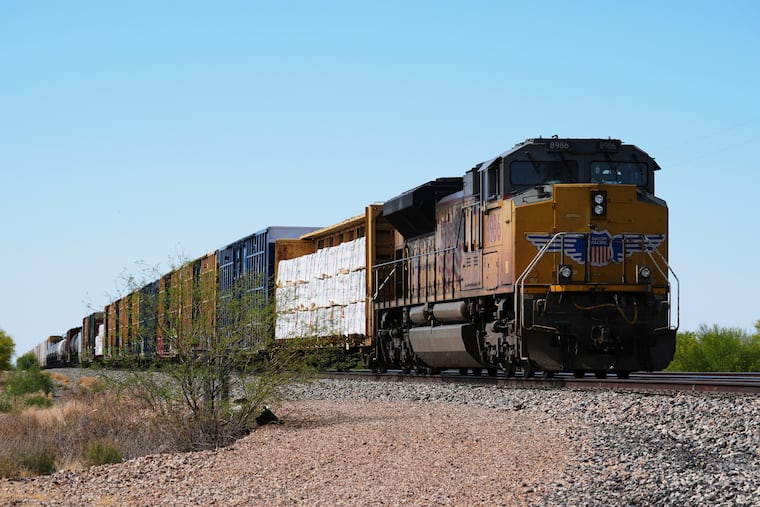
Now, containers and trailers stuffed with bananas, furniture, or flat-screen TVs are increasingly going by rail. This “intermodal traffic” has jumped in recent months, setting a record for U.S. railroads in August, according to the Association of American Railroads.
Railroads run on diesel, too. But freight trains are three to four times more efficient based on tons per mile.
“I do think that’s a plus for us,” Jennifer Hamann, Union Pacific’s chief financial officer (CFO), said recently at the annual Morgan Stanley Laguna Conference.
Norfolk Southern chief commercial officer Ed Elkins said diesel prices are so high they’re like “science fiction” and are just pulling freight off the road.
Trucking giants like J.B. Hunt Transport Services have felt pinched. Diesel prices have spiked faster than the firm’s fuel surcharges. But J.B. Hunt has seen a boost to its intermodal service.
“Do I want fuel to be $6 a gallon? No, not long term. But for today, it can be helper” in growing that business, Brad Delco, CFO of J.B. Hunt, told investors recently.
The company said the cost gap between trucking and trains was the largest it had seen.
Truckers are also hurt by the rapid price moves, said Bob Costello, chief economist for the American Trucking Associations. Most fuel surcharges are set weekly, based on the federal Energy Information Administration’s Tuesday morning price for diesel. Midweek moves make it even less likely that truckers can recoup their costs, Costello said.
“They’re not happy about it,” he said. “It’s absolutely costing them money.”
That’s spurred online angst, including a viral call to launch a nationwide trucker strike on Oct. 1. It’s unclear how much support this push has. Costello said his organization was unaware of it. Another major trucking organization, the Owner-Operator Independent Drivers Association, said it was not involved.
“Besides the obvious difficulty in getting hundreds of thousands of drivers to all agree to shut down, the greatest obstacle involves antitrust laws and illegal boycotts,” said Lewie Pugh, the group’s executive vice president.
Trucks that don’t use diesel are seeing renewed interest.
Morgan Stanley suggested in a research note that this makes electric trucks more attractive, writing, “$6 Diesel … Enter Tesla Semi.”
The first battery-electric Tesla tractor-trailer rolled off a new high-volume production line in April, several years after it’d been first promised. The company has been lining up orders since then. Last week, it got one for up to 2,500 trucks for a coalition that plans to lease out the vehicles.
Clean Energy Fuels, a company that provides renewable natural gas for vehicles, said they were hearing more interest from trucking fleets “particularly with higher diesel prices,” according to CEO Clay Corbus.
States that impose diesel sales taxes could reap more revenue. Others have taken steps to blunt the impact on consumers.
California — which has the highest average diesel price in the nation at $8.43 a gallon — puts a 13% state tax on diesel.
This summer, Illinois suspended plans to raise its flat diesel tax by 1.3 cents to 57.1 cents a gallon. And Kentucky briefly suspended a planned increase to its diesel tax.
But even industries that are benefiting from higher diesel prices today are worried about what is to come.
Several railroad executives said prolonged, elevated diesel costs would hurt the broader economy.
“At some point it will be a drag on consumers,” said Elkins of Norfolk Southern.