Woman charged in 2014 cold case killing of 69-year-old Northeast Philly man who was shot and dumped in the Schuylkill
Vito Maglio disappeared in December 2014, and his body was found in the Schuylkill months later. His killing went unsolved for nearly 12 years — until this week.
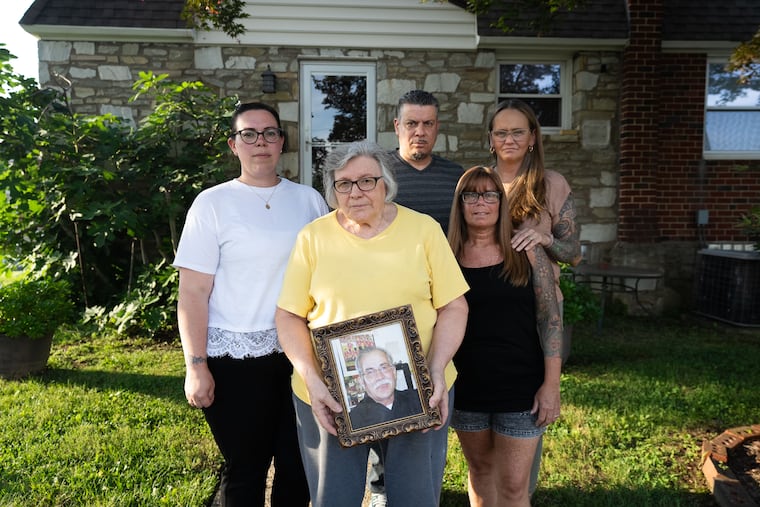
For nearly a dozen years, Vito Maglio’s family has agonized over who could have shot him in the head and neck, torched his SUV, then dumped his body into the Schuylkill.
“I said to myself, maybe I’ll die before I know,” his wife of 40 years, Maria, 75, said from her Bustleton home.
Then, this week, Philadelphia police arrested a 30-year-old woman in connection with Maglio’s death, saying she and others robbed him of his gold ring, phone, and a small amount of cash, then killed him and tossed his body into the river in December 2014.
Melanie Morat was taken into custody at her East Frankford home Tuesday afternoon and is expected to be charged with murder, robbery, arson, and related crimes, police said. Detectives are investigating whether at least two other people were involved in the crime, law enforcement sources said.
The arrest comes as Philadelphia homicide detectives, with more time and resources amid a striking decline in violence, continue to work through a backlog of unsolved cases — a combination of the hundreds of killings from the pandemic-era spike in shootings and higher-profile cases from years past that ran cold.
The killing of Maglio, 69, was among the latter, a disappearance and death that shocked his family and community, and left police struggling to amass enough evidence to make an arrest.
Maglio, a father of six, was a mechanic who owned several gas stations and ran a social club, the Napoli Association in Rhawnhurst, for many years before selling the businesses and retiring in November 2014.
But on Dec. 14, 2014, he did not return to his Bustleton home, and his family reported him missing. Several days later, police found his GMC Yukon in East Germantown, charred and windowless, with a bullet casing inside and a pool of blood beneath the driver’s seat, police said.
His remains were not recovered from the Schuylkill until late March. He was identified by his pacemaker.
The investigation was challenging from the start, officials said, in part because homicide detectives did not take over the case until his body was recovered months after his disappearance. The assigned detective, Gregory Santamala, said in a 2016 interview that police did not know where Maglio was killed because his phone records showed that he was in various neighborhoods on the night he disappeared, and there were no surveillance cameras in the area where his car was burned.
Detectives suspected he had been set up in a robbery that went awry, he said. An early tip led investigators to interview two women in the Northeast, and both failed polygraph tests. But the women immediately hired lawyers and stopped talking, officials said.
Santamala retired in 2022, and the case went cold.
Then, this summer, the case was reassigned to Detectives Joseph Cremen and Robert Daly, who began reviewing phone records and the more than a dozen interviews their colleagues held with suspects and witnesses over the years.
Investigators told Maglio’s family it was not necessarily new evidence that allowed them to make an arrest this week — but a new style of building cases. Years ago, they said, prosecutors had less experience making cases from cell phone location data and circumstantial evidence. Now, they said, law enforcement has greater expertise in understanding those records, which, alongside the witness statements, allowed prosecutors to conclude there was sufficient evidence to charge Morat with murder.
Deputy Police Commissioner Frank Vanore said using today’s technology to solve older cases is the crux of cold case review.
The Philadelphia District Attorney’s Office declined to comment.
Maglio’s family said the developments came as a welcome surprise after a decade of fleeting hope. Sitting in the green-walled living room of their parents’ home Tuesday night, Maglio’s children said they were grateful for an arrest and eager for the court process to begin.
“I’m just glad it didn’t fall through the cracks,” said daughter-in-law Sandra Maglio, 50. “It was our biggest fear. We live in a city where people die every day, sadly. … So I’m just glad that, you know, someone took the initiative to say, ‘Hey, let’s look at this again.’”
They were also struck by the timing. Maglio’s brother-in-law died Monday. And his son, Donato, died three years ago this month at the age of 47.
They imagine them all together now.
“It gives us some kind of closure,” said daughter Lucia Thrasher, 37. “But we already got the outcome we didn’t want to 12 years ago.”
Thrasher’s eyes welled with tears as she looked at her 6-year-old twins, Charles and Thomas, who never got to meet their grandfather. Charles, bouncing in the doorway, asked why everyone was in the living room.
“Nonno,” she told him.
“You know, Nonno,” she said, as he looked away bashfully. “Where’s Nonno?”
He pointed toward a gold-flecked picture frame in the corner of the room.