Superintendent Watlington explains why he reenrolled 720 students who haven’t been to school this year
“Let me be very clear — this isn’t about cooking the books, this isn’t about padding enrollment. This is about, we’re going to do our due diligence because it's the rules," the superintendent said.
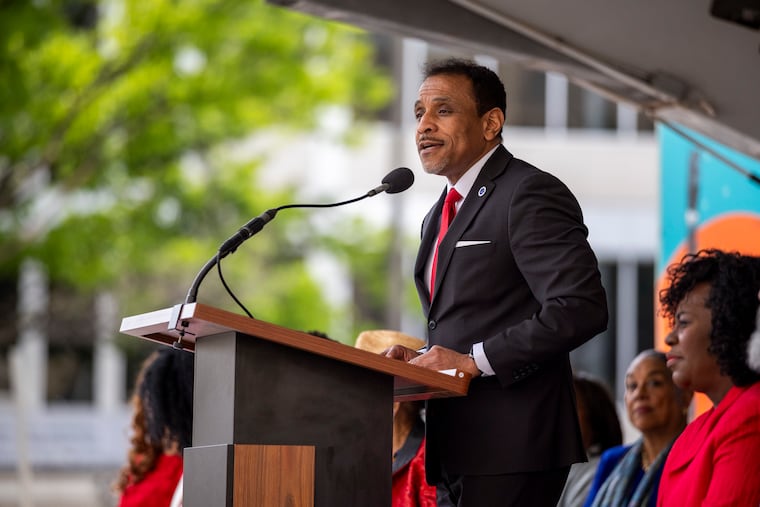
The Philadelphia School District was right to put back on its books 720 students who have not attended a day of school this year, Superintendent Tony B. Watlington Sr. said.
“Let me be very clear — this isn’t about cooking the books, this isn’t about padding enrollment,” Watlington said in an Inquirer interview. “This is about, we’re going to do our due diligence because it’s the rules.”
This year marked the first time the district has added back students it deemed improperly dropped in order to verify the students’ whereabouts, said Watlington and Ericka Washington, the district’s deputy chief of student enrollment and placement.
Philadelphia’s enrollment is down. As of Sept. 17, about 4,000 fewer students than the prior year had attended at least one day of school, according to internal records. And Watlington last month ordered central office employees, including assistant superintendents, and school staff to knock on doors to get students back in district seats.
But, Watlington emphasized, reenrolling the students was not tied to a desire to inflate numbers, as some district principals told The Inquirer.
» READ MORE: Students who moved out of the country were put back on Philly schools’ rolls
Instead, the reenrollment was tied to a belief that the school system must find every child, and a desire “to push the organization to get that next level of performance,” the superintendent said.
“We’re going to follow the rules for children and young people that people don’t stand up and come to advocate for, whether some of these children are hard to love or have attendance problems,” Watlington said. “We’re not going to throw them away.”
What happened?
The district added back students on Sept. 30, the day before school systems must report their enrollment to the Pennsylvania Department of Education.
About 2,000 students were improperly dropped from the district’s rolls, Watlington said; 720 were added back on the last day of September because they could not be verified as being enrolled in another school or district.
Multiple principals told The Inquirer that many of the 720 had not shown up to school at all in the 2026-27 school year, and many families reported moving out of the state or country.
Both Pennsylvania state code and Philadelphia school board policy require parental consent and documentation for a student to be withdrawn from school rolls. But it’s not spelled out what documentation is required.
The gold standard is verification from a new school, or a copy of a plane ticket if families leave the country, officials said. In the cases of families who stop responding to requests for information, principals say, in the past, they were able to use their best judgment to unenroll students.
Watlington, who became Philadelphia’s superintendent in 2022, said he was trying “to get better and better and better at our record keeping.” Last year, he ordered a more careful review of students who had been dropped from school rolls.
“For kids who are dropped inappropriately, we want those numbers there too and to be very transparent with the Pennsylvania Department of Education: These are kids who we are still looking for or trying to certify,” Watlington said. “I did the same thing last year. We just didn’t make as many headlines about it.”
Watlington said if he had known students were dropped from the rolls without proper documentation, he would have ordered them added back “last year and every year I’ve been here,” he said. “And would be unapologetic about it.”
An additional district-level review of the 720 students’ records is underway as the school system tries to locate the students, track down documentation, or begin the truancy process.
But that’s also happening at the same time as the state’s enrollment verification process, said Watlington and Tonya Wolford, the district’s chief of evaluation, research and accountability. Student records are cross-referenced with other schools and districts, and Philadelphia will not get funding for students who have not actually attended, said Watlington.
“We couldn’t just willy-nilly throw 800 kids who are all in Ghana on our rolls,” the superintendent said. “None of that.”
‘I want everybody in Philadelphia to know’
Several principals said they were alarmed by the order to add back students they have reason to believe are enrolled elsewhere.
Watlington said he understood that frustration.
“Our principals are busy,” he said. “They are hardworking, trying to get the reading and math performance up, the graduation rate up, the dropout rate down to keep this momentum that we want to continue. And it’s an additional tax and strain to be focused externally sometimes.”
The central office will help with the work of tracking students down, Watlington said, and the work is no secret.
“In fact, I want everybody in Philadelphia to know. I want the whole city to know that we are canvassing this city. We want every child who was in school last year back in school this year.”
Watlington is responsible for the whereabouts of all 200,000 students in public schools — district and charter — in the city, he said.
“If you’re not in the district-operated school, you need to be in a charter school or a home school or a private school,” he said. “I’m not going to turn a blind eye and say I don’t want to grow the district enrollment, but let me be clear, when we submit data to the Pennsylvania Department of Education on Oct. 1, there’s a process that the Commonwealth does to work with the 500 school districts to certify all of those children.”
‘Fair game for competition’
Watlington has given marching orders to the entire organization: The district is responsible for helping find students, too, tapping outside partners like faith leaders and others to spread the word.
The district needs to tell its story better, Watlington said.
Academics have generally improved in the school system — Philadelphia was tops in the nation in its learning rate post-pandemic, according to research out of Harvard and Stanford — but children still struggle, with only 33% reading at grade level and 25% meeting that benchmark in math.
City charter schools’ performance is slightly worse, with only 31% reading at grade level and 20% meeting the benchmark in math.
“I’ve shared with the assistant superintendents my expectation that they get shoulder to shoulder, elbow-to-elbow with ward leaders and block captains just like the politicians do, because they know this city and the community,” he said.
“I take the position if any of these 720 children could potentially be here, but be one of these kids that I see walking up and down Lehigh Avenue in the middle of the day, I want to make sure that we’ve done our duty to get these kids in school.”
The district can and should make a push to compete in ways it hasn’t in the past, Watlington said — not to demonize any other sector, because “I think whatever kind of school kids go to, and their parents want, that’s right for that child.”
But, the superintendent said, “we’re going to be focused on being visionary enough to aspire to grow our enrollment in the school district, because the numbers suggest to me that we need to be competitive, we need to be accurate, and we need to be honest with the data.”
“Once we do that, it’s fair game for competition,” he added. “Competition is good for the consumer in this capitalistic system we live in, and I think it’s the same way when it comes to public education.”