Temple’s Rome campus offers study abroad experience for older adults. No tests, grades, or stress.
Most students in the adult study abroad program are 60-plus.
ROME — Joyce Roush’s son wanted her to move to Philadelphia, so she started researching adult education opportunities in the city.
She wound up in Italy instead.
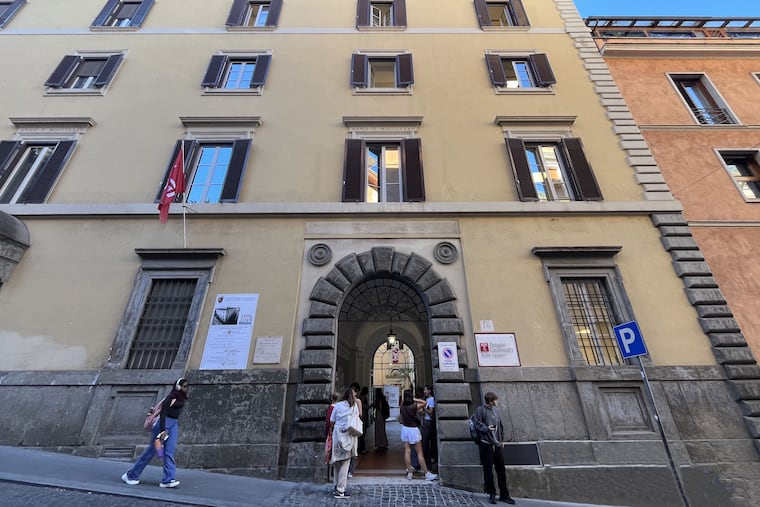
Roush found that Temple University offered what it believes is the only noncredit study abroad program for adults by a U.S. college on a foreign-based campus — and she enrolled. Now, she is one of nearly 50 adult students from cities around the country who took six weeks of classes at Temple’s Rome campus, nestled in an upscale, historic area of the city adjacent to the famous Spanish Steps.
“So I didn’t end up moving to Philadelphia, but I ended up coming to this program,” Roush, 79, a retired foreign language teacher from Louisville, Ky., said. “I would highly recommend it.”
Temple opened its Rome campus 60 years ago, serving students in art and architecture from its Tyler School of Art. Then it began largely enrolling traditional undergraduate students from Temple and other universities who wanted to study abroad. In 2019, an alumna audited courses and the school decided based on her experience to launch a formal adult program in 2021. Its first cohort was just 10 students, growing to two groups and about 30 in 2022.
Now, the number is about 100.
Acting on the Rome campus’ success, Temple’s campuses in Tokyo and Kyoto launched adult study abroad this year and their cohorts were filled, with waiting lists, said Matthew J. Wilson, president and dean of Temple University Japan. Two more programs will be held in Kyoto in November and December, with another scheduled for next year, he said.
“There’s clearly a big demand out there,” said AJ Fitzgerald, the Rome campus’ director of adult education.
» READ MORE: With its 40-year-old Tokyo campus growing, Temple will open a new site in Japan
Though they cannot say it definitively, Temple officials think their adult study abroad program might be the only one of its kind. While there are touring and travel programs for adults to learn abroad, Temple officials are not aware of any others run in the same way by a university, said Emilia Zankina, dean of the Temple Rome campus and vice provost of global engagement.
The courses are noncredit. No tests, grades, or stress.
“They’re here for enjoyment,” said Daniela Curioso, an Italian language professor.
Temple offers a six-week program in the fall and a four-week program in the spring, with courses in the ancient history of Rome, its modern history, and its art history from classical to the Baroque period.
Curioso teaches immersive Italian, which is a mix of language instruction and tips for daily living, such as how to order items in a market and make gelato.
“We try to make the students use the language they learn in class for these experiences,” she said.
Students have done field trips to Cinecittà Studios, where Federico Fellini and, more recently, Martin Scorsese made films. They also visited a local high school and an opera theater. There are weekend trips, too, to Tuscany, the Gulf of Naples, and Palermo, where students hear about its Mafia history.
» READ MORE: A gift to Temple will create the first endowed editor position at its student newspaper
Enthusiasm for the program abounds. The campus’ largest gift — $1 million — came from Jack and Monica Pinkowski, who attended the program in 2024. The money is being used to fund scholarships of up to $10,000 per academic year for credit-bearing undergraduate students.
When the program started, it served almost exclusively Temple alumni, but now more than half are non-alumni, Fitzgerald said.
“The bulk I’d say are from Pennsylvania, although now we’re getting more from Texas, California, New York,” he said.
There is a man from the Netherlands, and a couple from Australia, too, he said.
Sid Kaplan, 79, a retired foreign service officer from Washington, had audited classes at Georgetown University and looked for experiences outside the United States. He found Temple’s.
Loria Cavallo, 67, a retired elementary school principal from West Virginia, read about Temple’s program in the book You Deserve Good Gelato by Kacie Rose, who moved from New York City to Italy.
“She says if you really want to learn the Italian culture you need to immerse yourself for a length of time, and then she recommended this program at Temple,” said Cavallo, an Italian American who was eager to learn more about the country.
Connie Martin, 72, of Warrington, studied in Rome when she was an undergraduate at Pennsylvania State University in the 1970s.
“I fell in love with Rome 51 years ago, tossed lots and lots of lira in the Trevi Fountain,” said Martin, who attended this fall’s program with her husband, Guenther Tumasz, 76. “This is our first trip back.”
Tumasz, who had worked in trade financing, said he found the trip interesting but warns there is a lot of walking — he said he averaged 10,000 steps a day.
“I would highly recommend it to anyone who loves walking and loves going up and down hills,” he said.
Ann Waters, 72, a Temple alumna and retired planner from South Carolina, got an email about the program and enrolled along with her husband, Mike, a retired risk analysis executive.
The couple at one time lived in the Philadelphia area and raised their children in Delaware County. Neither studied abroad as undergraduates, and they jumped at the chance to do it now.
“We’re going to parts of Rome that tourists don’t normally ever see and experience so that we can understand the past, present, and future of Rome,” said Mike Waters, 71. “We’re seeing it like a Roman.”
While the majority of students are in their 60s and above, the program also attracts mid-career and young adults, Zankina said.
“One year we had this group of women, not retired yet, but who had sent off their kids to college, and they came as a group,” she said.
Some students — including six of the 49 this fall — are returning for the second or third time.
That includes Kathryn Aurand, 69, who is from Lewistown, Pa., but now lives in California. She first studied on the Rome campus in 1979, when she was an art history major at Penn State.
She returned in 2021 as part of the inaugural class of adult study abroad students, then again in 2023, and a third time this fall.
Now, she is thinking about trying a program at Temple Kyoto.
Adult students arrange for their own housing. Some said they opted for Airbnbs or apartment rentals. The base fee for the fall program next year will be $4,695, according to Temple’s website, with discounts for certain groups, such as alumni, employees, and parents of students. There are additional charges for trips and elective courses.
In addition to adult study abroad students, the campus enrolls about 240 credit-bearing students this fall, the bulk of them traditional-age study abroad students who attend for a semester or their full first year. Thirty of those spending their first year on the campus are international. In addition, the campus this year launched its first four-year degree programs, enrolling 15 new students and retaining seven students who attended as freshmen last year.
“The goal is for us to become a campus where about maybe half of the population is degree seeking and the other half is study abroad,” Zankina said.
The campus expects to have 400 credit-bearing students this spring and aims to grow to about 600 over five years, she said.
To accommodate growing interest in adult study abroad, the school this fall for the first time offered a weeklong alumni reunion, which brought back 26 former participants.
The campus this spring also is starting a one-week program focusing on Italian gardens. About 160 people signed up, Fitzgerald said.
“There’s been way more interest than we expected,” he said. “We’re trying to figure out how we can best accommodate everyone.”