Valley Forge Military College is weighing a move to Oklahoma over a legal dispute with Radnor Township
A boys' hockey academy leasing space on the campus is at the center of the disagreements.
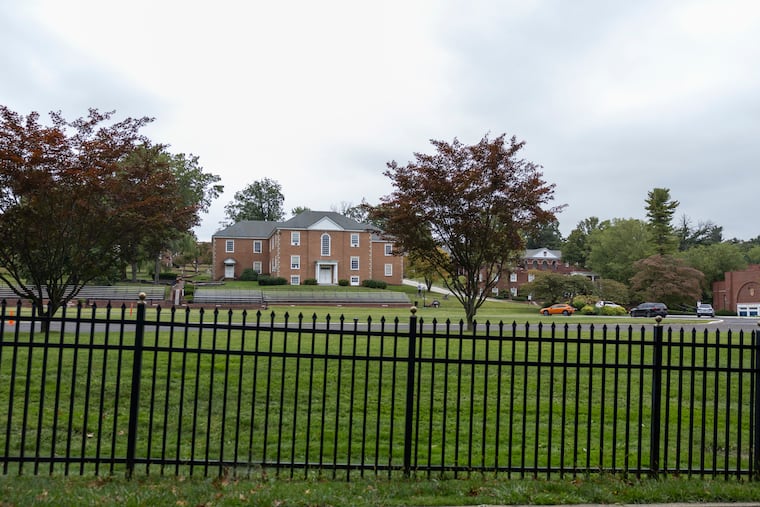
Valley Forge Military College is mulling a move from Radnor Township to Oklahoma.
Board chair John English said the college, which gives students a path to become U.S. Army officers, is considering relocating because of multiple legal challenges from Radnor Township.
“We were always supported by the neighbors, by the local government, by the state, and somewhere along there, that has changed,” English said.
The relationship with the township fractured in the months after the college’s former sibling institution, Valley Forge Military Academy, which served grades 7-12, announced its closure last year, English said. The township has since attempted to seize the college’s land through eminent domain, determined the campus to be out of compliance with zoning laws, and challenged its tax exempt status, English said.
Radnor Township officials said the actions were necessary to enforce the law and prevent unwanted property development.
“The Township certainly does not want Valley Forge to fail,” Radnor Township Commissioner Jack Larkin said in an emailed response to questions. “The Township’s hope is for Valley Forge to find a path forward that enables it to remain a successful Radnor neighbor for another hundred years.”
What are the legal issues?
English traced the problems back to January, when the township attempted to use eminent domain to acquire 14 acres of school property for a recreation center.
Larkin said the township wants to keep campus land from being sold to developers.
“The Township’s interest is to ensure that the last sliver of Valley Forge’s campus is maintained either as it is or as a purely public purpose—not sold to a developer,” Larkin said.
Radnor Township dropped its eminent domain claim when the school agreed to give the township “right of first refusal” to buy campus properties, English said. But the township soon returned with a notice that the school was violating zoning rules by leasing its land to a boys’ hockey academy.
Township solicitor John Rice said the zoning officer determined that the hockey academy “was not a permissible use in that district.”
A hockey academy
Recently, in addition to the approximately 90 military college students on campus, about 90 aspiring professional hockey players with the West Chester Wolves Academy became seasonal residents.
Rice said the hockey academy, which uses Valley Forge property to house the teen players for part of the year, doesn’t meet the township’s rules for a “planned institutional district” and is not a school.
“If you’re a senior in high school, you can sign up for Liberty or some other online school, but it’s pretty much on your own,” Rice said of the students enrolled in the hockey academy. “And of course the kids that are out of high school, they’re not going to school. They’re just there to play hockey.”
The township has since filed a tax assessment appeal against the military college, Rice said. The appeal asks the county board of assessment to review whether the Valley Forge campus should pay some taxes for leasing its land to the hockey academy.
Heading west?
Valley Forge’s enrollment numbers have dropped significantly since its heyday in the 20th century, English said, but that’s not a problem in itself because its financing structure ensures it’s paid by the U.S. Army.
English said the college’s financial outlook has improved since its separation from Valley Forge Military Academy. The now-shuttered academy faced lawsuits alleging students were violently hazed, sexually assaulted, and abused while living there. It cited high insurance costs as a result of litigation among its reasons for closure.
For the military college, it’s Radnor Township’s lawsuits that are draining its resources, English said. And if the college has to pay taxes, it would be forced to shut down.
English said he’s looked into other solutions, such as getting Valley Forge accredited as part of the state system of higher education, but those efforts haven’t led anywhere.
All that has led English to seek out Oklahoma, where he is no stranger. His father is former Oklahoma Congressman Glenn English. He earned an undergraduate degree from the University of Oklahoma, and worked in Oklahoma state government before launching a consulting business that works with the federal government.
English, who splits his time between Puerto Rico and Virginia, said the connections didn’t hurt him when he spoke to the Oklahoma Senate Veterans and Military Affairs Committee in mid-September. He said Oklahoma state officials have offered him a new campus in Oklahoma City and offered the Oklahoma National Guard as a military partner.
“The folks out there just couldn’t believe what we were going through and how we were being treated,” English said.
English said he would need continued tax-exempt status, or state assistance, to keep operating in Radnor Township. Meanwhile he’s in continued talks with Oklahoma officials.
“We have a duty ... to protect the resources of the institution,” English said. “I take that very seriously.”