The Flyers’ Achilles heel has long been their last-ranked power play. Turning the tide in 2026-27 is imperative.
The Flyers have finished dead last with the man-advantage in four of the past five seasons. They are banking on internal solutions to lead them out of the NHL's basement.
Former Flyers forward Simon Gagné probably said it best:
“I think every season’s a new chapter. So, whatever happened, even if you had the best power play last year, you need to start all over again.”
The Flyers did not have the best power play last year. In fact, they had the worst. But as the guy who is tied for 12th in franchise history with 74 power-play goals said, the slate is truly clean, and everyone starts from scratch.
But when it comes to the Flyers and the power play, will this chapter have an all too familiar ending?
» READ MORE: The Flyers and their fans have craved a star in the mold of the Tkachuk bros. They look to have one in Porter Martone
‘When the whole situation was wrong’
We’ve used the words tortured, dreadful, and horrific to describe the Flyers’ time on the man advantage in recent seasons. We even joked that they should decline power plays.
The Flyers are trapped in a great depression with the man-advantage. This past season, they finished dead last for the fourth time in five seasons at 15.7%. They finished 30th two seasons ago, but the percentage was a tick worse than last year at 15%.
It may not feel like it, but the Flyers’ power play hasn’t always been bad.
Since the NHL started tracking power-play stats in the 1977-78 season, the Flyers are tied for 16th in power-play percentage (19.2) and tied for 15th in power-play goals per game (0.75).
They’d probably love to finish in the middle of the pack this season.
Those all-time numbers mirror where the Flyers ranked cumulatively over the five years before this recent plummet to the basement: 16th at 19.5%. The only true holdovers from then are Travis Konecny, Sean Couturier, and Travis Sanheim (Cam York played three games in 2020-21).
The personnel, including the cycling in of three coaches, has changed over the years. The results have not.
‘It’s a matter of trust’
Although it’s hard to pinpoint one thing that makes a power-play click, beyond having good players, one word kept resurfacing when talking with Gagné and Hall of Famer Mark Recchi, who ranks 17th in NHL history with 569 career power-play points and ran the Pittsburgh Penguins power play as an assistant under Mike Sullivan after Rick Tocchet left.
Trust.
As Billy Joel sang, “It’s always been a matter of trust.”
“You need to trust your teammate is going to be there because you ... don’t see him. He’s supposed to be there, so you need to go blind and say, ‘Hey, he’s going to be there,’” Gagné said.
This was one of the issues during John Tortorella’s tenure as bench boss. At times, Tortorella noted that Rocky Thompson, who ran the power play, wanted to keep things the same to build connectivity. Tortorella was impatient, and it’s hard to build trust when guys are shuffling in and out of units or the power play as a whole.
It’s part of the reason why teams like the Penguins, who play at Xfinity Mobile Arena on Wednesday (7:30 p.m., TNT, truTV), and the Edmonton Oilers consistently find themselves at the top of the standings.
“Simon’s bang on,” Recchi added in a recent phone interview when told of Gagné’s comment. “A lot of it’s trust. A lot of it’s playing together, [meaning] you know what your teammates are going to do, and that’s why it’s nice when you can get a group of players together.
“You might have to bounce one guy in and out, but say you have four guys all the time, four or five guys, just builds that trust and that you know exactly what they’re thinking, what they’re going to do.”
Although there was already one switch in the preseason, with York taking David Jiříček’s spot on the second power-play unit, the plan is to give the groups some time to gel and build that trust.
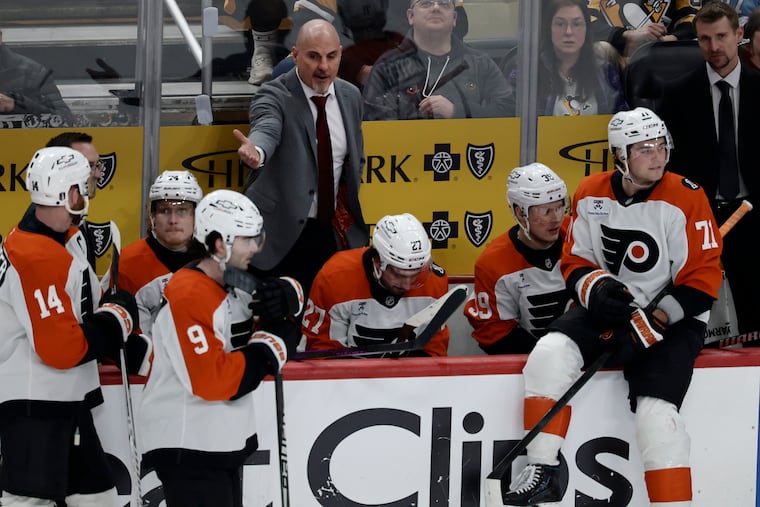
“I’d be an idiot [if] for a bad couple of games to start the year to abandon [it],” Tocchet said Sept. 23. “I’ve got to give these guys some runway for sure. But they’ve got to get the 50-yard line too.”
‘This time you’ve got nothing to lose’
While trust is being created on the ice, it is also being developed between the coaches and the players.
This summer, Tocchet and his staff, led by power-play coach Jaroslav “Yogi” Svejkovský, sent players to their offseason cottages with homework. That included videos of some of the league’s best players with the man-advantage, including Nikita Kucherov, Jack Eichel, Mark Stone, and Wyatt Johnston.
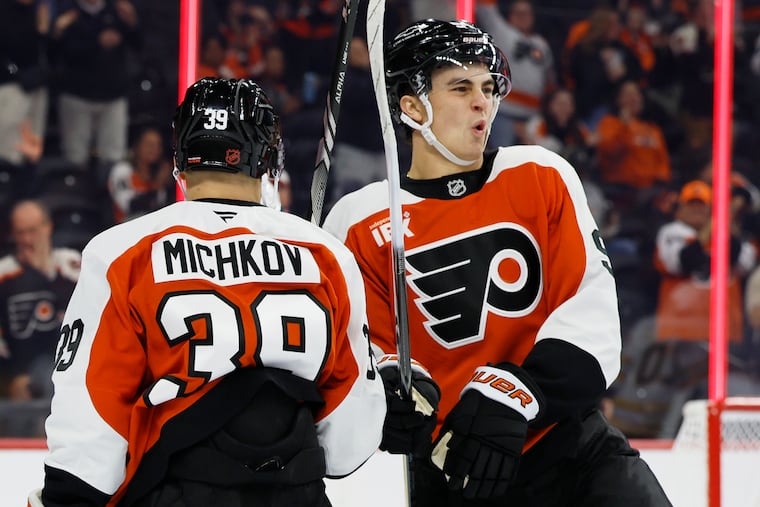
Outside of the first two or three days, the coaches have been working on the power play at practice every day. After doing unit work, they are pulling guys aside, like Tocchet with Jiříček on Tuesday or, on Sept. 21, when Trevor Zegras, Matvei Michkov, Tyson Foerster, and Jamie Drysdale were working on plays without Porter Martone, who was in the game group that night.
Each side has to do the work, but the onus is on the players to figure it out and produce. And a big part of that is making the right reads. Tocchet has repeatedly said that he didn’t think the players on the power play last season were reading situations properly — on zone entries or once set up — and therefore missing opportunities to move the puck or to strike.
“It’s a fraction of a second,” Gagné said. “The PK is so good that a seam pass is going to be open for a fraction of a second. This is where you need to read that play and make that play. If you wait, the play is going to die there.”
“We spent a lot of time last year on knowing those lanes, and there’s only so many options from each kind of quadrant on the ice or area that you’re in, and it’s just picking the right one,” Drysdale said, noting he also used video.
“It’s making the read sooner before I get the puck, things like that. So it kind of just tacks on to finding the spots that I know I’m going to be in, and just working from those spots, working on my reads from those spots, and just getting ultra-comfortable with my outs, my options, and my shooting lanes.”
» READ MORE: Matvei Michkov symbolizes the steps forward the Flyers can take in 2026-27
Finding lanes, moving the puck, and being patient when needed, are elements that make successful power plays. But trust and confidence are the two biggest factors in building a cohesive unit and the proper muscle memory. “It’s like riding a bicycle,” said Gagné. “When riding a bike you jump on there, and you don’t think about what you’re doing. So on the power play you need to have the right people first, and after that, you need to go with your instinct.”
And the hope is that you get one and then another and another and confidence builds.
“I remember when we struggled on the power play, it was just keep it really simple and get some ugly goals,” Gagné added. “Having traffic in front of the net and hoping that it’s going to deflect off someone and get an easy goal. Or just deflecting and go in, and after that, it’s funny, because it’s the confidence coming back and now you say, ‘Oh, we got one,’ so you just get looser and more on with your stick and making plays.”
‘It took a lot for you to not lose your faith’
Tocchet said he agrees with former NHL coach Bruce Cassidy’s philosophy that 80% of the power play should revolve around plays below the hash marks. For the Flyers’ first power-play unit, Michkov, Zegras, and Martone will be heavily relied on in that aspect. They’ll be asked to score around the net and create enough havoc to open up space for others.
But the biggest cloud hanging over the Flyers is the and demons of years past. The Flyers will say it doesn’t bother them, but it’s fair to say those past failures linger in the air.
“I think pressure hits you when you don’t trust your teammates, or you don’t trust what’s going on, or you don’t trust even yourself,” Tocchet said on Sunday.
“But if you’re confident in what we’re trying to do, like we’re talking about low plays — and they’ll work — trust it, and they’ll start to go in. It’ll bounce off a skate, or Mich will go in there [and] it’ll go top shelf sometimes. That builds confidence.
“So, I think, to me, handling pressure is handling the right things to do, and the system. And power plays, even if you ask [Cassidy], there has to be creativity too. You can’t tell the guys exactly where to go, but there are certain situations where I feel last year we didn’t take advantage of. [Like] when we had two at the net, we never got the puck there. We were doing all these high plays, and it would hit a stick or a guy would fumble the puck instead of just getting the puck to the net with two guys in front. It’s as simple as that sometimes.”
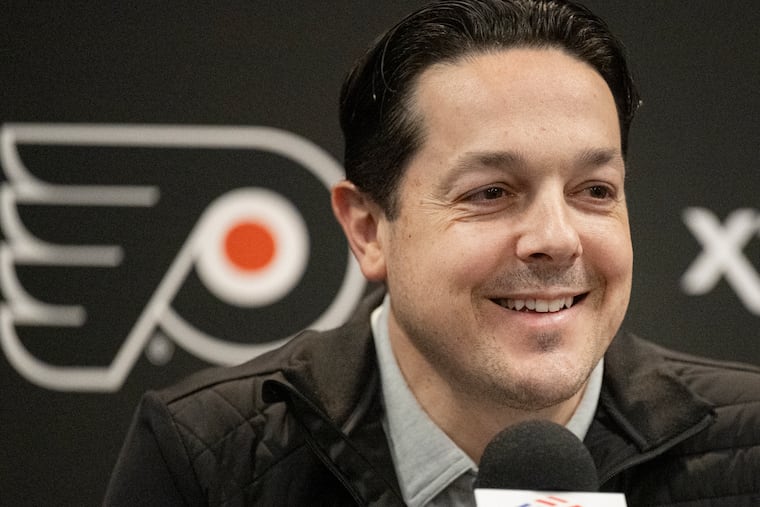
The puck drops on the season Wednesday, and while general manager Danny Brière wants to quiet the outside expectations of another playoff appearance by saying the team could take a step back, there is no denying that a better power play would help make a postseason berth attainable. As many have said, power plays can make or break teams.
» READ MORE: Meet the Flyers’ 23-man opening night roster from Noel Acciari to Trevor Zegras
The Flyers, who didn’t make any major personnel changes to upgrade their power play in the offseason, believe they have solutions in-house with the likes of Martone, Michkov, Zegras, Travis Konecny, Foerster, and Drysdale. Will young players growing together and learning through experience be enough to spearhead a turnaround?
Time will tell. As Konecny quipped on Sunday when asked if it’ll be better: “You got a crystal ball for me?”