SEAMAAC works to steady immigrant communities facing new concerns on top of old challenges | Philly Gives
Beyond securing grants, the Southeast Asian Mutual Assistance Associations Coalition gives Philadelphia’s new arrivals a support system that is now being tested on several fronts.


About Philly Gives

Supermarket owner Joyce Lin jab-scrolled through her phone’s call history — five hours on hold, again and again, week after week. So frustrating, so aggravating, so upsetting.
If Lin wants to keep the doors open at her No. 1 Supermarket, pay the mortgage, pay the taxes, pay the electric bill that powers her refrigerator and freezer cases plus walk-ins down in the basement, she’s got to get her merchants’ electronic benefits transfer (EBT) license back.
Dominic Brennan, SEAMAAC’s community building coordinator, looked on as Lin showed him the calls she made in vain to the government agency in charge. “I can help you with that,” he offered.
She needs his help.
After all, 75% of her sales come from customers using their EBT (food stamp) cards to buy groceries at her store on South Seventh Street, the heart of South Philadelphia’s Asian business district. She didn’t know the license had expired and that she would have to renew it.
Maybe Brennan can find the time to deal with a balky bureaucracy and wait on hold so Lin can run her business, a business that’s now barely hanging on.
SEAMAAC has gathered grants to pay for planters on the corridor, for motion-sensor lights to illuminate block corners at night, for bulbs strung across the street to add cheer and happiness. Brennan wrangled a forgivable merchants’ loan for Lin so she could buy several freezer cases and some shelving to hold produce.

Help Support This Work

The grants SEAMAAC (Southeast Asian Mutual Assistance Associations Coalition) manages to corral help to improve the neighborhood and give a hand to merchants like Lin. But they don’t pay for Brennan to help save Lin’s business — or her home, for that matter. She, her husband, and their three children live upstairs.
Administrative support is critical, but it’s that kind of support that many grants don’t often fully cover. Donations need to make up the difference.
Including Brennan, the majority of people who work for SEAMAAC are immigrants in an organization that began in 1984 by serving people from countries like Vietnam and Cambodia, and now assists all low-income and marginalized people, including immigrants from Asia, Africa, Europe, and South and Central America.
SEAMAAC serves its community in 55 languages with a wide array of programs. It partners with Jefferson Health to provide healthcare to the neighborhood. A lawyer from Community Legal Services can help people gain benefits. Many refugees come to Philadelphia from places where they experienced trauma, and there are culturally sensitive art groups to help them and victims of domestic violence. In its space in the former Bok High School, SEAMAAC offers English-language classes and social gatherings to combat isolation among the elderly. A new headquarters will open in January.
Brennan and his colleague, Sabia Afroz, community development program manager, work in SEAMAAC’s community development wing.
Together, they and partners raised funds for a wonderful new playground at Mifflin Square Park. Refurbished basketball courts are coming next.
To improve the cleanliness of the neighborhood, they partnered with an outside contractor to increase trash pickup. They added trash cans and mounted an educational campaign for merchants.
“They don’t understand the rules about the days, or the designated places because they can’t read the warning signs,” Afroz said. She’s proud that the campaign has paid off. The corridor, once one of Philly’s most trash-filled, has improved.
“Grants cover the costs of planters and supplies, but not what it takes to build trust and relationships,” Brennan said. That takes time and shoe leather — many, many walks along the corridor — learning the different business challenges involved in running a fish market vs. a deli vs. a grocery, hair salon, or bike store.
“Many people have experienced systemic violence, and there’s a hesitancy and reluctance to trust, born of good reason,” he said.
Lin’s business, like others along the corridor, has been hit hard. Some immigrants, who used to shop, aren’t coming anymore, afraid of being targeted by U.S. Immigration and Customs Enforcement (ICE). Tariffs have raised the prices of some imports — which are valued by immigrant customers who come to Lin’s No. 1 Supermarket for food from home.
Lin now pays the person who delivers her milk a $4 gas fee, plus the wholesale cost of milk has increased.

Make Your Year-End Gift

She’s worried about a change in Philadelphia’s city business taxes. She used to be exempt from paying the city Business Income and Receipts Tax (BIRT) on the store’s first $100,000 in revenue. Now, though, she’ll owe taxes on all her revenue, hiking her tax bill even as her revenues decline.
She has had to lay off two employees, and knows that other merchants are doing the same. Where will those families get the money to patronize local businesses? It’s a downward cycle. Now it’s just her and her husband, working seven days a week and many more hours a day. “My children complain,” she said.
And then there are other complications. On-and-off border tensions between Cambodia and Thailand, half a world away, mean many Cambodians won’t buy Thai products. And so, packages of giant gourami fish from Thailand sit in the freezer.
Which is why, when Brennan offers his very practical help, it matters. “When I call him, he comes,” she said.
Walking the Seventh Street corridor from Porter to McKean Streets with Brennan and Afroz turns into a hugs-and-appliances tour — new refrigerators, new shelving, and new stoves — all acquired with help from SEAMAAC.
On the corridor, SEAMAAC’s help is friendly, but also practical and businesslike. The fees merchants pay for credit card transactions are expensive. So SEAMAAC helped business owners acquire ATMs so customers can pay in cash.
SEAMAAC works with 78 businesses along the corridor, helping merchants who speak 16 languages. At Cafe Vinh Long, Afroz sits across the table from an employee, helping her to separate mint leaves from their stalks. The leaves will build a soup. The help builds trust.
Hor Chou, a citizen and leader among the Philadelphia Tse Chow group of Cambodian-Chinese, came to the United States many years ago via a refugee camp on the Cambodian-Thai border. He remembers seeing so many people massacred along the Mekong River that the waterway was clogged with bodies floating on top. Thirty people in his family were killed.
Chou, owner of New Happy Garden Chinese restaurant, now serves as an ambassador in his community, helping SEAMAAC organize events like community-wide Lunar New Year celebrations. His daughters have graduated from college. And thanks to SEAMAAC’s work, he points out a gleaming new three-wok stainless steel stove in the restaurant’s kitchen.
“It’s about build community — spend time together, learn together, and living in this community,” he said.
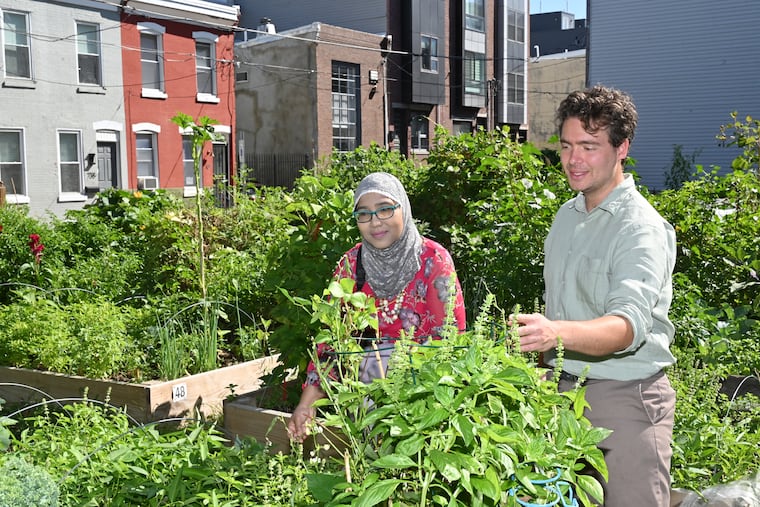
Community is also cultivated in SEAMAAC-organized gardens, aptly named “Growing Home Gardens.” On side streets, area residents apply for plots to grow food for their own use in what amounts to a United Nations of very specific produce.
For example, the Karen people from southern Myanmar plant lemon tulsi, while the Nepali and Bhutanese folks harvest Krishna tulsi, another variety. In the evening, the Nepalis use the Krishna tulsi in a prayer ritual to protect their homes from overnight evil.
At SEAMAAC, all the tulsis and their gardeners are welcome.
Afroz, a gardener herself, said that no matter where gardeners come from, they bond with each other, watering each other’s plots, examining each other’s plants, and sharing what they grow with friends old and new.
“They can grow something that is not available in any other place, or if it is, it’s very expensive,” she said. “In a city like Philadelphia, it gives them an opportunity to stay connected with their roots, with their culture, and with their cuisine.”
In October, SEAMAAC hosts a harvest at the community garden on Emily Street. “They share their food,” she said. “They share their recipes. They share their culture. They share their views. It brings them together.”
About SEAMAAC Inc., Philadelphia
Mission: To support and serve immigrants and refugees and other politically, socially, and economically vulnerable communities as they seek to advance the condition of their lives in the United States.
People served: 15,000 families
Annual spend: $3,793,384 in FY2025
Point of pride: SEAMAAC provides direct services to approximately 15,000 families annually through a variety of services and programs, supporting them through ESL classes, job readiness, domestic violence support, services for low-income elders, food security, public benefits, health and nutrition education, business development, and more. SEAMAAC plans to increase its impact to serve even more Philadelphians at its newly constructed main office and community center, located at 626 Snyder Ave., Philadelphia, PA 19148, which is scheduled to open in January.
You can help: Volunteer to beautify and improve Philadelphia’s neighborhoods through SEAMAAC’s urban gardening, neighborhood and public park cleanings, school and places of worship beautification, and tree-planting events.
How your donations support the communities we serve:
$50 provides toys for two children at SEAMAAC’s annual toy distribution.
$100 covers maintenance for an entire growing season and the annual registration fee for one gardener’s plot at SEAMAAC’s community garden.
$150 covers the full cost of supplies for one youth in SEAMAAC’s summer programs.
$200 covers four hours of ESL instruction.
$250 provides a family with emergency food, hygiene items, diapers, and social service support for one month.
$500 supports a domestic violence survivor’s move into safe housing by covering the cost of utility hookups and household supplies.
$1,000 covers the full cost for one high school student to participate in SEAMAAC’s eight-week summer career exploration program.
About guest essays
Guest essays, or op-eds, are commentary pieces that present the opinion or perspective of the author. Many are submitted to us by Inquirer readers and writers with insight on the news, but we also solicit op-eds from authors on specific topics. For more information visit our guidelines.