Funding was cut to life-saving medical research programs in Philly. Rep. Brendan Boyle demands to know why.
“These are not just abstract academic accomplishments,” said one Penn professor. “They are real improvements in the practice of medicine that have resulted in thousands of lives being saved."
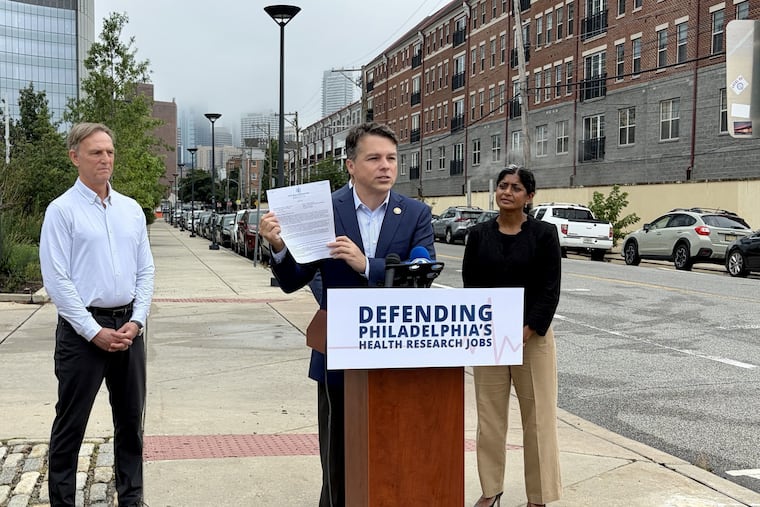
Rep. Brendan Boyle sent a formal letter to the federal government on Wednesday, demanding an explanation for the recent cuts to health care research funding in Philadelphia.
The Agency for Healthcare Research and Quality last month cut dozens of grants nationwide, totaling hundreds of millions of dollars. The cancellations affected multiple programs at the University of Pennsylvania and Children’s Hospital of Philadelphia, disrupting studies into how healthcare systems can be organized and financed to improve health outcomes.
That included projects on improving translation services for hospitalized patients and expanding access to hormone therapy for menopausal women.
“Their funding isn’t partisan, nor is it controversial,” Boyle said at a Wednesday press conference on Schuylkill Avenue where he was joined by affected researchers from Penn and CHOP. “It represents exactly what our federal government should be doing, creating jobs and saving lives by funding critical medical research.”
As the top Democrat on the United States House Committee on the Budget, Boyle asked in his letter to AHRQ and the Office of Management and Budget whether the administration would commit to fully spending the funding that was congressionally appropriated for AHRQ.
He requested a list of every grant that was cancelled and the justification given. His letter referenced a recent district court ruling in New Jersey v. OMB that found the government “cannot terminate grants based on their inability to effectuate program goals and agency priorities identified after the award was made.”
The original cancellation notices sent to researchers in mid-July did not list specific reasons, stating only that continuing the grant was not “in the best interest of the Federal Government.”
Boyle also asked whether AHRQ grants were cancelled based on the political identity of the grant recipient’s state, city, or congressional district.
He said this information would help determine whether the grants were illegally cut and if Philadelphia was targeted for political reasons.
“We are here to demand that the Trump administration immediately reverse these cuts and unfreeze the programs sitting in limbo,” Boyle said.
In a statement on Wednesday, the Department of Health and Human Services said that the AHRQ director determines “whether continuation funding is in the best interest of the federal government.”
“To be clear, these grants were not terminated – they were not awarded continued funding,” the HHS statement said. “The Trump Administration remains committed to the responsible stewardship of taxpayer dollars.”
Local researchers speak out
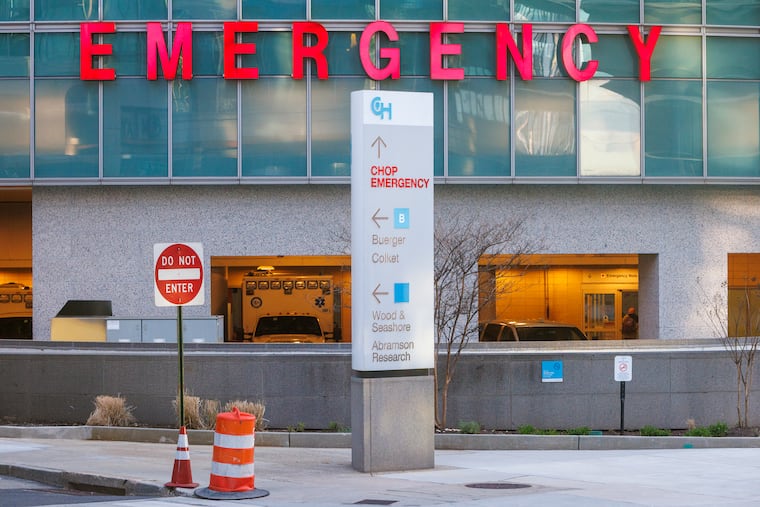
CHOP pediatrician Christopher Forrest had to shut down his PEDSnet Scholars program in June after AHRQ cancelled the $5 million grant designated for it.
For nearly a decade, the program had trained 44 early-career scholars on how to design studies that improve the safety and quality of healthcare for kids.
One project focused on preventing strokes in children with sickle cell anemia, a rare blood disorder.
Another project reduced antimicrobial resistance in the intensive care unit by improving providers’ ability to identify which children needed antibiotics.
A third helped families adapt to a congenital heart disease diagnosis, reducing rates of post-traumatic stress disorder.
“These are not just abstract academic accomplishments,” said Rachel Werner, a Penn professor who was also affected by grant cuts. “They are real improvements in the practice of medicine that have resulted in thousands of lives being saved.”
Werner has helped lead the PORTAL program at Penn, an AHRQ-funded research training program that lost millions in funding last month.
She said the grant cancellations would lead to fewer discoveries, an immediate loss of jobs, and a shrinking pipeline of future scientists.
“For the sake of the health of all of us, it’s really imperative that that work continues,” Werner said.