Penn and CHOP researchers lost millions in federal funding for healthcare research last week, forcing programs to close
The Agency for Healthcare Research and Quality last week cut dozens of grants, affecting multiple programs at Penn and CHOP. “These are not controversial topics,” CHOP doctor Christopher Forrest said.
Children’s Hospital of Philadelphia researcher Christopher Forrest has spent nearly a decade training early-career scholars on how to design studies that improve care for kids with congenital heart disease, stroke, and influenza.
That work ended last month, when he had to shut down his PEDSnet Scholars program. The federal funding designated for it stopped coming last fall.
Forrest received official notice last week that the Agency for Healthcare Research and Quality (AHRQ) had canceled his $5 million grant — originally intended to last through 2028. The letter gave no specific reason, stating only that continuing the grant was not “in the best interest of the Federal Government.”
PEDSnet Scholars trained researchers to study how healthcare systems can be organized and financed to improve health outcomes. It was one of 16 such programs nationwide funded by AHRQ. Another program site, located at the University of Pennsylvania, received an identical cancellation notice last week from AHRQ.
“These are not controversial topics,” Forrest said.
Eighty-two affected grants totaling an estimated $211.6 million as of Tuesday had come to the attention of AcademyHealth, a nonprofit that supports health researchers and has been tracking AHRQ grant cancellations. Those include funding for research projects, career development, training programs, and centers.
Some researchers received letters saying their work did not align with the agency or federal government’s priorities, followed by a list of the priorities, AcademyHealth president Aaron Carroll said.
However, many of these projects appear to be directly aligned with priorities, he said.
One involved a randomized trial of antibiotic stewardship — efforts to encourage careful and responsible use of antibiotics to avoid resistance — across 40 hospitals. Yet in the letter canceling it, antibiotic resistance was listed as a priority.
“It can’t possibly be that all of these grants that are seeking to improve the quality, safety, and efficiency, and patient-centeredness of healthcare delivery are all incompatible with this or any other administration’s priorities,” said Scott Halpern, a Penn health services researcher whose funding was also canceled.
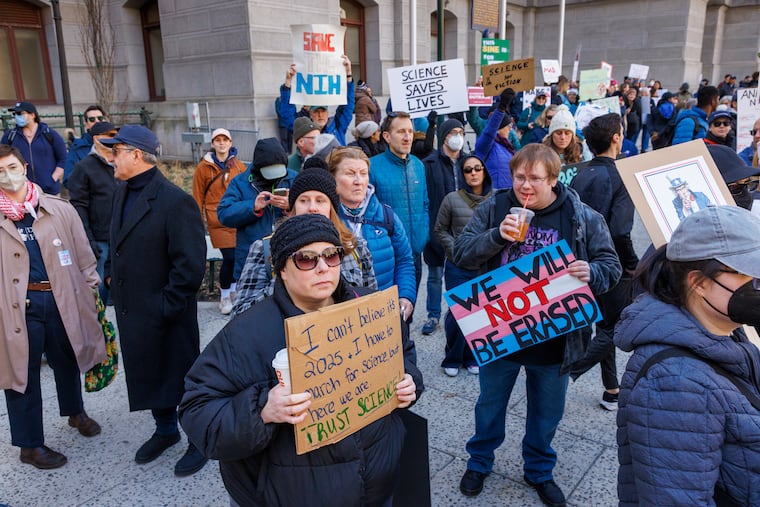
Billions in scientific funding have been disrupted under President Donald Trump’s administration over the last year and a half, prompting lawsuits and court reversals in certain cases.
The Department of Health and Human Services did not respond to requests for an exact count of the grants impacted, saying in a statement that the AHRQ director determines “whether continuation funding is in the best interest of the federal government.”
“To be clear, these grants were not terminated — they were not awarded continued funding," the HHS statement said.
‘Incredibly demoralizing’
In late 2025, Halpern had planned to hire a new staff member for the Penn PORTAL program, one of the 16 AHRQ-funded training programs, separately funded from CHOP’s program.
His team identified a candidate, but — unable to access funding from their $5 million grant since the fall — delayed extending an offer.
The position was ultimately eliminated. They also rescinded offers to train new scholars in the program.
Halpern received his official notice last week that his grant, set to continue into 2028, was canceled. He had only spent $1.5 million of it so far.
Instead of having 10 trainees this month as planned, the Penn program has zero.
“To not have the resources to support the people who will make a difference in the future is incredibly demoralizing,” Halpern said.
He drew on philanthropic resources and a roughly $150,000 commitment from Penn Medicine to finish training his first cohort. However, the second cohort of scholars was stopped midway.
As a result, projects on improving translation services for hospitalized patients and expanding access to hormone therapy for menopausal women were canceled.
Grant cancellations from AHRQ will have longstanding impacts on advancing healthcare in the United States, a Penn Medicine spokesperson said in a statement, declining to answer more specific questions.
“Some research projects at Penn Medicine have felt those cuts at their core and impactful work now cannot progress as planned,” the statement said.
CHOP did not respond to a request for comment.
In limbo
Penn researcher Jaya Aysola had not heard as of Tuesday whether her AHRQ grant is canceled, but she assumes the notice is coming.
She had received a $3.8 million grant to serve as a coordinating center for the 16 training centers starting in 2024. The grant should have been renewed for its second year last November, but that didn’t happen.
At first, she was told by the agency that it was delayed due to the government shutdown. Then she was told it was held up due to a lawsuit filed by the Society of General Internal Medicine, a physicians group, in August over AHRQ shutting down its grantmaking program.
Since then, “it’s been radio silence,” she said.
All but roughly $300,000 of her grant remains unused. Unable to access funds since last fall, she had relied on bridge funding from the university to support staff and research faculty.
When that funding ended earlier this year, she had to find new jobs and projects for three of her full-time employees, as well as three part-time employees.
“We already shut down most of the operations,” Aysola said.
The work she has done since has largely been pro bono with her personal time and limited internal funding.
Aysola convened a meeting this spring with the 16 AHRQ-funded training centers to discuss how other programs were bridging the gap in funding. Most had paused on accepting new trainees, and have prioritized finishing the current cohort’s work.
At Halpern’s Penn PORTAL, the first cohort of scholars’ projects have already been implemented. Across the Penn health system, they “are yielding improvements in the patient experience of care,” Halpern said.
None of the projects led by later cohorts, who would have been trained had the full five years of funding been maintained, are likely to see the light of day, he added.
He hopes to bring awareness to what he considers an inappropriate cancellation of AHRQ funding. Many organizations are exploring options in terms of advocacy and potentially legal engagement, he added.
CHOP’s Forrest estimates 30 faculty will never be trained due to PEDSnet Scholars losing its grant funding.
“It’s very sad because it’s been so instrumental to my career, and I had hoped that it would be instrumental to the career of many of our junior faculty,” Forrest said.