Philly-area cancer vaccine trials show new promise after decades of setbacks in the field
Researchers at Jefferson and Penn are developing vaccines designed to train the immune system to recognize and attack cancer cells. The field has seen progress this year after decades of setbacks.
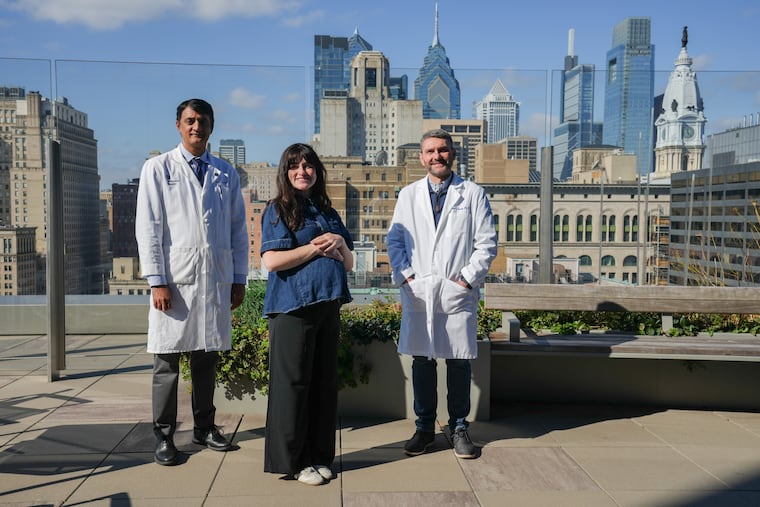
After finishing treatment for Stage 3 colon cancer in 2022, Colby Johnson was ready to try anything that might keep her cancer from returning.
The then 26-year-old enrolled in a small, early-stage Jefferson Health trial of a novel vaccine. Designed to train the immune system to recognize and attack cancer cells, the treatment gave her hope that, if the cancer were to return, her body would know to eliminate it.
That’s the idea behind so-called cancer vaccines, a rapidly evolving field seeing progress in several clinical trials this year after decades of setbacks.
The first late-stage trial success for an mRNA cancer vaccine came in August for a melanoma vaccine developed by pharmaceutical giants Merck and Moderna. And this month, New York-headquartered company SELLAS Life Sciences announced positive results in an advanced cancer vaccine trial involving 126 leukemia patients.
» READ MORE: Penn helped test a promising mRNA cancer vaccine. Here’s what the trial means for the field.
Experts believe the technology may work best when cancer is caught early or after other treatments have already removed tumors.
Some early cancer vaccine trials failed when they were tested as standalone treatments in patients with advanced cancer, who tend to have significant disease and weakened immune systems. Other candidates used targets also present on healthy tissue, weakening the body’s ability to generate an immune response.
“I think there’s a potential for vaccines in virtually every type of cancer — the key being the ability to get those vaccines into patients when their immune system is still robust,” Ben Stanger, director of the Penn Pancreatic Cancer Research Center, said.
Jefferson’s trial is just one example of a cancer vaccine being developed and tested locally. The University of Pennsylvania’s Susan Domchek is leading trials testing whether vaccines can prevent cancer in people with BRCA genetic mutations, which increase their risk of certain cancers.
» READ MORE: Penn’s BRCA cancer vaccine trial aims to prevent the disease in healthy people
Many of these efforts remain in the early stages, meaning it will still take years to prove safety and efficacy. Most novel treatments do not make it to the point where they gain approval and become widely available to patients.
Across 46 patients in the Jefferson trial whose gastrointestinal cancers were previously surgically removed, the vaccine was found to be safe, according to an abstract presented at the American Society of Clinical Oncology (ASCO) annual meeting in late May.
The results are preliminary and have not yet gone through the rigorous peer review process usually required for publication in an academic journal.
The tested vaccine also induced robust immune responses in patients who received the highest dose, suggesting it could provoke, and hopefully train, the immune system. However, its effect on cancer remains unproven.
Since the trial was not randomized and controlled — the gold standard for establishing causation — it cannot be used to evaluate efficacy.
“It needs a larger, better-powered study with a control group,” said Stanger, who was not involved in the trial.
The Jefferson team said it was too early to determine the cost of the vaccine.
Johnson doesn’t know whether the vaccine helped her. But she was happy she received the strongest dose, believing it could give her the best chance of benefiting.
The 30-year-old Manayunk resident remains cancer-free and is expected to give birth next month to her first child.
“We live a very happy, healthy, fortunate life with a lot of friends and family around us,” she said of her life post-cancer.
The potential
When people think of a vaccine, they usually picture shots for the flu or COVID-19.
These train the immune system to recognize and fight off a virus if exposed. Cancer vaccines are much the same. By teaching the body to recognize a particular target on cancer cells, the technology helps prepare the immune system to fend off threats.
Think of it like arming the immune system with wanted posters of suspected criminals.
“When it comes to vaccines, the immune system is the drug,” Stanger said.
However, cancer vaccines in trials are more often being deployed after cancer is already diagnosed.
For example, the novel melanoma vaccine was used to prevent cancer from recurring in people after initial treatment. The same goes for the leukemia trial.
“We traditionally think of vaccines as something that you give before you get an illness,” Domchek said. “And suddenly we’re using the word vaccine for things that are considered treatments.”
The Penn researcher wondered whether the label “immune therapy” should be used instead to avoid confusion. Her BRCA cancer vaccine approach, by contrast, is trying to prevent cancer from developing in the first place.
Approaches have ranged from personalized therapies to off-the-shelf products that are premade and standardized.
In the melanoma trial, patients’ individual tumors were sequenced to identify targets for the personalized vaccines.
Meanwhile, Domchek’s trial focuses on patients whose BRCA mutations elevate their risk but who don’t yet have cancer. A personalized approach won’t work “because they don’t have something to sequence,” Domchek said.
The Jefferson vaccine uses a target shared across patients with gastrointestinal tumors.
The benefits of an off-the-shelf therapy are its scalability, immediate availability, and potentially lower manufacturing costs. A personalized approach offers greater adaptability, precision, and specificity.
“There’s going to be a role for both, for sure,” Eileen O’Reilly, a medical oncologist at Memorial Sloan Kettering Cancer Center in New York not involved in either local effort, said of the two approaches.
Cancer vaccines can be delivered in different ways, from the mRNA technology built on Nobel Prize-winning research at Penn to virus-based platforms.
If successful, cancer vaccines could offer a lasting advantage compared to other treatments.
“When responses happen, they have the potential for durability,” O’Reilly said.
Penn effort continues
BRCA carriers are at elevated risk of developing cancers involving the breasts, ovaries, pancreas, prostate, and skin.
That creates a unique challenge for scientists seeking a target shared across tumor types and patients. A universal vaccine for all cancers is considered unlikely because cancer encompasses many different diseases.
The approach being tested at Penn vaccinates patients against three common features of cancers.
One is a subunit of an enzyme called telomerase that appears in larger amounts than typical in 95% of human cancers. The others are WT1, a protein found in a range of cancers, and PSMA, a protein largely found in prostate cancer.
Vaccines with multiple targets could prove more robust given that cancers are highly complex and adaptive, said O’Reilly, who is developing a novel pancreatic cancer vaccine at Memorial Sloan Kettering that targets several common genetic drivers of cancer.
However, researchers will need to determine whether having multiple targets dilutes the overall quality of the immune response.
“If you have multiple different targets, are you limiting what the immune response can do?” O’Reilly said.
Domchek’s Phase 1b trial is testing the vaccine in 44 participants: 28 who are healthy with no prior cancer, and 16 who are cancer-free but have a history of the disease. Early findings reported in 2025 at the ASCO annual meeting showed the vaccine was safe.
The technology uses bits of DNA delivered into cells via an electric jolt.
Her team is next looking at whether the vaccine generated an adequate immune response before they move on to trials testing its efficacy against cancer.
“We still have a ways to go because we have to prove that it decreases cancer risk,” she said.
Jefferson’s vaccine trial
Drew Weissman, one of the Nobel Prize-winning mRNA scientists at Penn, doesn’t think cancer vaccines would work well in someone whose advanced cancer cannot be removed. The immune system has a hard time killing large tumors, he explained to The Inquirer in a September article.
That’s part of why Jefferson’s approach targets patients who have already had their tumors surgically removed.
The vaccine, delivered using a virus, targets a protein called GUCY2C commonly found on cancer cells in gastrointestinal tumors.
Forty-six patients all received the treatment, with most reporting flulike side effects. For Johnson, that meant a high fever and symptoms that lasted for about two to three days.
Among the 21 patients with colorectal cancer included in the analysis, higher vaccine doses were associated with lower rates of cancer recurrence at two years.
“We are seeing an earlier hint of preventing the recurrences in high-risk patients, and our next step is to prove that,” said Babar Bashir, the Jefferson oncologist who led the trial alongside Adam Snook, the Jefferson scientist who developed the technology.
Stanger said it is hard to tell whether the reported decrease in relapse is meaningful, since there was no control group and the study was small.
O’Reilly agreed, noting that without randomization, there can be “enormous selection bias” in how patients are chosen.
The Jefferson team is preparing for a follow-up Phase 2b trial, funded by a roughly $2 million grant from the Pennsylvania Department of Health.