A sculpture by a ‘Monuments Man’ is dedicated at 30th Street Station on this week in Philly history
Walker Hancock was among 345 men and women who were sent overseas during World War II to save Europe's artistic treasures.
Not all Philadelphians who answered President Franklin D. Roosevelt’s call to action were soldiers and civilians.
Even the artists went to war.
Like renown sculptor — and local legend — Walker Kirtland Hancock, these educated Americans charged into the bomb-pocked battlefields of World War II to also confront unprecedented evil.
Their task? Saving priceless pieces of art.
Hancock was part of the “Monuments Men,” an outfit of about 345 men and women who were sent overseas to try to pry Europe’s cultural treasures from the grip of the Gestapo.
“I was really prepared,” Hancock told the Daily News in 1991. “I knew where I was going and what I was looking for.”
Hancock, who would become one of the United States’ most distinguished sculptors, attended the Pennsylvania Academy of the Fine Arts and taught there from 1929 to 1967.
He enlisted in the Army in his mid-40s and was trained as a medic, but later transferred to the Army’s Monuments, Fine Arts, and Archives outfit.
The unit’s monumental task: reclaim art the Germans had stolen and then hidden throughout the countryside in caves, on trains, in castles, and in hospitals.
But it was in a salt mine in Bernterode, Germany where Hancock struck gold.
The first painting he rescued was a work by Jean-Antoine Watteau, Embarkation for Cythera, what he described as “one of the greatest paintings” the artist ever completed.
“The surprise was so enormous to see a very famous old friend like that standing on the ground without any frame on it,” he told the Daily News.
The mine was also filled with other treasures: the great seal of Prussia; an emperor’s scepter; the art collection of Frederick the Great, which was considered to be the best collection of French paintings in the world; and palatial libraries.
The group’s efforts to reclaim precious pieces of human achievement were documented in a 2009 best-selling book. In 2014, their tale was given the “based on a true story” treatment and made into a star-studded motion picture dubbed The Monuments Men, featuring names like George Clooney, Matt Damon, Bill Murray, and John Goodman.
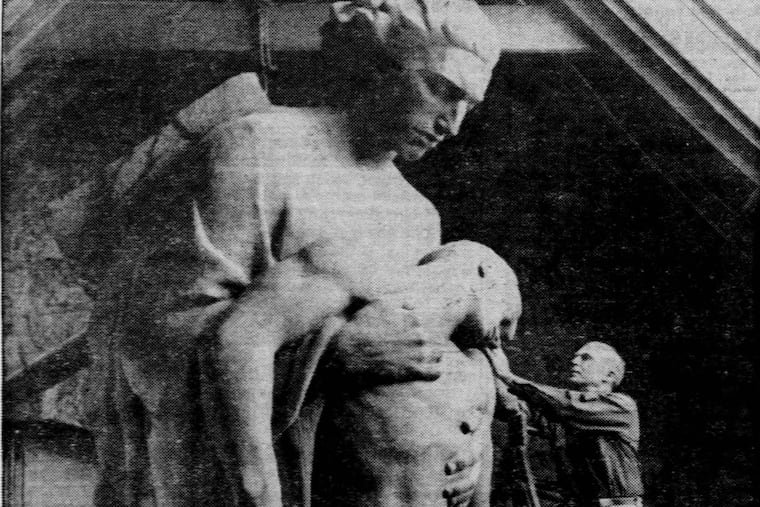
Today, Hancock’s public works can be found all over the country, and locally, his most notable work sits at the east end of 30th Street Station.
The 39-foot-tall, 10½-ton Statue to War Dead depicts an angel holding a dying soldier. It commemorates in bronze the 1,307 employees of the Pennsylvania Railroad who died during World War II. Gen. Omar N. Bradley was on hand to help dedicate the artwork on Aug. 10, 1952.
Hancock died in 1998 at age 97 but his sculpture remains the station’s monumental centerpiece.