Portraits of past mayors were defaced in City Hall on this week in Philly history
A recently fired city carpenter was arrested for smashing three portraits of Philadelphia mayors.
Faces from the past were dragged into the present.
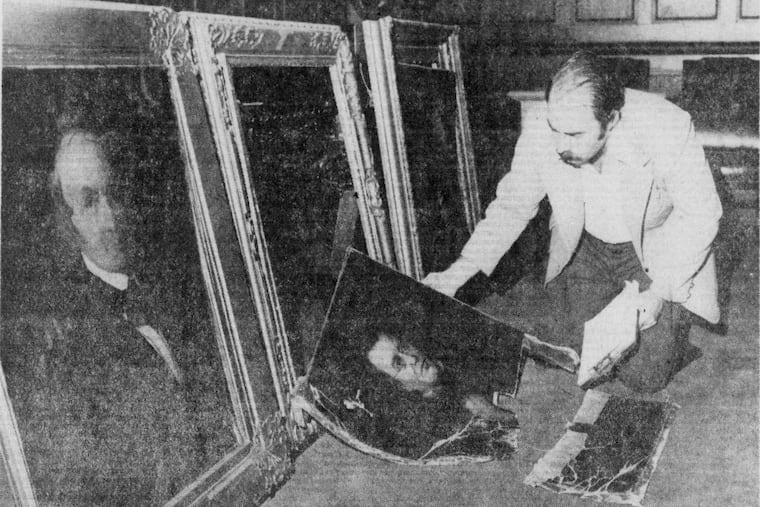
Oil portraits in City Hall of three former Philadelphia mayors were defaced on Sept. 27, 1978.
Around 4:30 p.m., a former city employee smashed the portraits that were hanging in a gallery on a lobby wall outside the second-floor Mayor’s Reception Room. The gallery features stately portraits of the city’s dozens of former mayors.
A 21-year-old recently fired city carpenter, Russell Byrd from Ogontz, pulled four framed, two-foot-by-three-foot portraits off the wall and smashed three against nearby railings and stairs. He left a fourth portrait — of John Barker, mayor from 1808 to 1812 — unharmed.
A cop on duty watched Byrd suspiciously pacing the stairway and went to investigate. He found the portraits in the second-floor stairwell, and followed Byrd into a men’s room and placed him under arrest.
Byrd was charged with theft, burglary, receiving stolen goods, and criminal mischief. He pleaded guilty to the mischief count in June 1979 and was sentenced to two years of probation, court records show.
The damaged paintings were of Isaac Roach, who served in the 1830s; Robert Conrad, who led the city in the 1850s; and William Smith, who helmed the big desk in the 1880s.
A descendant of Conrad, his great-great-grandson Wendell W. Oberholtzer, read about the destruction the next morning in the newspaper.
“This whole thing upset me terribly,” Oberholtzer told The Inquirer.
Oberholtzer called City Hall and offered to help.
He said he would lend the city a personally owned portrait of his famous relative, or he could supply photos, for an artist or engraver to use to create a replacement portrait.
But the donations were not necessary. Robert Silver, commissioner of public property, said conservators from the Philadelphia Museum of Art sized up the situation and decided the portraits were not beyond repair.
Silver told The Inquirer that he could have the portraits restored to “practically their pre-smash condition” within a few months.
And the honored could once again return to their rightful places in history.