‘Who are these Schuylkill Dragons?’
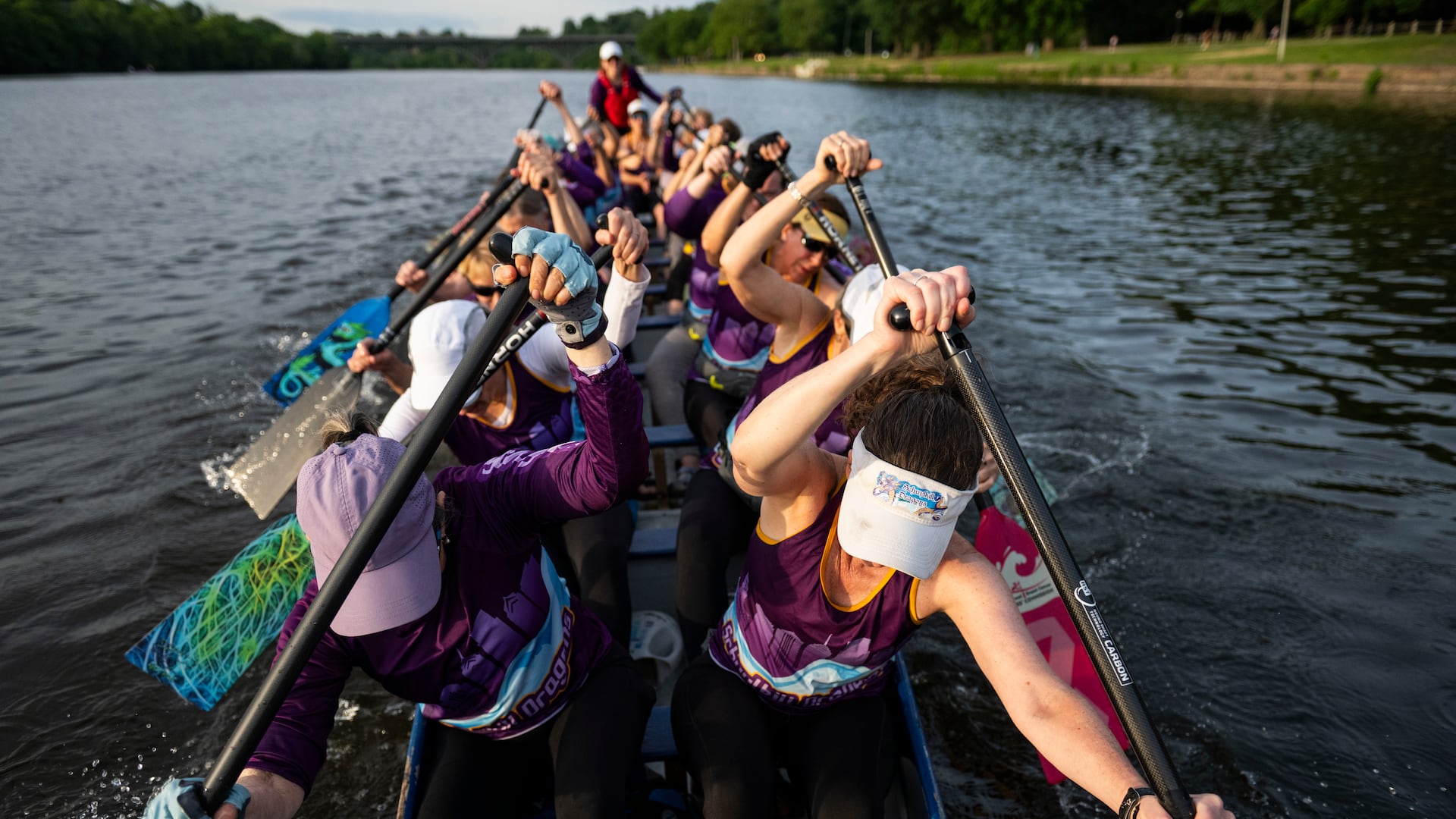
A group of Philly-area women — many in their 70s and 80s — have banded together as the scrappiest dragon-boating team on the river.
“It’s a great art, is rowing. It’s the finest art there is. It’s a symphony of motion. ... When you near perfection, you’re touching the Divine.”
— George Y. Pocock, renowned rowing coach and boatbuilder
“If you want to be a Schuylkill Dragon, don’t be a schmuck.”
— Judy Gernon, 81
Boathouse Row, on the Schuylkill, is the epitome of old-money elegance — a Ralph Lauren catalog come to life.
Home to more than a dozen of the city’s storied rowing clubs, it’s a timeless civic fixture. Opulent brick houses with palatial decks. American flags fluttering from poles. Young rowers with sinewy physiques and well-earned tans, milling about the docks.
There’s a reason it is considered one of the city’s most iconic settings, the subject of postcards and poetry.
About two miles upriver, meanwhile — far from this extravagant scene — sits another boathouse, of far less renown.
To get to it, you have to trek through knee-high grass, past the porta-potties and discarded car tires, and the mosquitoes as big as Buicks. Go past the chain-link fence choked by weeds and the dead trees the city hasn’t yet gotten around to clearing, and soon enough, you’ll reach it.
The humble headquarters of the Schuylkill Dragons.
It is 4 feet by 6 feet. It is packed with faded life jackets, water jugs, a smattering of rusted, secondhand tools. The only thing WASPy about it are the actual wasps — which, at the moment, have infested a corner of the small structure.
It is damp and dirty, thick with dust and cobwebs.
To the ladies of the Schuylkill Dragons — the city’s oldest all-woman dragon-boating team and its unlikeliest sports dynasty — there might be no better place on earth.
A ‘dump truck’ on the water
My introduction to the Schuylkill Dragons came on a Saturday morning this summer, at a team practice along the Schuylkill.
As I followed the team down a dirt path toward the water, a tiny white-haired woman in her 80s sidled up to me.
“It’s a good thing you didn’t come last Thursday,” she said, “‘cause it was raining like a b—.”
For 25 years, the Dragons have been rumbling their way up and down the Schuylkill.
And for 25 years, they have been the river’s most immovable force — a sweatin’, swearin’, swaggerin’ group of bandits that no one has quite figured out how to tame.
“Underestimate them at your own peril,” says Bob Mina, a longtime member of the Philadelphia Dragon Boat Association.
Many are in their 60s, 70s, and 80s, and — having endured some of life’s cruelest challenges: cancer, divorce, the loss of spouses — do not find it particularly daunting to propel a two-ton boat upriver until their backs and shoulders scream.
There is Cindy Roberts, a 65-year-old retired preservationist known for growling loudly throughout races. And Sue Ferry, 64, who goes by the nickname “Machete” — due to the fact that she once brandished one at practice and used it to hack a path through the weeds to the team’s boat ramp.
There is “Crazy Judy” Gernon, a tattooed 81-year-old former Army brat who stands 5-foot-1 (“and a half”) and has never met a sentence she felt couldn’t be enhanced with an expletive (or six). A while back, the team had to convince her to stop flashing people on the river.
Nothing has been able to slay the Dragons. Not injury (they’ve been known to schedule their hip-replacement surgeries around dragon-boating season). Not the city’s rowers (with whom they regularly clash), or the younger, fitter teams they routinely find themselves lined up against (the Dragons have won medals across the globe and are widely considered the gold standard for women’s dragon-boating in the city).
Even their own coaches have occasionally found themselves at the mercy of the Schuylkill’s Bad News Bears.
Years ago, the team was led by a man who worked as an attorney for a prominent pharmaceutical company, a guy with a reputation for navigating the corporate world with iron-fisted efficiency.
“What cracked us up is he had no qualms going into some office and firing everybody there,” says Crazy Judy.
“But to work with a women’s dragon-boating team? He couldn’t say s— if he had a mouthful.”
‘Renegades’ of the river
Since hosting its first regatta in 1835, the Schuylkill has been a national hub for U.S. rowing. It has produced Olympic rowing medalists and national collegiate champions, been the training ground for clubs with names like Vespa and Crescent.
It was into this hallowed setting, meanwhile, that the Schuylkill Dragons arrived, in 2001, with all the subtlety of a right cross.
Though not the first dragon-boating team on the river — at least one men’s team started in the mid-1980s — the Dragons quickly established themselves as the most colorful.
“We were like renegades,” says Patti Miller, 72, one of the Dragons’ founding members. “We were a novelty: Who are these Schuylkill Dragons?”
If rowing is jazz — smooth, elegant — then dragon-boating is a half-dozen teenagers in a garage, thrashing on electric guitars and banging on drum kits.
Their stroke is urgent and aggressive. Their boats — usually adorned with large dragon heads and tails — are massive, measuring some 40 feet in length. Unlike rowing, which typically includes no more than eight people to a boat, dragon boats hold 22: 20 paddlers, a drummer (who sits up front, banging a drum to set the paddling pace and barking instructions through a microphone) and a steersperson (stationed in the back and responsible for keeping the boat on course).
Amy Virus, a 52-year-old member of the Dragons, explains it this way:
The Schuylkill is like a smooth-running highway, the rowers and kayakers minding their own business.
“And then a dump truck gets on,” she says, “and gets in [everybody’s] way.”
The early years weren’t always easy. To find members, the Dragons handed out flyers and published classified ads in the newspaper: Women wanted to paddle on the Schuylkill.
For years, the team was stationed on the Kelly Drive side of the Schuylkill, their boats tied to a tree on the river’s bank. Before each practice, the women — many postretirement age — had to rappel down a rock wall to board the boat.
Introducing dragon-boating to the Schuylkill, meanwhile, was a little like releasing a pack of honey badgers into a wedding reception.
Years ago, a group of male dragon-boaters — who’d apparently done a little too much prerace imbibing — managed to tip their boat during a race, sending themselves spilling into the river. When a police boat arrived to pull them out of the water, they managed to sink that boat, too.
It was “basically like West Side Story on the water,” says Mina, of the PDBA, of the rower-dragon-boater tension. “Only without the jaunty musical numbers.”
When the Dragons first started on the river, the mostly male rowers would report the team to the Schuylkill Navy — the river’s rule-enforcement body — for rules violations. Or scream at the women to get out of their way.
Today, the two groups seem to have reached an uneasy detente, though plenty of Dragons believe the rowers would be happy if they packed up their hulking boats and disappeared forever. Says Meg Fasy, 62, “They’re looking at us like we’re a bunch of old broads, I’m sure.”
Which is not to say, of course, that the Dragons do not give as good as they get.
Not long ago, when the team encountered a group of younger male rowers on the river during practice, one Dragon couldn’t help herself.
“I’ve got shoes older than you!” she bellowed.
‘I was better than they were’
Because many came of age before Title IX, the Dragons are, for some, the first team they’ve ever been a part of.
Growing up in Massachusetts, Susan Wilson — the Dragons’ oldest member at 83 — spent childhood evenings playing street baseball with the boys in her neighborhood — long, glorious hours chasing fly balls under a fading New England sun.
But at a certain point, the boys all joined organized teams, and Wilson was relegated to the bleachers — a development particularly unjust, she explains, considering “I was better than they were.”
When she eventually discovered dragon-boating several decades later, in her late 50s, it was a revelation.
“The first night I went out on the water, there were whitecaps [and] hail,” says Wilson. “And I went, ‘Oh, yes, this is for me.’”
One after another, members credit the Dragons with bringing them out of their shells, with instilling in them a newfound confidence.
As a young mother, Karen Anderson, 72, says, she was so competition-averse that during her kids’ youth sporting events, “I’d hope for a tie, so everyone left happy.”
Now?
“I never know what’s going to come flying out of my mouth,” she says. “It’s made me really like a crazy woman when I’m racing.”
Consider Marina Della Putta Johnston. On land, she is a mild-mannered, 62-year-old former Italian Studies lecturer at Penn. On water, she’s “The Marinator” — a nickname earned following a race in Sarasota, Fla., in which the boat she was steering inadvertently clipped that of a rival team, dumping its occupants into the lake.
“They flipped,” Johnston says, “and we kept going.”
Beneath all their bluster, the Dragons care deeply for one another.
They arrange meal trains when a teammate is sick or injured. They check in on one another. When her husband’s health was declining in 2022, says Stacy Kent Wyckoff, 66, it was the Dragons who helped her through her grief.
“It was just a very healing thing to jump into,” she says.
This is another Dragons specialty — moments of quiet tenderness amid all the grunting and growling and middle-finger salutes.
Two years ago, at a team camp in Florida, a few Dragons were driving from their hotel to dinner. In the passenger seat, 79-year-old Phoebe Wood — who is typically about as sentimental as a court order — suddenly grew nostalgic.
“I just want to say,” she announced, “that I love everyone in this car.”
‘Solemn and deadly’
At competitions, some teams arrive at the starting line light and loose — laughing, dancing. The Dragons prefer a different approach: “Looking solemn and deadly,” says Wood.
Talking is almost always prohibited in the boat, even at practice — the better to stay focused.
Today, the team has a standing offer: $20 to anyone who pukes during a race.
The Dragons train four days a week in the summer — Tuesday and Thursday evenings, plus Wednesday and Saturday mornings. In the winter, many team members travel more than an hour each weekend to Pottstown, where they train indoors in a simulation paddling pool. Each spring, a group of Dragons attends a grueling preseason dragon-boating camp in Florida, enduring hours-long days on the water.
They have competed across the world — Hungary, Canada, Italy. Members have paddled for Team USA at the dragon-boating world championships, considered the sport’s Olympics.
“If you want to race seriously,” says Mina, “that’s the club you want to go to.”
Indeed, it is not for the faint of heart.
The Dragons have paddled with torn rotator cuffs, artificial hips, wonky knees. You could field a marching band with all the Dragons who are currently in physical therapy for one ailment or another. One local paddler with emphysema used to lug her oxygen tank with her onto the boat.
Today, Philadelphia is home to more than a dozen competitive dragon-boating teams, many of which share a pair of docks on the Schuylkill’s western bank, off Martin Luther King Jr. Drive.
And while this growth has been viewed very much as a positive, it has occasionally resulted in what the husband of one team member refers to as “Dragon Drama.”
For the Dragons, much of that drama has involved another of the city’s longstanding women’s dragon-boating teams, a rivalry that — like many great conflicts — traces its origins to failed romance.
Years ago, the story goes, the then-coaches of the two teams became romantically involved — which was fine, up until the relationship came to an unceremonious end.
“Then it became, ‘Kill the Dragons!’” says one longtime member of the rival team.
For a long time, the two teams wouldn’t acknowledge each other. Or, conversely, would acknowledge each other too much — lobbing insults from their respective boats before races.
The iciness has since thawed — to a degree.
“We might like them off the boat,” says Anderson. “But on the water ... we want to beat their asses.”
‘You ever heard of dragon-boating?’
The team built its own boathouse, over a single weekend in 2015. They own three dragon boats — long, massive vessels of wood and fiberglass — which they store, patch, and repair themselves. Whereas the clubs of Boathouse Row have stocked bars and gleaming workout facilities — the University of Pennsylvania’s College Boat Club recently underwent a $13.5-million renovation — the Dragons have 70-year-old Julie Regnier, nicknamed “MacGyver” for her proficiency with a two-by-four and a can of epoxy.
Says Linda Breitstein, a 72-year-old Dragon: “These are not women who are used to saying, ‘I’ll call the man to take care of everything.’”
Keeping the team competitive, meanwhile, has required a constant commitment to recruiting, a duty the Dragons have embraced with the intensity of a Southeastern Conference football coach on the hot seat.
They’ve plucked new team members from the gym, from the community garden, from dinner parties. They are not above cornering a fit-looking stranger in the cereal aisle of their local grocery store and extolling the virtues of dragon-boating.
Once, Anderson found herself at a Bucks County hospital. Her daughter had just gotten out of surgery, and was being wheeled into the post-operation room, but Anderson couldn’t take her eyes off the attending nurse.
“She was tall and she was fit and she had some muscles,” says Anderson, now one of the team’s three coaches. “And I said, ‘I’m going for it.’”
“Excuse me,” she said, as her daughter lay unconscious a few feet away. “Have you ever heard of dragon-boating?”
The nurse joined the team soon after, bringing a neighbor with her.
Though the Dragons are open to women of all ages — their youngest member is 23 — the team has long trended older. As of last year, the average age of the team sat somewhere in the neighborhood of 60.
Lately, there’s been a conscious push to bring in younger paddlers — “our succession plan,” says one former member of the team’s board of directors. The team has instituted an annual rookie camp to scout new members; of the six paddlers who received invitations to join the team this summer, five were under the age of 40.
Short of that, the Dragons have developed a backup plan for ensuring the team’s longevity.
When Crazy Judy told coach Stacey Scanlan recently that they’d have to find a replacement for her eventually, Scanlan shrugged.
“Just don’t die,” she replied.
The race
On a Saturday afternoon in July, the Dragons gathered in an asphalt parking lot near Baltimore’s Inner Harbor, one of a dozen teams across the Northeast competing in the Charm City’s Dragon Boat Challenge.
It was not going well.
Earlier in the day, the team had finished third in a race they’d hoped to win; afterward, they’d stalked silently to their team tent, pulling out knitting needles or hardcover books and keeping largely to themselves.
Now, as they boarded their boat for the regatta’s final event — the 2,000-meter, the sport’s longest and arguably most grueling race — they vowed to salvage their day.
Ten minutes later, they’d done it, cruising to an easy victory in the eight-team race.
Their smiles returned. They bumped fists. They slapped the side of their boat.
“What a show!” someone yelled from the crowd.
At the awards ceremony a few minutes later, the event’s teams gathered near the water. One by one, they stepped forward to collect their medals. But when it was the Dragons’ turn, the team was nowhere to be found.
“Schuylkill Dragons...” an MC called over a microphone.
“Schuylkill Dragons, are you still here?” he said, finally. “Do you want your medals?”
Far across the parking lot, however, the Dragons were lost in their own little world, giggling and dancing to “Funkytown” and looking to all the world like there was nowhere they’d rather be.