In measles outbreak, state turns its attention to hard-hit Mifflin County
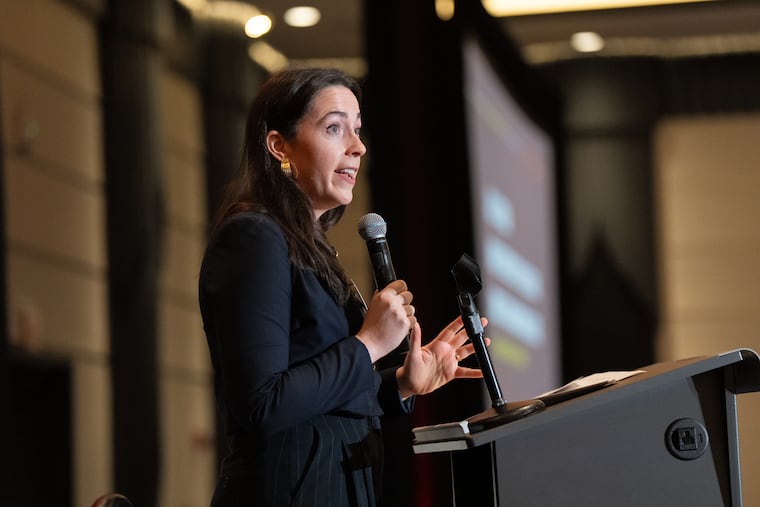
Secretary of Health Debra Bogen held a roundtable recently to discuss challenges facing local healthcare leaders.
Last week, amid the worst measles outbreak in decades, doctors, nurses, and first responders in the state’s hardest-hit county came together to strategize.
Representatives from nine Pennsylvania agencies and healthcare groups serving Mifflin County shared their experiences, the challenges they’ve faced, and ideas to more efficiently attack an outbreak involving nearly 1,400 reported cases statewide as of Wednesday.
Chief takeaways included the need to better educate nurses on treating an unfamiliar virus, how to cut through the bureaucratic red tape that has sometimes hindered vaccination efforts, and the need to monitor an upcoming Mennonite wedding season that could send case numbers surging.
The roundtable gathering — the first of its kind convened by the state’s Department of Health — comes six months into an outbreak in which nearly one in five infected has been hospitalized and six people have died, according to reports by the state and local coroners. Healthcare workers across large swaths of the state are contending with a disease they’ve rarely, if ever, encountered.
No county in the state has seen a higher rate than Mifflin County, which has reported 198 cases to date. (Though Lancaster County has recorded the highest number of total cases with 487, Mifflin County’s rate of infection is nearly five times higher.)
“Our state metrics and data tell part of the story of the measles outbreak in Pennsylvania, but listening to the people on the ground caring for people in affected communities like Mifflin County is essential to refining our public health response,” state Secretary of Health Debra Bogen said in a news release. “We hosted this roundtable to hear directly from healthcare providers about the challenges they are facing.”
Earlier this month, The Inquirer spent several days in Mifflin County, documenting the lack of conversation and concern regarding the ongoing spread of measles cases in the area, both inside and outside the Amish community.
At the time, county officials declined to speak about the rising number of cases. The state emphasized its ongoing coordination with Mifflin County healthcare workers but did not mention plans for a roundtable event.
Residents expressed little worry over the county’s infection totals.
“I’m more worried about my kid [coming home with] lice,” said one mother of two from Lewistown, the Mifflin County seat, at the time.
Despite the high rate of infection in Mifflin County, the roundtable marks the first publicized event state officials have held locally to address the measles outbreak.
“I think the major takeaway is how can we all work to our strengths at different organizations and help each other and help our community as we fight a virus that we haven’t seen in nearly three decades,” said Lilian McKinley, a pediatrician with Mount Nittany Health, who attended the roundtable.
Measles was declared eliminated in the U.S. in 2000, but the highly infectious disease has started to resurge in recent years amid declining vaccination rates nationally.
Helge Hartung, a physician at the Central Pennsylvania Clinic in Belleville, said those in attendance had “mostly praise” for the Department of Health, though there was also discussion of how to improve logistical issues that have occasionally arisen.
At times, Hartung said, there have been instances where his clinic treating many members of Mifflin County’s significant Amish population has struggled to access vaccine doses due to bureaucratic holdups.
“Both federal and state programs for vaccine access are great, but they do not allow us to rapidly react to changing realities on the ground,“ Hartung said in an email. ”We want to be able to scale down vaccine storage and associated bureaucracy when we don’t need them, and then to rapidly scale up when we do."
In Mifflin County, efforts to curb the infection’s spread have been complicated by widespread hesitancy toward the measles, mumps, and rubella (MMR) vaccine, which has proven 97% effective at preventing infection after two doses.
In the Amish community, which has been especially impacted by the outbreak, members have cited everything from religious beliefs to fears over potential side effects as reasons for avoiding inoculation.
A lack of information — both inside and outside the Amish community — has also been an ongoing challenge. Several who spoke to The Inquirer this month were unaware that an 18-year-old Amish woman from the county had died last month after contracting the measles or had heard misinformation about the role measles played in her death.
Scott Mickalonis, director of emergency management and business continuity for Penn State Health, said disseminating standardized messaging, along with the state’s robust data, were paramount to a successful response locally.
“The [DOH] has a lot of that information available,” said Mickalonis, who was also part of the roundtable. “We talked about how we could take that information and share it in the community.”
Statistics released Wednesday by the state show a recent decline in newly identified cases.
Still, some in Mifflin County worry that the arrival of wedding season in the Mennonite community — which typically takes place in November and December and involves large gatherings — could produce another spike in cases.
Similar to the Amish community, there are high numbers of unvaccinated among the local population of Mennonites, a group that hasn’t yet experienced a significant spread and thus remains susceptible to infection, Hartung said.
“It’s a smaller community for sure,” he said. “But nonetheless, it could be another peak.”
The state Department of Health is exploring whether to hold additional roundtables in other areas impacted by the measles outbreak, spokesperson Neil Ruhland said in an email this week.
Since April, state health centers have held 226 pop-up vaccination clinics. These clinics have administered more than 6,500 MMR vaccinations, according to numbers provided by the state.
The department is also working to create “additional educational opportunities for Pennsylvania nurses, as the vast majority of them have never treated measles before.”
In the meantime, those on the ground are bracing for whatever the fall and winter may bring.
“We all have the same goal in mind,” said Mickalonis, of Penn State Health. “And that is to really level off the incidents of measles before it becomes overburdening to our health systems.”

-
Your questions about Pennsylvania’s measles outbreak, answered
-
Measles is thought of as a childhood illness, but more Pa. adults are getting sick
-
New vaccination data show hundreds of Philly-area schools vulnerable to a measles outbreak
-
Chester County has more measles cases than most entire states in the country
-
Pa. measles outbreak is nation’s worst, echoing deadly 1991 Philadelphia epidemic
-
Pa. measles vaccine messaging depends on word-of-mouth to reach the Amish community