A sickly falcon found at the PMA in June is cleared for takeoff
Patient 718 was suffering from high levels of lead poisoning.
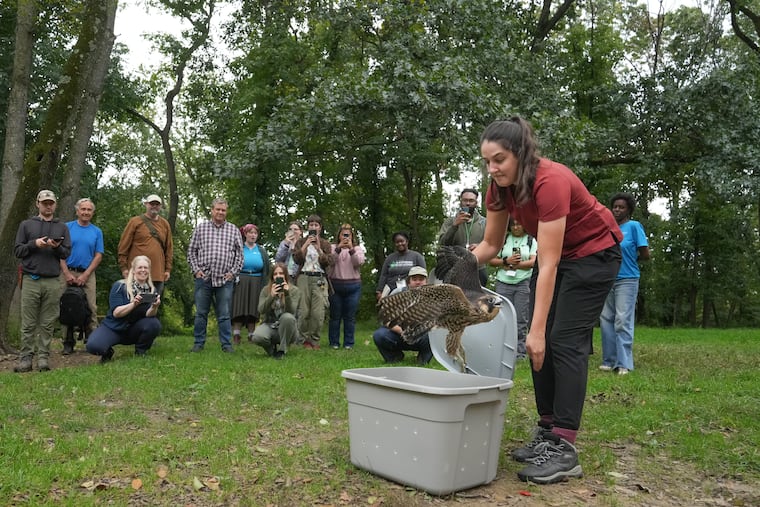
A gray plastic tote shook outside the Schuylkill Center for Environmental Education every few minutes Tuesday afternoon, proof that patient 718 was ready to fly.
A crowd gathered on the lawn beside it, adjusting shutter speeds to capture the world’s fastest animal. Just after 1 p.m., Sydney Glisan, director of the center’s wildlife clinic, unfastened the bungee cord, removed the lid, and offered the male peregrine falcon a few words of encouragement.
“All right, buddy,” Glisan said. “Today’s the day.”
Like a feathered fighter jet, the bird burst from the tote and bolted for the big trees in Roxborough, letting out a few raucous shrieks as it disappeared.
Patient 718 — animals are rarely named at the Schuylkill Center — arrived thin and sickly on June 4, suffering from high levels of lead poisoning. The bird was found near the entrance of the Philadelphia Museum of Art earlier that day, far below the nest its parents built there.
“He was just kind of sitting there,” Glisan said of 718.
A sibling, who had lower levels of lead poisoning, was also discovered at the museum the same day. That falcon, also a male, was treated at the clinic and released into the wild on July 1.
Glisan said most raptors in the region would test positive for lead, but 718’s levels were “off the charts.” Lead can be found in the soil, she said, from bullets, lead-poisoned prey, and even fishing gear.
At the clinic, 718 received chelation therapy, where a medication binds to the lead in the bloodstream and is then passed by the bird. The falcon received four rounds of chelation over the summer, with recovery breaks.
“It’s hard on the body,” Glisan said, “but he was a real trouper.”
After chelation, the falcon was taken to an aviary, where he practiced flying through an obstacle course that included pool noodles. He aced the test.
“It was fascinating,” she said. “They move so fast.”
Peregrines mostly hunt other birds from high perches and can reach speeds of over 200 mph when dive-bombing on prey.
Glisan said 718 would probably find his own territory and not return to the art museum. She said there are at least three active peregrine nests in Philadelphia, including one at City Hall.
As of Tuesday afternoon, the Schuylkill Center has treated 1,775 animals this year, including numerous species of birds, gray squirrels, and rabbits. More were coming in by the minute, including a red-tailed hawk with an injured talon and a baby squirrel that tangled with a dog.
Many animals that come in don’t survive long, Glisan said, and some, like Buttercup, the mostly-blind-but-friendly opossum with frostbitten ears, are unable to be released due to their injuries. They are used for education and, on occasion, cuddling.
“I do love you, Butter,” Glisan said, cradling the opossum.
Erin Mooney, the Schuylkill Center’s executive director, said the facility does not charge to take in and treat animals. She also said the center needs a new clinic building because theirs is 31 years old, and too small.
While the Schuylkill Center receives money from outside agencies on occasion, Mooney said they rely heavily on donors.
“In order for the work at the clinic and the Schuylkill Center itself to continue, we need people to give,” Mooney said.
For more information, visit: https://schuylkillcenter.org/support/donate/