Earthquakes shatter lives—and reveal existing fault lines
Recent earthquakes have devastated Venezuela. The longer sweep of Latin American history shows how often earthquakes have uncovered existed crises and sparked new mobilizations.
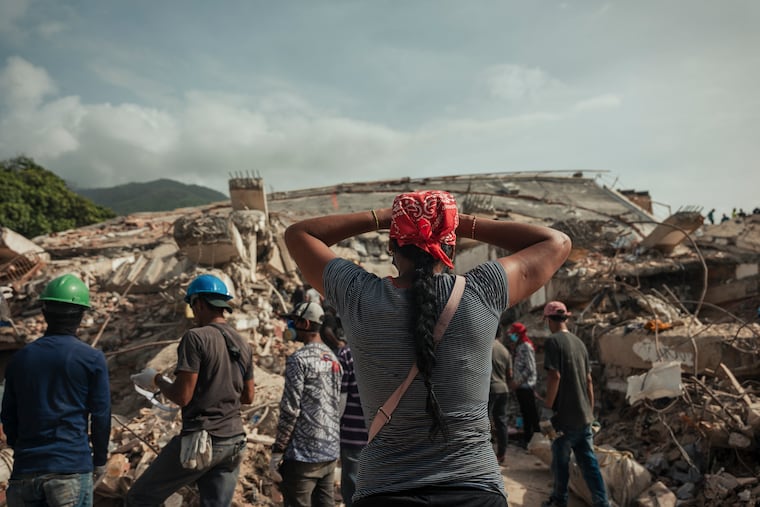
Apocalyptic images continue to emerge from Venezuela after the earthquakes of June 24: residents pulling relatives from collapsed homes, bodies piling up outside morgues, apartment buildings reduced to rubble and families in parks building makeshift shelters from nylon sheets and scrap metal.
Yet Venezuela was embattled even before the earthquakes. The collapse of oil revenues, combined with crippling U.S. sanctions, has pushed the economy into a prolonged crisis, eroding wages and savings. Eight million people have fled since 2017. Political instability deepened in January when the United States abducted President Nicolás Maduro and installed Delcy Rodríguez as acting president.
The earthquakes have accentuated that fragility. Yet in Latin America, earthquakes have long been more than natural disasters. They have repeatedly served as moments that unearth existing crises, intensify social fissures and spark political mobilization. That pattern stretches back to the birth of the Venezuelan republic itself, in the rubble of Caracas two centuries ago.
On March 26, 1812, Venezuelans converged on Caracas’s Plaza Mayor on Holy Thursday. The city streets were filled with religious processions when, suddenly, violent tremors brought the festivities to a halt. Residents scattered as government buildings, churches and homes collapsed around them.
When the dust settled, the city lay in ruins. Thousands perished under falling rubble and debris, and an estimated three-quarters of Caracas’s wealth was destroyed in an instant. Devastation also radiated across rural regions and the Atlantic coast. “Mérida no longer exists,” mourned survivor Francisco de Yepes in the aftermath.
The tremors struck at a tumultuous moment in Venezuelan history. The War for Independence was raging and, just two years earlier, revolutionaries had deposed the Spanish colonial government in Caracas. The new republic declared independence from Spain shortly thereafter but remained deeply divided. The quake exacerbated these social fissures and exposed the fragility of the fledgling state.
Capitalizing on the crisis, many royalists framed the destruction as divine punishment for the rebellion against the Spanish Crown. Prominent patriots such as Simón Bolívar countered by casting the convulsions as a call to realize, rather than reject, the revolutionary project. “If Nature is against us,” he proclaimed, “we shall fight nature and make it obey.” He would ultimately help bring this promise to fruition by 1821.
Bolívar became the first but not the last leader in modern Latin America to find possibility in tragedy. A century later, in 1944, another earthquake leveled San Juan, Argentina. Over the previous years, successive governments had failed to address deep inequality in the rural region, where wealthy elites owned sprawling estates while landless workers languished in flimsy dwellings.
Just months before the earthquake, a military coup overthrew a civilian administration, denouncing the “corruption” and “inhumanity” of the ruling regime. The devastation of San Juan appeared to confirm these claims by the armed forces, as tens of thousands of the province’s poorest residents lost their lives in the rubble.
In response, leading political and religious figures attempted to politicize the moment. President Pedro Pablo Ramírez described the disaster as divine punishment for “past errors” under liberal rule. Argentina’s archbishop agreed, describing San Juan as a “sacrifice” for the nation’s sins, a province “purified by pain.”
Juan Perón, a then-obscure military leader, responded more shrewdly. Rather than portray the wreckage as the wrath of the Almighty, he argued that it revealed the poverty plaguing Argentina.
As Secretary of Labor and Welfare, Perón launched an unprecedented relief effort, delivering food, water, medical aid and housing to survivors, and praised compatriots for “march[ing] to San Juan to clear the rubble…even those who have little to offer.” The campaign expanded his political base and helped propel him to the presidency. As historian Mark Healey has argued, Peronism was inaugurated in the rubble of San Juan.
If Argentina’s catastrophe thrust Perón into high office, the remains of Managua in 1972 ushered in Anastasio Somoza’s downfall. For nearly 40 years, the Somoza family had ruled Nicaragua through repression, relying on the National Guard and U.S. military aid to crush popular opposition. This alliance had produced an uneasy standoff by the early 1970s. Leftist insurgents could not seize power, yet the capitalist prosperity promised by Somoza and Washington never materialized.
A powerful earthquake shattered this political paralysis in December 1972. Managuans witnessed working-class barrios flattened, as fires consumed churches and municipal buildings. Overnight, over 250,000 people became homeless.
Instead of providing aid, the vaunted National Guard engaged in widespread looting across Managua, prompting the United States to deploy Marines to prop up Somoza. Reports emerged that the dictator himself diverted blood plasma provided by international aid groups to sell on the black market for personal gain.
Opposition leaders branded the Somoza clan as “mosquitos” sucking the literal blood of the pueblo in their moment of desperation. Even allies of the president, including members of the Conservative Party and younger business leaders, accused him of playing politics with tragedy. By the mid-1970s, the United States began conditioning military and economic aid to Somoza, laying the groundwork for the dynasty’s eventual ouster by the Sandinistas.
Four years after Managua, neighboring Guatemala faced a similar reckoning. There too, an earthquake struck a society marked by deep inequality and state neglect. As the population boomed, families increasingly crammed into tiny plots in the countryside or ramshackle shelters in the city, lacking access to clean water, food and health care. Successive right-wing governments ignored these needs, instead diverting funding to repression and counterinsurgency.
On February 4, 1976 a massive earthquake transformed chronic crises into calamity. In just 39 seconds, the shaking destroyed over 250,000 houses and claimed the lives of 22,000 Guatemalans. More than a million people, disproportionately Mayas from rural regions, were left unhoused.
The government’s inept response compounded an already widespread sense of abandonment. President Kjell Eugenio Laugerud García placed the military in charge of reconstruction, aiming to expand the institution’s reach into civilian life. He then proclaimed that rebuilding was ultimately “the responsibility of all Guatemalans,” declaring that his administration would “not tolerate bums or social parasites.”
Guatemalans responded to the president’s directive in ways he never anticipated. In Guatemala City, newly displaced residents commandeered private and public property to rebuild their shelters. Doctors and nurses staged unprecedented nationwide strikes in damaged hospitals, calling for more resources. These actions broadened the popular front against military rule over the following years.
Unlike in Nicaragua, that pressure did not culminate in a revolutionary victory. Instead, the armed forces used the organizational capacity they built amid the chaos of the quake to initiate a brutal counterinsurgency. This calamitous campaign culminated in a genocide against Ixil Maya communities by 1982.
Guatemala’s outcome differed from those of Caracas, San Juan, and Managua. Yet the broader historical pattern remains clear. Earthquakes do more than level cities. They shake loose the social and political foundations of societies. In their wake, ruins become a reckoning, inviting citizens to question what came before and compelling authorities to demonstrate their ability to respond.
Venezuela’s earthquakes are likewise becoming a test of political legitimacy. The convulsions transformed a nation already reeling from U.S. intervention, hyperinflation, mass outmigration and state repression into one engulfed by catastrophe. In response, some are racing to repair the old order. On June 28, President Rodríguez militarized La Guaira, a devastated coastal state, even as her government struggled to establish a coordinating committee for relief efforts, leaving survivors to fend for themselves.
At the same time, many Venezuelans are using the rubble to advance an alternative vision of state power, grounded in care rather than coercion. On June 30, one resident from La Guaira confronted Venezuelan troops sent by Rodríguez. “What did you bring your weapons for?” the man shouted, “you should’ve brought a shovel, and a pickaxe…that uniform is to defend the homeland.” “This is the country,” he stressed, gesturing to the rubble, “it needs you, not a weapon.” An admonition, made by history.
What Venezuela emerges from this catastrophe remains to be seen. As Antonio Gramsci once observed, “the old is dying and the new cannot yet be born.” One thing is clear, however. The tremors, like so many others in Latin American history, have created an opening for a new order to emerge.
Ilan Palacios Avineri is a historian of Central America, specializing in the politics of catastrophe and recovery in Cold War Guatemala.
Made by History takes readers beyond the headlines with articles written and edited by professional historians. Opinions expressed do not necessarily reflect the views of The Inquirer.