A Montco jury will decide the fate of three men in a murder rooted in a Norristown gang feud
Prosecutors say Jabriil Morgan-Cook, Naseem Worrell and Kaleem Roland "hunted" a rival gang member for disrespecting their friend. Their attorneys say investigators failed to connect them to the case.
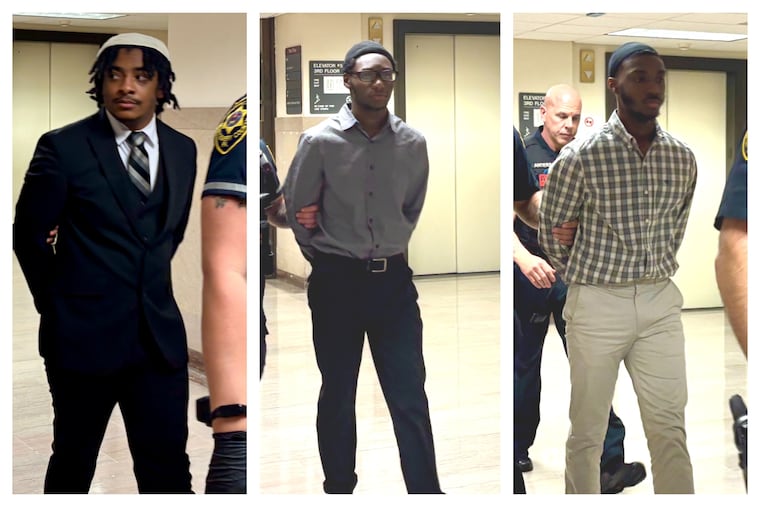
The murder of a Norristown man last year was a retaliatory shooting rooted in a bitter gang feud splitting Montgomery County’s seat, prosecutors said Tuesday as the murder trial for Tahaj Harrison’s three alleged killers ended.
Now, the fate of Jabriil Morgan-Cook, 20, Naseem Worrell, 19, and Kaleem Roland, 17, is in the hands of a jury, set to deliberate Wednesday morning.
Assistant District Attorney Tanner Beck said in his closing arguments that the three were self-proclaimed members of the 300s/All Black Bandits and set out in May 2025 to “hunt” Harrison.
Harrison, according to prosecutors, belonged to the 6s/Grimy Boys, a rival group, and had mocked the murder of Seth “Pop” Marshall, a 15-year-old 300s member who was killed in a West Philadelphia corner store two days before Harrison’s death.
In a message sent on Instagram hours before his death, Harrison, 20, told Worrell that Marshall “died like a [expletive],” an insult that, given the code of the streets, the three suspects could not ignore, according to Beck.
“The second Harrison sent that message to Worrel, everything changed,” Beck said. “The second he sent that message about his homie, his fate was sealed and his casket was as good as closed.”
The three travelled across Norristown to Harrison’s home on Corson Street and then “fanned out,” when they saw him. Each carried handguns, and each fired two shots in what Beck described as an ambush.
Harrison, shot once in his chest, later died at the scene.
Defense attorneys for the three suspects refuted Beck’s theory of the case, saying the investigation was rife with reasonable doubt and urging jurors to acquit their clients.
Surveillance footage of the shooting and from the area around Corson Street was grainy and difficult to view, according to the three defense attorneys. Alone, they said, it was not enough to identify who fired the fatal shots.
And there was no physical or DNA evidence taken from the crime scene that concretely identified them as the gunmen, aside from traces of Worrel’s found on a gun magazine left behind.
Morgan-Cook’s attorney, George Yacoubian Jr., said in his closing argument that the prosecution was “hanging its hat” on an Instagram live video featuring the three teens filmed an hour before Harrison’s death.
In that video, Morgan-Cook, brandishing a gun, talks about “dropping some shots” in the territory of the gang Harrison allegedly belongs to and saying he was “killing for [his] dead homie.”
Roland also wields a gun, and the trio perform a profanity-laced rap about gang violence.
But Yacoubian dismissed the video, saying it was nothing more than vulgar bragging.
“It’s puffing,” he said. “And it doesn’t equate to murder and conspiracy to commit murder.”
Worrell’s attorney, Richard Giuliani, told jurors they could not rely on key witnesses for the prosecution, including Harrison’s longtime friend who claimed Morgan-Cook threatened her by showing her a picture of her home when she accused him of killing Harrison.
That woman, according to text messages displayed in court, claimed to be afraid of Morgan Cook, but then invited him into her home to bring her McDonald’s shortly afterwards.
Three other witnesses who claimed to have been with the suspects before and after the shooting, and who identified to police the distinct clothing each wore, both recanted their testimony during the trial.
They testified they were pressured into speaking with police and told them whatever they could to get out of custody. Beck later dismissed that, saying the real reason for their recanting was pressure from their friends and fellow gang members, seated across from them in the courtroom
Yacoubian, Giuliani and Roland’s attorney, Thomas Egan, told jurors that if the prosecution’s theory about gang culture pervading Norristown was true, there would be a “wide net” of people upset at Harrison for mocking Seth Marshall’s death.
“You can’t shine a spotlight on just three guys when there’s a large group of people who’d take umbrage with saying [Marshall] ‘died like a [expletive],’” Egan said.
But Beck said it would stretch credulity to believe that all the circumstantial evidence, including the Instagram video and threats exchanged with Harrison online, were coincidences.
“They almost got away with it,” Beck told jurors. “Now, it’s up to you to make sure they don’t.”