A final day at the Academy of Natural Sciences is bringing tears, nostalgia, and disbelief
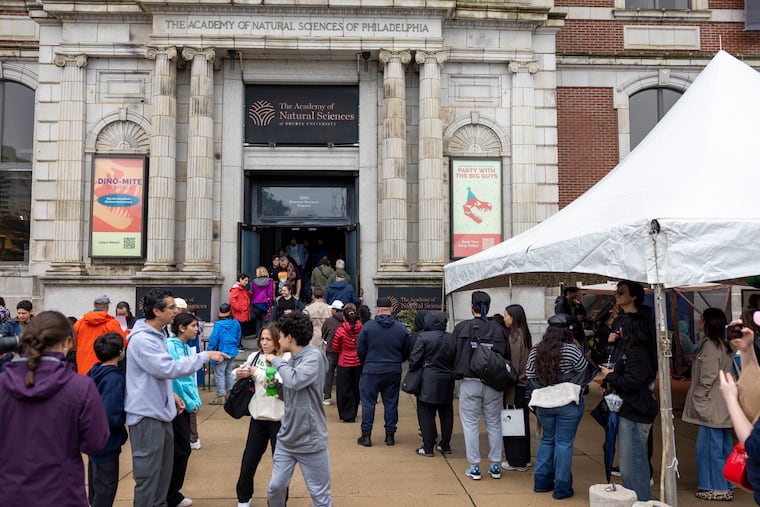
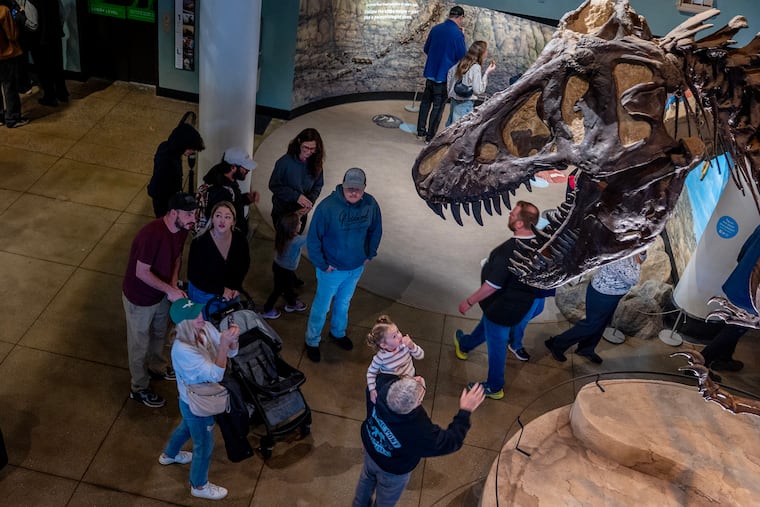
Inside the museum, a steady stream of visitors took photos, touched the skin of of a scaly anteater being circulated by educators, and guided toddlers in dinosaur costumes through exhibits.
Rene Garner cried even before the doors swung open Sunday to admit visitors to the last-ever day of operation for the Academy of Natural Sciences of Drexel University.
“I feel so sad,” said Garner, a retired educator who brought classes to the museum for years and credits her son’s love of science to summers spent learning at the academy’s summer camp. “This was such a great big part of our lives.”
Garner, a West Philadelphia resident, came with her son, Addison Garner, and her granddaughter, Sage Young, 7, to see the academy one last time.
Garner was far from alone.
About 8,000 fans streamed through the museum on Saturday, with some flying in from across the country to squeeze in one last visit, a museum leader said.
On Sunday, a steady stream of visitors inside the museum took photos, touched the hard but smooth skin of a pangolin — a scaly anteater — being circulated by museum educators, and guided toddlers in dinosaur costumes through exhibits.
“I can’t believe this,” one woman cried, peering over a second-floor balcony at a packed room full of visitors examining dinosaur bones.
Drexel announced this month it was closing the museum amid declining attendance and economic pressures. The academy has been open to the public since 1828, and is considered the birthplace of American paleontology.
The William Penn Foundation offered Drexel a lifeline to keep the academy open for a year, saying it would pay operating costs while the the museum studies the feasibility of its long-term survival.
Drexel has not specifically said it’s declined the offer but a spokesperson said that the university doesn’t have a viable proposal for a “permanent, sustainable path forward for the academy’s museum.”
William Penn’s offer was on the minds of many Sunday. Canvassers from a group attempting to save the academy chatted up visitors as they walked in the museum. They relayed their message from a billboard truck parked outside.
“200 years of natural history can’t end on our watch,” the billboard said.
Erin Kelly agrees.
“My 11-year-old grew up coming here,” said Kelly, who lives in Kensington and brought her son, Phoenix Johnson, to the museum for one more lesson Sunday. “I’ve taught him about our city, and country, and cultural treasures just by coming here.”
In some ways, it felt like an ordinary Sunday at the museum - kids digging for fossils in the sand, parents pushing strollers, people fake-climbing into dinosaur mouths for photos.
But there were definite signs of the end: the crowds, the activists handing out flyers, the picked-over gift shop, where signs told patrons that there was no stock left. A smiling teal stuffed dino purse seemed incongruous, a burst of cheer amid so much regret.
Artist Thomas LaPine traveled to Philadelphia to witness the museum’s last moments. He set up his easel, unpacked his paper and pencils and oil pastels, and sketched.
The was something magical in seeing people from all walks of life absorb the exhibits, LaPine said — watching children gain a sense of magic, a perspective on where the world has been, to perhaps think of where it’s going.
“It’s a pretty big tragedy to me, a big deal; that’s why I’m here,” LaPine said. “I’m paying my respects.”
LaPine said he planned to turn his sketches into a painting.
“Hopefully, it’s a little time capsule of a time when people decided to cut off this resource,” he said.
In Outside In, a hands-on exhibit designed for young children with animals to meet and exhibits to climb on, the walls were papered with notes on colorful paper - messages about what the museum meant to familes, pleas to save it.
“Stay Open!” a child wrote on a pale yellow page, with a frowny face. “Love Henry.”
“This has been a place of solace, fun and learning for me since childhood,” someone else wrote. “I was here before COVID, I was there after, and I’m here now. I hope this isn’t the last time.”
BREAK
Multiple politicians have urged Drexel to accept William Penn’s offer.
State Sen. Nikil Saval (D., Phila.) said in a statement that “the museum is of incalculable value to both our region and to international scientific and cultural fields,” said the academy must remain on Benjamin Franklin Parkway.
City Councilmembers Nina Ahmad and Jeffery Young Jr. said in a statement that William Penn’s offer comes at a crucial time, and allows officials the time “to take a breath and better understand how we got here and what we can do to keep the Academy open for hundreds of more years to come. All parties must be willing to explore every option to save this precious institution.”
This is a developing story and will be updated.
Staff writers Peter Dobrin and Susan Snyder contributed to this article.