Trump now says the Kennedy Center could be deadly. Months ago, it was ‘great.’
Many of the underlying physical problems were documented years before Trump took control — when Kennedy Center officials were planning to repair them while continuing performances.
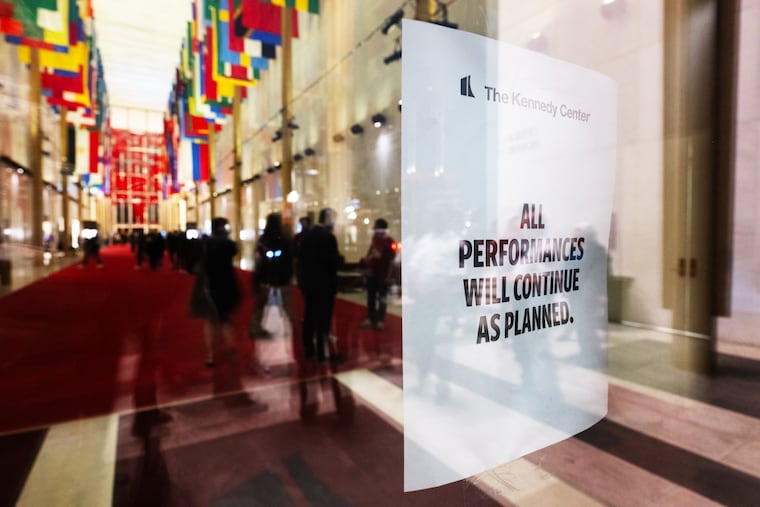
President Donald Trump stood on the red carpet at the John F. Kennedy Center for the Performing Arts in December and declared his mission to fix the building, to “make it beautiful,” all but accomplished.
“It was falling apart, and now it’s pretty much back,” Trump told reporters as he stood beside FIFA President Gianni Infantino ahead of the World Cup draw. “We’ve done a really great renovation job on it,” he added, predicting that remaining work would be complete within three or four months.
By Trump’s telling, it was the culmination of a transformation he had set in motion shortly after returning to office when, vowing to end “woke” programming, he purged the Kennedy Center’s board of trustees and became its new chairperson.
But less than two months after Trump’s victory declaration — after his name was added to the building, artists balked at performing there and income dropped further — his assessment of the center’s condition soured.
In late January he hosted a starry red carpet premiere for the documentary Melania but days later announced that the center was so “tired, broken, and dilapidated” that its main building would need to close for two years. The building was “sort of dangerous,” he added that week, though it was deemed safe enough for Trump and the first lady to catch a performance of Chicago about two months later. By the end of April, executive director Matt Floca was testifying about dangerous roofing conditions and electrical equipment that he said posed a risk of fire or, in the worst case, explosion.
Over the following months, the descriptions grew more dire. Trump said people entering the building were in “serious danger.” The center’s lawyers called it “structurally unsound” and “fundamentally unsafe.” This month, after a section of ceiling plaster fell in the Grand Foyer, Trump described the building as being in a “virtual state of collapse” and said the incident could have “killed” people.
Yet many of the underlying physical problems cited by management were documented years before Trump took control — when Kennedy Center officials and their engineering consultants were planning to repair the aging building while continuing to stage performances.
A dozen current and former Kennedy Center staff members interviewed by the Washington Post described a building that needed substantial repairs and routine maintenance but said they had not experienced conditions that led them to believe the building as a whole was unsafe. Some described elevators and escalators that frequently broke down, mice, and aging equipment. But the current and former employees, all of whom spoke on the condition of anonymity because they fear retribution, also recalled repairs being made around performances, often overnight, and said employees were regularly briefed on plans for larger projects.
Some of those projects stalled out under the new leadership, former staffers said. Before Trump’s takeover, Floca had been hired to oversee improvements including a renovation of the building’s Eisenhower offices. Employees working there were told they would temporarily relocate to office space at the Watergate during construction, according to three former staff members.
An executive had given the employees potted plants in anticipation of the move because, unlike their Kennedy Center offices, the temporary space had windows. But the renovation was paused after new leadership took control, and the move never happened, the employees said.
“We all named our plants,” one former staffer said, “and then they slowly died on our desks.”
On Thursday, a lawyer for whistleblowers told lawmakers about another project they say was cut short under Floca: The center planned $9 million roofing repairs, as part of the $257 million approved for renovations by Congress last year. But Floca canceled a contract that would have moved the project forward, according to the disclosure, which was reported Friday by the New York Times. Other money set aside for waterproofing was instead diverted to painting the center’s columns, the whistleblowers said.
A Post review of engineering assessments, building plans, congressional budget requests, and court records found that many of the conditions now cited by management — including water intrusion, deteriorating steel and concrete, aging mechanical equipment, and failing plumbing — were identified before Trump’s takeover and incorporated into plans to keep the center open during construction.
It was as the center’s financial and programming problems mounted, an employee at the Kennedy Center familiar with the renovation planning said, that discussions increasingly turned toward a complete shutdown. The employee said they came to believe an argument seized on by some staff, patrons, and Trump’s critics.
“The whole reason to close the building is not because it needs to close for renovations,” the employee said. “The whole reason to close it is because we’re not going to be able to secure the artists or the audiences needed to make the economics work.”
Kennedy Center leaders have since made new reviews that they say show immediate dangers to the public. An engineering assessment this month found widespread corrosion in the building’s heavy soffit panels, which form the underside of the exterior overhang, Floca said Wednesday in a sworn declaration. Separately, after severe storms Sept. 4, plaster fell 60 feet from the Grand Foyer ceiling into a public area below. The center did not rush to fix the damage. A consultant reported seeing the resultant “debris field” more than a week and a half later.
In a statement, a Kennedy Center spokesperson did not comment on halted repairs but avoided blaming past leaders and said “it is completely understandable that staff felt comfortable” in the building because of their past experience and because they had not seen the most recent assessments or the danger firsthand. “Employees’ firsthand experience matters,” the spokesperson added, “and their work maintaining the building and supporting performances deserves recognition.”
“The Center believes leadership teams, past and present, share a fundamental commitment to the Kennedy Center’s success and the continuation of its programming,” the spokesperson said. “There may be differences on priorities, timing, or the best way to deliver necessary improvements, but those differences should not be mistaken for differences in a commitment to the institution.”
The dispute has made the state of the building a high-profile concern — escalated, in a recent fight to restore his name to the building, by Trump’s threats that it could be torn down. On Thursday, House Democrats asked the Government Accountability Office to start its own review of the center’s financial and physical health.
The Kennedy Center, which opened in 1971, has never been an easy building to maintain.
Within a few years, its flat roof was plagued with leaks. A parade of thunderstorms in July 1977 sent water through the roof, weakening plaster that fell from the Grand Foyer’s 60-foot-high ceiling. The center, the Post reported at the time, “went on with the show,” moving the Champagne bar and rerouting opera and theater patrons into adjoining halls.
Officials at the time set up plywood walkways for visitors inside, then closed the roof terrace, restaurants, and, for about five weeks the following summer, the Concert Hall while crews undertook extensive waterproofing and other repairs. Contemporary Post coverage described water seeping into storage rooms, dressing rooms, and the Concert Hall and corroding or damaging parts of the building.
Leaks remained a persistent problem for decades. The center kept renovating its spaces and systems while continuing to operate, periodically closing individual venues or sections of the building.
The cycle became a routine headache for center leaders and lawmakers. In 1994, Congress sought to address more than 20 years of “severe deterioration,” passing a law that required the center to develop and annually update a comprehensive building plan that lays out future repairs and renovations.
The center last comprehensively updated that plan in 2022, identifying extensive needs across the sprawling complex: structural repairs, waterproofing, fire-safety and evacuation improvements, replacement of aging chillers, upgrades to water and electrical systems, elevator repairs, and improvements to technical stage systems.
But the plan called for work to be done in phases, scheduled around an operating performing arts center, accepting the higher costs and complexity involved.
“Projects have been scheduled in such a way as to keep the facility operating to the maximum extent,” the plan said.
A former senior Kennedy Center official who was directly familiar with the center’s capital planning said the current plans reflected how the center had long approached its physical needs.
“Every single thing that I have seen,” aside from some of the new decorative changes, was included in the center’s comprehensive building planning, the former official said. The plans laid out not only what needed to be repaired but also when the work could occur and how it could be scheduled around performances.
“The building remained open at all times,” according to the official.
That didn’t mean every part of the building was always available.
In November 2024, the official recalled, a small fire triggered the sprinkler system above the Opera House, sending large amounts of water into the theater below. The center relocated that night’s performance while workers dealt with the flooding. Such incidents, she said, were part of operating an aging and complicated building.
Other longtime workers described a similar reality.
David Berkowitz, a stagehand who has worked regularly at the center since 2002, said much of the equipment management wants to replace genuinely needs work. Freight elevators have repeatedly broken down, he said, and an enormous motorized lighting bridge in the Opera House is as old as the building and needs to be replaced.
The dispute is not whether the Kennedy Center needs repairs, but whether its condition had deteriorated enough to require abandoning plans to repair it in stages while it remained open.
That question became more pressing after Trump took over.
In August 2025, Trump declared the center a “great gem” that needed “a little fix up and a little work.” In an October post he said the center would stay “fully open during construction, renovation, and beautification.”
By Dec. 5, after inspecting work at the center, Trump said it was “pretty much back.”
Then, 58 days later, Trump announced the center would close for two years.
Trump said he had conducted a yearlong review with contractors, musical experts, arts institutions, and other advisers and concluded that closing the building would produce a faster, higher-quality renovation. In announcing the decision, Trump emphasized speed, construction quality, and the disruption of working around audiences and performances rather than saying the building was unsafe to occupy.
Asked about the shift, White House spokesperson Liz Huston said in a statement, “For years, Democrats let the Kennedy Center rot, allowing water damage and crumbling infrastructure to turn a national treasure into a building in decay. As President Trump said, without his intervention, The Kennedy Center will inevitably continue to decline.”
But in court-ordered disclosures, Floca identified four reports he relied on in recommending the shutdown: the center’s 2021 and 2022 building plans, a 2022 soffit report, and a 2024 leak investigation — all prepared before Trump’s second administration.
Put together, the records left the judge skeptical. Floca said he had concluded by the fall of 2025 that closing the center was necessary, but U.S. District Judge Christopher Cooper noted that the possibility of a shutdown did not come up at board meetings that September or December.
“No evidence in the record substantiates that timing,” he wrote of Floca’s account. And the evidence for an involved yearlong review of the kind Trump described “is nil,” Cooper wrote.
Cooper also noted that the center’s former president, Richard Grenell, had been promoting the center as a major venue for America’s 250th anniversary — “quite a concerning idea if the Center is as dangerous as the Defendants now represent.”
Craig Williams, an architect with decades of experience renovating performing-arts facilities who reviewed those reports for Rep. Joyce Beatty (D., Ohio), an ex officio Kennedy Center trustee challenging the closure in court, reached a different conclusion from Floca: A complete closure was not required for the deferred maintenance described in the reports, he said in a sworn declaration.
When Cooper blocked the planned July shutdown, the center remained open but had already stopped booking new performances while the board reconsidered whether to close all or part of the building. Meanwhile, the lost bookings were helping propel a drop in ticket sales and fundraising: By late May, management projected about $124 million in revenue against a $220 million budget, leaving a roughly $23 million deficit despite substantial spending cuts.
Floca has said a full closure is necessary because performing the extensive work around audiences would be unsafe and impractical. And by August, Delta Consulting Group had concluded that a two-year closure would be safer, faster, and substantially less expensive than rolling closures.
The center spokesperson on Friday pointed to the recent engineering reports and said “the building exists to support the mission. Success should be measured by whether the Center can sustain excellent programming in a safe, reliable, and financially sustainable environment.”
On Sept. 3, management received preliminary findings from engineering firm Walter P Moore’s inspection of the soffit system, according to a sworn declaration Floca filed Wednesday in federal court.
Walter P Moore estimated that about one-third of the 278 panels — each of which weighs about 2,500 pounds and hangs roughly 60 feet above the plaza outside — were severely corroded and required immediate replacement, while nearly all the rest had some degree of corrosion. The firm said continued wear could mean the panels fall and endanger people below.
Floca has pointed mainly to the soffits as his reason for closing the building. The second reason came Sept. 4, the day after the firm’s report, when plaster fell from the Grand Foyer ceiling after severe storms passed through the area. No one was injured.
Center officials have described the incident in increasingly stark terms, as Trump and allies spread footage of the collapse on social media.
Floca in a court filing Wednesday said the fallen material weighed about 150 pounds, and that more testing was needed. He also noted “ceiling irregularities” elsewhere in the Grand Foyer, reports of falling objects in the Hall of States, and continued leaks in the Hall of Nations.
Floca has extended the emergency closure through Sept. 30 while engineers continue their work and said he will reassess it weekly. Portions of the building could reopen if engineers determine it’s safe, he said. The latest findings “should not be generalized into a claim that every interior space is structurally unsafe,” the center spokesperson said.
Although leaders say this closure is not a full shutdown, layoffs have begun.
That longer-term plan remains tied up in federal court. The judge has not blocked repairs, but a full closure can’t happen without his permission.
Earlier this month, Cooper ruled in an increasingly intertwined dispute, blocking the board of trustees’ latest attempt to put Trump’s name back on the front of the building.
Trump reacted by explicitly tying the fate of the building to getting his name displayed on the front of it. Hours after Cooper’s ruling, Trump said renovations won’t proceed until his administration gets appropriate recognition for rescuing the institution.
“Frankly, if we don’t do that, it’s going to close,” he said later. “It’ll end up being ripped down.”
Hours later, he was photographed aboard Air Force One studying a large printout whose partially visible headline appeared to read “Kennedy Center DEMOLIS[HED].”