Proposed housing at Lionville Station Road won’t go forward, after Uwchlan officials deny rezoning
Roughly 500 houses in an age-restricted community — plus a large swimming center — had been proposed.
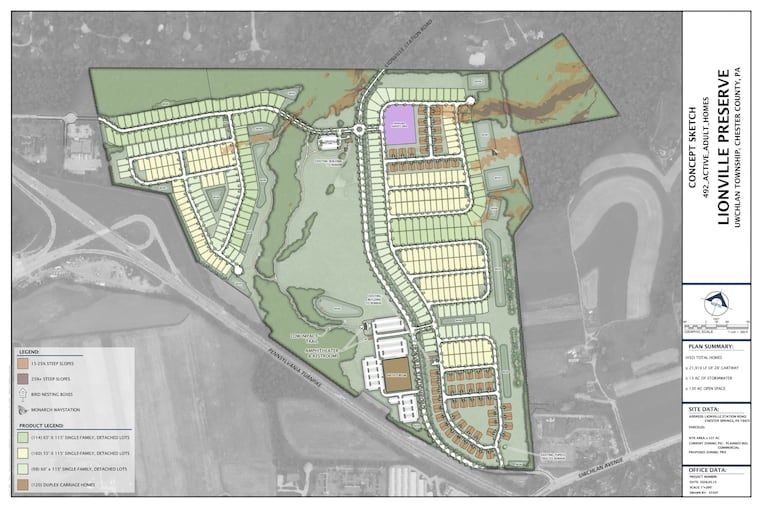
Plans for an age-restricted community with nearly 500 homes on hundreds of acres of open farmland in Uwchlan Township were denied by elected officials this week, who felt the proposal “did not meet the bar” for rezoning the property to include residential.
The township’s three supervisors voted unanimously Wednesday to deny both a zoning amendment that would have allowed for residential development at Lionville Station Road, and a tentative development plan that included about 492 homes, a swimming center, miles of nature trails, a Monarch butterfly way station, and more than 100 acres of open space.
There are elements of the plan that would have served the township well, said board chairperson Laura Obenski, with its focus on recreation, preservation, and residential. But it wasn’t a perfect fit.
“Unfortunately at the end of the day, I think that the burden that was going to be borne by taxpayers of Uwchlan Township did not meet the bar in my head for a rezoning request and I hope that we can revisit those conversations because there are some extraordinary opportunities on the table,” she said.
The denial is a blow for some residents, who rallied together years ago as the group Save Lionville Station Road to fend off plans for industrial development of the 237-acre property. They had worked with the developer, Rockwell Development, to create what they considered a satisfactory residential development proposal. The developer said there were about 112 meetings regarding the project.
Greg Lingo, president of Rockwell, said Friday the board’s decision was “surprising to us, and all the stakeholders that worked so earnestly to develop the low-density active adult residential plan that we all could be proud of.”
“It was helpful for us to now know formally that the Township does not desire to rezone the property and instead would like to see it developed under its current zoning,” he said. “...We anticipate over the next 60 days to be in front of the Township to process the plan that they prefer.”
Downingtown Area School District purchased the land in 2003 for roughly $22 million to build a school campus. The district has sought to sell the property for more than a decade after its request to change the zoning was denied.
After several deals didn’t come to fruition, including what could have become a warehouse complex with an outdoor recreation area that residents opposed, the district in 2024 entered into a sales agreement with Rockwell.
That year, the township tried to open communication between the district and prospective buyers to avoid repeating history: disagreements about zoning, Obenski said.
“I think the rest of this process has followed predictably when there’s not healthy communication with all the stakeholders at the table,” she said.
Still, it’s not a “dead conversation,” she added, saying she “hope[s] we can move forward in a productive way.”
Before the board took its vote, members of Save Lionville Station Road said while they’d prefer it to remain open farmland, they knew that was unlikely. A residential development seemed much more agreeable than a warehouse.
“If this community plan doesn’t go through, we’ll end up with ugly warehouses instead of homes and well-maintained properties,” said resident Bonnie Fertell.
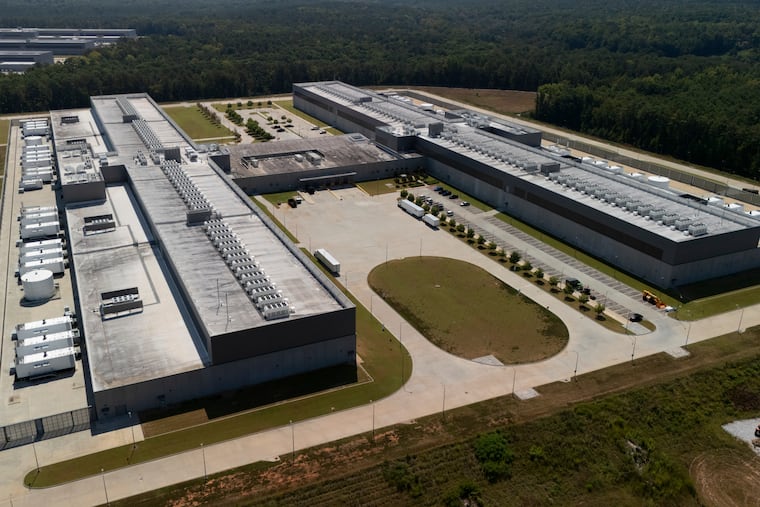
Or, they worried, data centers.
“I have a great concern that we may be opening a Pandora’s box by allowing … the entry into data centers if we don’t go forward with the residential plan,” said resident Christopher Engle.
But it wasn’t enough for the supervisors to greenlight.
“I don’t think there’s enough positive benefit to the township to justify changing our comprehensive plan,” said vice chairperson Bill Miller, saying that while he wasn’t “necessarily fundamentally opposed” to adding homes there, “the density was too much.”
Earlier this year, the township’s planning commission had voted to recommend approval of the project — contingent on axing the natatorium and decreasing the houses in the community.
The traffic the development would create would be “just a nightmare,” Dennis Martin, chairperson of the planning commission, told the board Wednesday. “You don’t have to be a genius to figure all those cars are going to be a problem.”
Traffic was a large concern for other residents, who asked the township to look further into what it could do to preserve the open space. Some residents Wednesday were also opposed to the addition of a natatorium, which proved to be one of the more divisive parts of the plan. It would be used by the community and the Downingtown Area School District for its swim team’s practices and competitions.
Resident Kaitlin Knecht, an assistant swimming coach in the district, advocated for its approval, saying, “It is one thing that we’re missing in this community, and I know that from growing up here.”
Supervisor Larasz Moody was “agnostic” to the natatorium but believed residential development was better than what the alternatives could be.
“I do hope that future discussions will include a residential development that will better fit into the comprehensive plan of our community and that aligns with what we want as residents currently, and certainly what will benefit future residents as well,” she said.
Losing the natatorium in the denial “devastated” Obenski the most, she said.
“I think we have fantastic pieces on the table. They just did not fit together,” she said.

Want to get Inquirer Chester County straight to your inbox every week? Sign up here for our guide to the news, stories, and events shaping life in your community.
This suburban content is produced with support from the Leslie Miller and Richard Worley Foundation and The Lenfest Institute for Journalism. Editorial content is created independently of the project donors. Gifts to support The Inquirer’s high-impact journalism can be made at inquirer.com/donate. A list of Lenfest Institute donors can be found at lenfestinstitute.org/supporters.