Julian Brodsky, a cofounder of Comcast, has died at 93
Mr. Brodsky was described as “an extraordinary leader, a brilliant financial mind, and one of the architects of cable television” by Brian L. Roberts, Comcast's co-CEO and chairman.
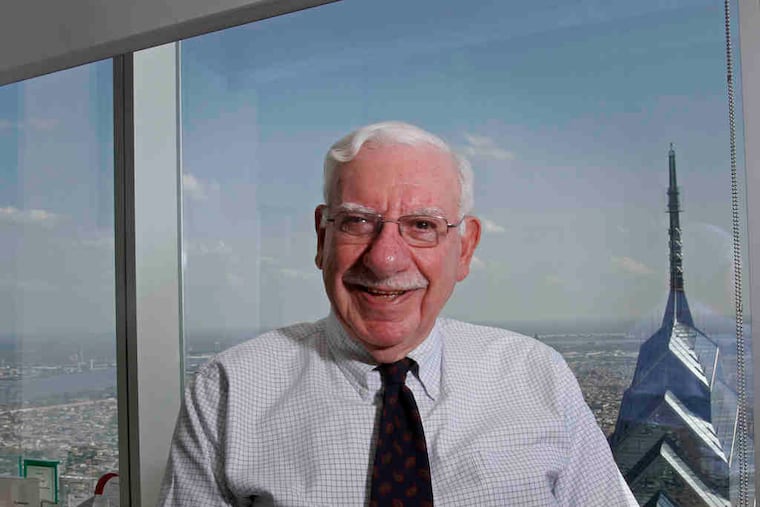
Julian A. Brodsky, 93, of Philadelphia, a cofounder of Comcast who helped grow a tiny cable venture in the Deep South into one of the biggest companies in the country, died Thursday, Nov. 5, while in hospice care.
He passed away peacefully, surrounded by his family, Comcast said.
Mr. Brodsky was described as “an extraordinary leader, a brilliant financial mind, and one of the architects of cable television” by Brian L. Roberts — Comcast’s co-CEO and chairman, whose late father, Ralph, founded the company in the 1960s.
“He was a trusted partner and close friend to my father, Ralph, and someone I was fortunate to learn from and work alongside for so many years,” Roberts said in a statement Friday.
Mr. Brodsky “established a culture of financial integrity, uncompromising standards, and respect for colleagues that remains at the heart of our company today,” Roberts said.
While the elder Roberts was Comcast’s undisputed leader, Ralph credited Mr. Brodsky, an accountant, with much of the company’s success. “We were never short on money when we wanted to grow,” Ralph Roberts said in 2011, calling Mr. Brodsky one of the smartest men he ever met.
What began as a single cable system in Tupelo, Miss., with around 1,200 customers is now a telecommunications and media giant headquartered in Philadelphia, with $124 billion in annual revenue.
“We were lucky, and we were good,” Mr. Brodsky told The Inquirer in 2011. “We never saw a cable company we didn’t like.”
At 6-foot-4, 250 pounds, Brodsky had a commanding presence — “a very powerful figure, both physically and mentally,” John Malone, a billionaire cable and media pioneer, said in a statement Friday.
Mr. Brodsky was Comcast’s longtime chief financial officer and served as vice chairman from 2004 until his retirement in 2011. He was an early advocate at Comcast for focusing attention on the internet and started the company’s venture capital fund in 1999.
Mr. Brodsky was also known as a philanthropist. He served as a trustee at the Philadelphia Museum of Art for almost three decades. Last month, he and his wife, Lois, pledged $20 million to the museum to create a learning and engagement center aimed in part at educating schoolchildren.
“His impact on the Philadelphia Museum of Art will be felt for generations,” Ellen T. Caplan, chair of the museum’s board of trustees, said in a statement.
Mr. Brodsky lived in Philadelphia’s Logan Square neighborhood for the last two years and before that resided in Cherry Hill for 42 years.
The son of a homemaker and Dock Street produce wholesaler, Mr. Brodsky was born in Philadelphia in 1933 and went to Overbrook High School.
When Mr. Brodsky was 17, he told an interviewer, he blocked a shot in a summer-league game by a teenager named Wilt Chamberlain — the future NBA superstar.
Mr. Brodsky graduated from the Wharton School at the University of Pennsylvania in 1956 and served two years in the Army in Alabama. He joined the Philadelphia accounting firm of Adler, Faunce & Leonard — whose clients included Ralph Roberts, an entrepreneur and Navy veteran who at the time owned a belt-manufacturing business.
Mr. Brodsky helped Roberts sell the company. Two years later, in 1963, Roberts bought the community antenna television system in Mississippi.
Mr. Brodsky and Daniel Aaron, a former business writer for the Philadelphia Bulletin, joined Roberts as partners.
“I said, no way you’re doing this without me,’’ Mr. Brodsky recalled in a 1996 interview. “I loved cable and I loved Ralph. What could be better?’’
In the early days, Roberts operated out of a small office in Bala Cynwyd, where Mr. Brodsky used a card table as a desk.
Early on, banks sometimes viewed Comcast with skepticism, but Mr. Brodsky sold them on new financing schemes like low-interest, long-term loans.
With 40,000 cable-TV subscribers, Comcast went public in 1972. Mr. Brodsky played a “central role” in the initial public offering, the company said Friday.
He was “instrumental in financing the company’s expansion, efforts to raise capital, and helped guide major acquisitions that transformed Comcast from a small regional cable operator into an industry leader,” the company said.
Mr. Brodsky was the last remaining Comcast cofounder. Aaron died in 2003, and Roberts in 2015.
Mr. Brodsky is survived by Lois, his wife of 70 years; daughters, Debra, Ellen, and Laura; as well as four grandchildren, one brother, and a niece. A celebration of Mr. Brodsky’s life will be announced at a later date.
Donations can be made in honor of Mr. Brodsky to the Philadelphia Museum of Art, the Barnes Foundation, and the Free Library of Philadelphia.