5th year of gains for Phila. schools
The district's scores rose on state tests, but a third of students still scored below basic in reading and math.
Despite a year marked by a surprise deficit, a rash of serious assaults on teachers, and the loss of its chief executive, the Philadelphia School District showed a fifth consecutive year of test-score gains on the state's standardized reading and math tests, officials announced yesterday before an auditorium of more than 250 principals.
Still, less than half the district's students scored at proficient or advanced on the Pennsylvania System of School Assessment.
And whether the district can maintain improvement while it faces another money crunch - the latest projection is an $80 million deficit this year in the $2.18 billion budget - remains uncertain.
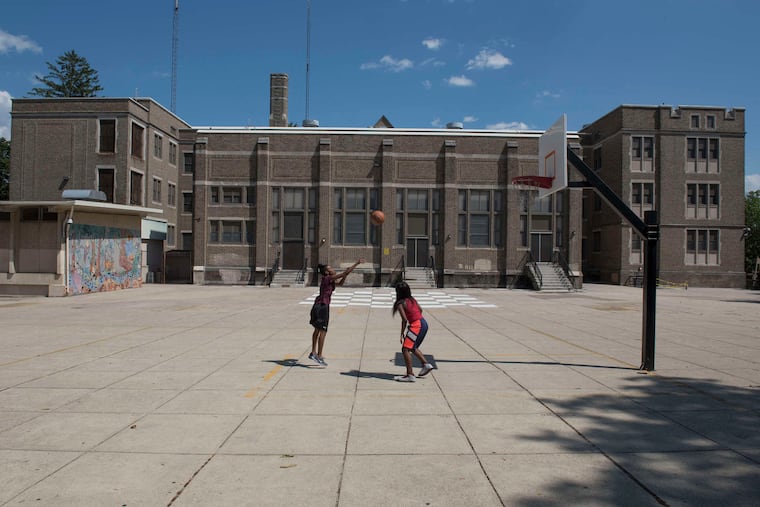
So while the mood was celebratory at the news conference, held at the district's High School of the Future in West Philadelphia, officials said the district still had a long way to go.
Overall, from 2006 to 2007, the percentage of students scoring advanced or proficient rose by three percentage points in math, to 44.9 percent, and 2.5 points in reading, to 40.6. More than a third of students continue to score below basic in reading and math.
"One, two, three, four, five," commission chairman James Nevels said, holding up his fingers in sequence, as he stood at the podium looking out at the principals.
"Who would have thought it? Aren't our kids something?"
He also congratulated and thanked principals.
"Now, how about number six?" he asked.
Thomas Brady, the district's interim chief executive, presented slides showing the district's growth over five years.
"Are we there? No. But take a moment and appreciate the magnitude of that slide," he said, referring to the 16.7-percentage-point increase in reading scores since 2001-02 - the year of the state takeover of the district - and the 25.4-percentage-point increase in math.
In the last year, scores rose at every grade level on the test except for third-grade math, and some improvements were substantial, district officials said. Fourth-grade reading and sixth- and eighth-grade math scores showed particularly strong growth.
District officials declined to speculate on what happened with third-grade math, where scores fell 6.8 percentage points, until they see state results.
And 11th-grade scores climbed for the third consecutive year, a plus for a district that has struggled mightily to instill improvements at the high school level, including adding dozens of smaller, theme-based high schools.
The district did not release the scores of individual schools but plans to do so later this month. The state is also expected to release test results for all schools in Pennsylvania by the end of the month.
Educators say that the results were impressive considering the controversy that arose after a $73.3 million deficit was announced last fall in the district's $2.04 billion budget and the cuts in spending that were made midyear to close the hole.
"Even during an extremely challenging school year, teachers and staff demonstrated just how capable and motivated our students are," said Jerry Jordan, Philadelphia Federation of Teachers president.
"It just means that you can do what you need to do in spite of all these problems," said Ernest Angiolillo, principal of Greenfield School.
The achievement gap persists in the district, although it has continued to narrow between white students and black and Latino students, results show. More than 60 percent of Asian and white students scored advanced or proficient in reading and math in the spring, while 36.3 percent of black students and 33.7 percent of Latino students reached that level.
The minority groups showed strong improvements over the last five years: a 18.5-percentage-point gain for black students; a 15.7-percentage-point gain for Latino students; and a 23-percentage-point jump for Asian students.
The 41 schools managed by outside groups - two universities, two for-profit companies, and two nonprofit companies - also showed growth: 1.7 percentage points in reading and 2.4 percentage points in math.
Collectively, only a quarter of the students in the privately managed schools scored proficient or advanced in reading. The figure was 28.9 percent in math.
The managers were given some of the lowest-performing schools to oversee.
The outside managers are the for-profit Edison Schools Inc. and Victory Schools; the nonprofit Foundations Inc. and Universal Companies; and Temple University and the University of Pennsylvania. Their contracts have been extended for a year, and terms are being negotiated.
The district-run schools posted stronger growth than the outside managers in 2007 compared with 2006, improving by 2.3 percentage points in reading, to 44 percent, and by 2.5 percentage points in math, to 48.3 percent.
Charter schools continued to improve at greater rates than both district-managed schools and those run by the outside providers. They posted gains of four percentage points in reading, to 46.7 percent, and 4.9 percentage points in math, to 45 percent.
The state test is administered annually in reading and math to third through eighth graders and 11th graders.
Asked how much credit former CEO Paul Vallas should get for the gains, Nevels responded: "I would have loved to have him be here today. It is a real tribute to him, but it's also a tribute to the management that he put in place. It's our teachers who are doing it and also principals who are doing it."
Facing criticism over the deficit, Vallas left in June to run the schools in New Orleans.
The School Reform Commission today expects to discuss possible cuts to close the deficit. It plans to act on a proposal next week.