Every Philly school now offers students free breakfast - after classes begin
“By shifting to breakfast after the bell, we removed every barrier standing our students and the nourishment they need in order to fully engage in our instructional program,” one principal said.
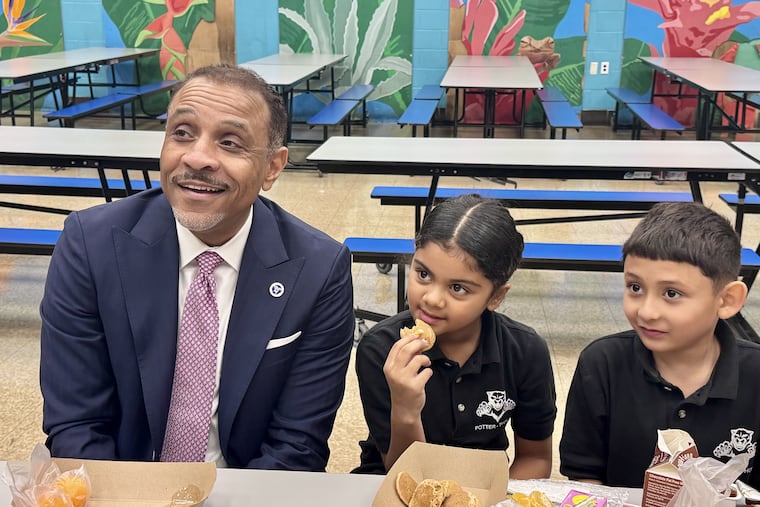
Every Philadelphia student now has access to free breakfast, served after classes begin.
The Philadelphia School District has long been a universal free meal district, meaning all students qualify for free breakfast and lunch, regardless of income or circumstance.
But participation in breakfast especially had been spotty — because of the stigma for some families around accepting free food, and, in many cases, because students didn’t arrive at school early enough to eat before the bell rang.
Superintendent Tony B. Watlington Sr. ordered the change to “Breakfast After the Bell” for all 216 schools this school year. But Principal Nichole Willoughby made the shift at Potter-Thomas Elementary in North Philadelphia last year.
Participation skyrocketed, said Willoughby - 19% of Potter-Thomas students ate breakfast at school prior to the change. Now, nearly 70% do.
“No student is left out,” said Willoughby of the 340-student K-8 school on N. 6th Street.
Watlington, who visited Potter-Thomas Monday morning, said the shift was to ensure students’ basic needs are met. It’s tough to excel at math or reading when you’re hungry, the superintendent said.
“If you get here right when class starts because traffic or bad or it’s raining outside or for some reason — when that stuff happens, we want to make sure that everybody has an opportunity to eat,” said Watlington.
Removing barriers
As the school day began in Room 101 at Potter-Thomas, kindergarteners unwrapped bags of oranges, yogurt, fruit juice and mini French toast bites.
Watlington, folding himself onto a tiny chair, peeled an orange next to a boy wearing a Teenage Mutant Ninja Turtles fleece.
“Do you eat breakfast every morning?” the superintendent asked the boy, who nodded solemnly, concentrating on his peeling.
Willoughby moved breakfast service later voluntarily last year, she said, as a way to expand access.
“By shifting to breakfast after the bell, we removed every barrier standing between our students and the nourishment they need in order to fully engage in our instructional program,” she said.
At first, there was some reluctance, Willoughby said: how would it work? What about the extra classroom trash? But the program got buy in.
Willoughby and other members of her staff began delivering breakfast to classes themselves. Building engineers placed large red trashcans specifically for food trash in every part of the building.
Now, there’s no more pre-school breakfast, Willoughby said. Students regard eating breakfast at school as just part of their day. They might drink milk or eat pancakes while engaging in the morning meeting that starts every day.
Consuming breakfast is not mandatory. If students ate at home, or don’t want what’s being served, they just don’t eat.
Though every school must now offer breakfast after classes begin, the models look different around the district.
Some, like Potter-Thomas, bring bags of breakfast to classrooms. Others have carts stationed at classroom doors in key areas, with students able to grab meals if they so choose, then return to class. In other schools, kids can grab food from carts positioned in hallways.
Lisa Norton, the district’s executive director of food services, said the switch to breakfast after the bell system-wide requires significant logistical coordination, both by in-school food services staff and by district staff.
But, she said, it’s resulted in over 65,000 more meals being served across the district’s 216 schools. Potter-Thomas’ breakfast boost could soon be replicated in other schools, Norton said.
“Almost every student here starts their day with a nutritious breakfast, which sets them up to learn for the rest of the day,” Norton said.