Cheltenham locker-room assaults prompt new Pa. anti-hazing law
School employees will now be required to report suspected hazing to a state child abuse hotline under a law passed in response to the Cheltenham football scandal.

Teachers, coaches, and school administrators who suspect hazing will now be required to report it to law enforcement, under a new law spurred by locker-room assaults on a Cheltenham football player last fall.
The new requirement, which takes effect Jan. 20, closes what lawmakers described as a loophole in Pennsylvania’s mandatory reporting laws, which require people who work with children to reported any suspected child abuse to a state hotline.
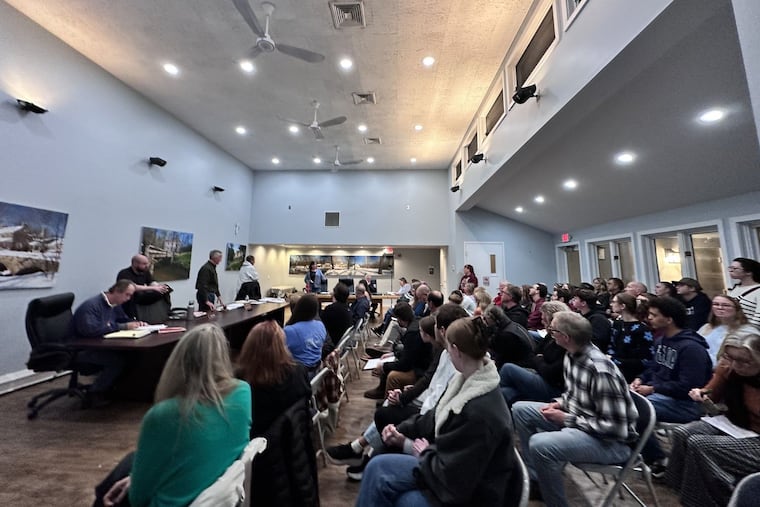
“Looking away is no longer permitted,” Ikysha Dearry, president of the Cheltenham African American Alliance, a parent group, said Tuesday at a news conference hosted by lawmakers and Cheltenham school leaders outside Cheltenham High School.
The change comes after Montgomery County prosecutors in July charged four football coaches and six players in connection with two assaults on a player in August and September 2025 in a high school football locker room.
Prosecutors accused the coaches of trying to cover up the incident by instructing the player not to tell his parents what happened.
Employees at the high school took the head football coach at his word when he denied instructing the player not to report the assault and included him in their investigation, according to a report from a county grand jury faulting the district’s response.
The district did not initially contact police when it learned of an alleged assault in September 2025. But police got involved after a tip later came into ChildLine alleging that a broomstick had been used in the assault.
Had the employees been required to contact the police when they were first notified, “the school administration would not have been able to open and control a biased investigation that was ultimately more concerned with protecting coaches and the institution than protecting a juvenile victim,” the grand jury said in its report.
The grand jury recommended added hazing to the state’s mandatory reporting law.
State Sen. Art Haywood, a Cheltenham Democrat who backed legislation to make that change, said Tuesday that it marked “an important difference in how hazing will be treated across the commonwealth.”
While Cheltenham school officials have voiced support for adding hazing to the mandatory reporting law, the district has also suggested the requirement might not have changed the way it handled the football incident.
Noting hazing’s legal definition in Pennsylvania — conduct for the purpose of initiating, continuing, or enhancing a student’s membership in a group — former Cheltenham Superintendent Brian Scriven said in a response to the grand jury report in July that the components of hazing were “not always immediately recognizable in reports of student-on-student assaults.”
Interim Superintendent Chris McGinley said Tuesday that the new law does not require school employees to determine whether hazing has occurred, only to report suspicions.
“It’s not a matter of making a series of decisions. It’s making one decision: Does this information concern me? Am I concerned about the safety of this child?” McGinley said.
A veteran school administrator, McGinley noted that the law does not apply just to sports, but to all student activities. He cited a hazing incident involving a theater group in another district he previously oversaw.
Employees will be instructed on the new rules as part of state-required mandated reporter training, McGinley said.
In Cheltenham, where the district will also be considering policy changes, all high school students will be undergoing a series of safety trainings, intended to encourage them to speak up about misconduct.
That type of work must now be the focus of Cheltenham and other schools, said State Rep. Napoleon Nelson (D., Montgomery), calling for a change in culture that “we can’t solve with legislation.”
“We must be the community that helps to model for every school district how we make sure that these incidents don’t happen again,” Nelson said Tuesday.