Nine Inch Nails, still driving
Reznor and crew in an intense postmodern spectacle at the Wachovia Center.
Industrial music is about the intersection of man and machine, drawing sonic tropes from the pneumatic wheeze of moving parts, and taking lyrical cues from the existential exigencies of life in a mechanized world. Trent Reznor made it speak to the punkish angst of youth trapped in dead-eyed factory towns at the dawn of the Information Age - and became the new Man in Black.
Twenty years on, Reznor may have lost some of his cultural cachet - Friday night the Wachovia Center was only three-quarters full - but the potency of his art is undiminished. Judging from the recently released
The Slip
, Reznor has lost none of the rage in his machine nor - as the performance confirmed - his intensity or ambition as a live performer with a taste for outsized postmodern spectacle.
The Nine Inch Nails show had three distinct segments: The first was a stripped-down rock band configuration wherein Reznor and company - guitarist Robin Finck, keyboardist Alessandro Cortini, drummer Josh Freese and new bassist Justin Meldal-Johnsen, on loan from Beck - pounded out NIN showpieces such as "Closer" and "March of the Pigs" and new stunners such as "100,000,000" and "Discipline" with a ferocious precision only exacerbated by banks of strobes and a Vegas-like wall of lights.
The second segment found the band hunched over keyboard consoles perched on the lip of the stage and backed by a semitransparent scrim illuminated to look like a giant LED screen, while conjuring up the spectral synth murk of
Ghosts
. This scrim, it must be pointed out, was a thing of wonder - able to do things I could not begin to explain to you, eye-dazzling things that defy the laws of science and logic.
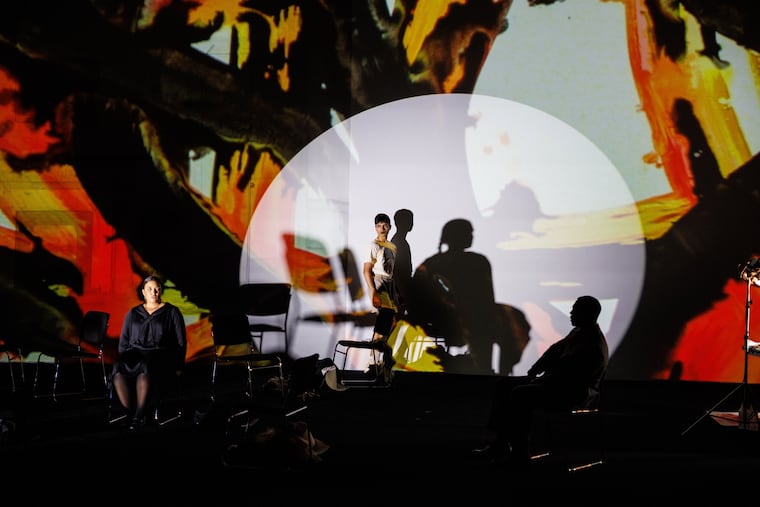
For the third segment, the band members disappeared behind the magical scrim, again taking up guitars and drums. They appeared as fuzzy silhouettes behind a two-story wall of TV static that slowly morphed into a rainstorm during "19 Ghosts III," making it look like the band was performing in a monsoon, and then morphed into an Asian temple tableaux, complementing the oriental percussion of "The Big Come Down."
Fittingly, NIN closed out the set with a ripping spin through "Head Like a Hole," the song that started it all, then returned for a low-key encore that peaked with a mass sing-along of "Hurt," the Reznor-penned song that became a death-bed hit and de facto epitaph for Johnny Cash - a dark gift from one Man in Black to another.