Sadness pervades Albanian's tale
Scenes and themes follow in quick succession in the story of Lula, nanny to a New Jersey boy.
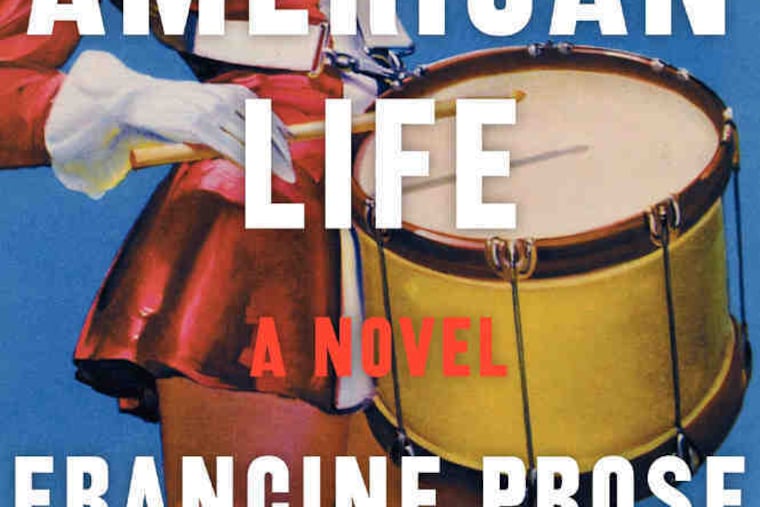
By Francine Prose
Harper. 320 pp. $25.99
nolead ends nolead begins
Reviewed by Susan Balée
If Chelsea Handler had written a novel about an Albanian immigrant working as a nanny in a New Jersey bedroom community, it would sound a lot like
My New American Life
. The joke's the thing, so forget real Albanians here. The audience is American, not foreign, and the point is to skewer our own pretensions by pretending to see them through a foreigner's viewpoint.
Prose, then, gives us Lula, the Albanian orphan working as a waitress at a Mexican restaurant in New York City, her tourist visa about to expire. Suddenly she lucks into a dream job as a nanny for a high school student, Zeke. Zeke's father, a single parent, works in the city and wants someone at the house when Zeke gets back from classes. Someone to feed him dinner and keep him out of trouble. Lula is only too happy to do it, as Zeke's father, Mister Stanley, is both kind and sponsoring her for a green card.
Americans associate Eastern Europe with vampires, but America is the land of endless work and insomnia: "She'd worked for Mister Stanley for almost a year and still had no idea what he did for food and sex. Maybe he was a vampire. Mister Stanley's milky skin was so translucent that, until she tired of it, Lula liked standing where she could see him backlit so that his bat ears glowed like a pair of night lamps."
Zeke, with his dyed-black hair and his gargantuan loneliness, tells Lula he wishes he were a vampire. "Why would you want that?" said Lula . . . . "Because you don't have to live and you don't have to die. It's easy." . . . "Not for a vampire," said Lula."
Zeke's mother abandoned the family on Christmas Eve in his childhood and he has never recovered. Lula muses about Ginger the missing mother, and Prose seems influenced by Broadway's Next to Normal and Charlotte Brontë's Jane Eyre. Scenes from both come to mind in the course of the novel.
In the tragic parody that is life in America, Lula wonders what has happened to her friend Dunia. They worked at La Changita, the mojito joint, until Lula got her nanny job and Dunia disappeared. Lula's fears revolve around sex trafficking. She doesn't know what to do, so she "promised herself not to forget how lucky she was, living her comfy new American life in Mister Stanley's comfy house instead of selling her body to some tuna fishermen in Bari or hiking up her skirt on a service road beside a Sicilian autostrada."
Prose, who seems not to know if she's writing a novel, a comedy sketch or a play, just keeps tossing in scenes. When in doubt, brandish a weapon. This occurs when three Albanian guys show up at Mister Stanley's house and induce Lula to hide a gun for them. Lula, desperate for male company beyond her two American sad sacks, falls for Alvo, the leader of the three. She fantasizes about him and even goes out with him on a couple of dates. He's shady and, Lula concludes, paranoid. That's OK, though. "Paranoia was English for Balkan common sense."
The novel finally arrives at what should be a climax, but the timing is so off, it just seems like a step on an Escher-designed ziggurat. Up and down go the scenes and the themes: immigration and war, Guantanamo and the World Trade Center, haves and have-nots, law and injustice. The one thread that carries through clearly is the one about American teens as a generation of insecure children raised by single or distracted parents. Zeke, like Holden Caulfield, sees the hypocrisy of adults, though he cannot live without them.
The best scenes in the novel follow Zeke, Mister Stanley, and Lula on a college tour at the satirically named Harmonia College. They trail the student tour guide "into the eggy smelling, overheated cafeteria, past the organic salad bar, the troughs of mystery chunks bubbling in thick ochre sauce, the plastic canisters excreting coils of peanut butter. They toured the sunlit art studios where a group of students were spraying newspapers with red paint, then a theater in which another group was painting a backdrop of a red desert crisscrossed with white picket fences which, Bethany explained, was for a production of Our Town set in outer space."
For all his pretended world-weariness, Zeke is just a kid who longs to belong. He is the victim of a practical joke during the college visit that disturbed me more than any of the other tragedies Prose holds up for our ironic laughter. After all, irony is lost on children; they can only feel the hurt.
Sadness pervades the humor here, and perhaps that is the only thing that's really Albanian about this novel.