At the library, all is not lost
Who among us does not mourn something we've lost? "I lost my stuffed lion named Lionie when I was in the hospital. I had him since I was 6 and lost him in the hospital when I was 23 and diagnosed with MS. I am almost 29 now & still think about him every day. Thank you."
Who among us does not mourn something we've lost?
"I lost my stuffed lion named Lionie when I was in the hospital. I had him since I was 6 and lost him in the hospital when I was 23 and diagnosed with MS. I am almost 29 now & still think about him every day. Thank you."
"I left my only memoir of my late uncle, who was more like a father to me than anyone, with an angry ex-GF whom upon breaking up with me destroyed it completely. Mom, Gram Ciernos, Syhrri, I'm sorry . . . Please forgive me."
"I lost my grandmother's aquamarine & gold ring at the beach. I shouldn't of worn it there. We used a metal detector & did St. Anthony but no work."
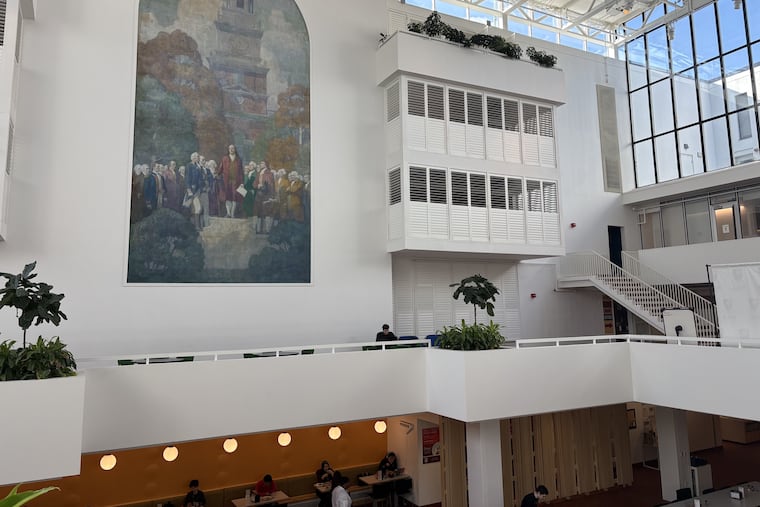
"Submit Your Story" reads the banner over the 4-by-16-foot bulletin board in the HOME Page Cafe at the Central Library of the Free Library of Philadelphia. The invitation, to write about something lost you wish you still had, has elicited dozens of tiny slips of paper containing sad, confessional tales, some with drawings. Among them are those that hint at deep wounds.
"I lost my house. It was all my fault. End of story."
A few draw a smile. "Here's a found object: I just returned a book that was due on DEC 14, 1998. Not my book, but in my house. I feel better already."
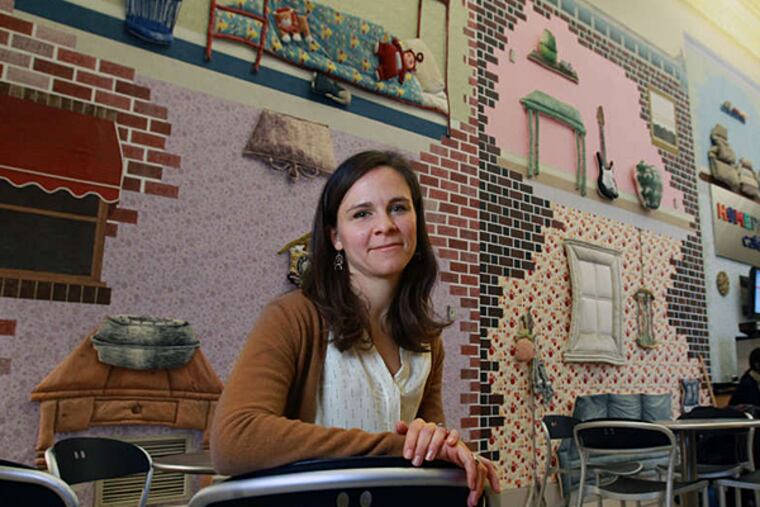
The board is an extension of "Lost and Found," a 1,000-square-foot assemblage of colorful wall coverings and soft fabric sculptures of everyday objects that clings to the opposite wall. Alone, the installation looks like a three-dimensional version of a store catalog from a bygone era. Explained, each piece is freighted with significance.
The long, narrow cafe does not immediately suggest an exhibition space. But when conceptual artist Kay Healy, 31, saw the 22-foot-high walls in late 2012, she says she had a vision. She knew the kind of stories she wanted and how to illustrate them. The wall would be transformed into five rowhouse exteriors splayed open to display 10 rooms showcasing missing objects once held dear.
Loss, she notes, is universal. "We all have loss in our lives, and we all lost something and wish we still had it." For her, it was the childhood home her mother sold, and much that was in it. "I dreamed about it all the time."
Lost objects are freighted with smells, touch, sounds. Says Healy, "I liked the idea of recreating peoples' memories for them."
"When I was 5 my family moved hours away from home. My brother and I each packed a box of our special stuff. My dad packed the pickup truck and put the boxes carefully on top. On the way there the boxes fell off onto the highway." - Johanna
A reproduction of that box of Johanna's is now featured at the library. "It really feels like somebody giving me back the thing that I had lost," she said in a recorded interview on Healy's website, www.kayhealy.com. "I feel like I could open it and find out what the treasures were that were so important when I was 5."
A student of architectural history at Oberlin College before turning to studio art, Healy earned her graduate degree at the University of the Arts. It was important to her that "Lost and Found" involve Philadelphians in all their diversity. The library was the perfect site. "There's no other space in the city I can think of that's as accessible as the library," she says, "all ages, all kinds of people. Everybody comes to the library."
Her previous installation, in Terminal F at Philadelphia International Airport, was titled "Coming Home." It replicated the childhood homes of four Philadelphians, with furniture and appliances that Healy fashioned from fabric, sewed, and then stuffed and hung on a quilted backdrop. Using much the same technique, she focused her library installation on single missing objects.
The library was aboard from the beginning. "Everybody loved the project," says Sandy Horrocks, head of external affairs, "the fact that it's so Philadelphia. I think everybody can sort of see themselves in it."
The Independence Foundation supplied a grant of $10,000. Ursinus College, where Healy teaches, gave $2,000. Another $2,000 came from the Friends of the Library's Print and Picture Collection.
The artist was pleased to learn the HOME Page Cafe is operated by Project HOME, which provides services to formerly homeless people who in many cases had lost everything - people she could interview. Several worked in the cafe. She also collected stories from friends and from those slips of paper now on the board.
When the question was posed to Yvonne Bailey, 50, a 17-year veteran of the streets, she remembered her mother at the stove, flipping flapjacks in a weathered cast iron frying pan, baking corn bread, biscuits, cobblers, and cooking collards you could smell a block away. Said Bailey, "She was from the South and she stayed in the kitchen. I don't know what happened to the pans, but I wish I could make them biscuits. They was so good."
She has looked without success in thrift stores for replacements; now, images of the pans hang on the wall just above her post at the cash register.
Another cafe worker, Dominique "Peak" Johnson, 25, told Healy how red bunk beds transformed his world one Christmas. Until then, he and his younger brother had shared a bed. The bunks represented "freedom." When the family moved, the beds were left, but Johnson hung on to the red ladder. Healy has given him back his bunk beds, on her wall.
Also up there is a clunky blue bicycle. The original wasn't cool, but it had belonged to one writer's father. The writer took it to college - the same college his father had attended, riding the same bike. "One day I came back from astronomy class and the bike was not there. I was devastated. For the rest of my time there I kept looking for it."
Near the bike is the "real royal-looking chair" that a young guy once trash-picked and toted up to the family apartment. "My mother threw it out because she didn't like it. I'm still upset to this day."
For her part, Healy included among the 90 pieces a replica of a clock her uncle made. The real one might be gone, but its rhythmic tick was lodged in her head, the sound track to her homework.
Karen Lightner, head of the library's art and literature departments, says the installation is "something really different for the library, but it really works. People say it makes the space feel homey." And it relates to the library's larger mission of storytelling. "It's just a different kind."
The installation went up in October and will remain until next October. New stories continue to pop up on the board.
"I've lost stuff - now I'm old and I forget what was lost. It's nice."