When Sylvester Stallone was challenged to a ‘five-to-the-head’ in Fishtown and other very Philly gems from ‘The Steps’
The actor's memoir includes several anecdotes of the city where he spent and misspent his teenage years. “The city has a big-time chip on its shoulder," he writes.
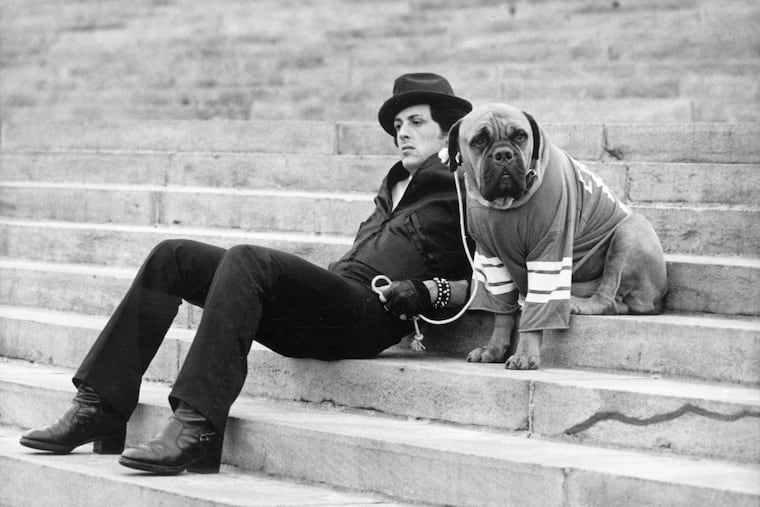
Shortly after it premiered in Los Angeles in November of 1976, Rocky was embraced as an instant American classic. A rebuke to the pervading cynicism of post-Watergate, post-Vietnam America (and American cinema), the movie’s story of a down-on-his-luck boxer overcoming all the odds struck a chord with viewers who wanted to feel good, for a change.
And it made an overnight star of its writer, and lead, Sylvester Stallone.
It’s tempting to view Rocky as a parable of itself.
» READ MORE: The ‘Rocky’ movies ranked, from best to ‘Rocky V’
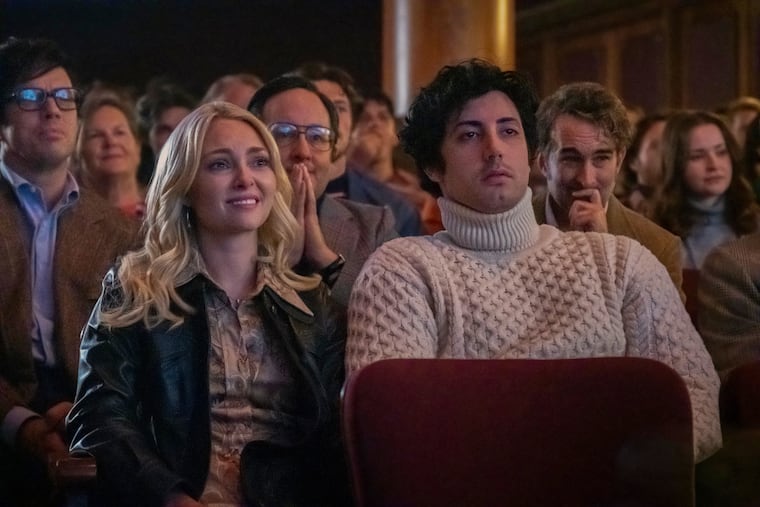
The making of the film is its own underdog story, featuring Stallone’s unlikely ascent from small-time debt collector to Hollywood leading man status. That story is coming to the silver screen, with Peter Farrelly’s new making-of-biopic I Play Rocky. It’s also the core of The Steps, Stallone’s new memoir. It chronicles the actor’s journey from his childhood in New York Hell’s Kitchen to the success of Rocky. Stallone devotes a lot of thought and reflection to Philadelphia, where he spent and misspent, his teenage years, beginning in the early 1960s.
Here are some of the most Philly anecdotes from The Steps:
A very Philly welcome
Most Philadelphia transplants have a “welcome to Philly” memory and Stallone’s was particularly pointed. When he moved to Holme Circle as a teenager to live with his mom, he was immediately greeted by a local toughie named Pat, who immediately proceeded to kick a teenage Sly in the groin. Stallone would get his revenge, years later, after inviting Pat into his mother’s basement, and laying a beat-down on him.
A picture of pre-gentrification Fishtown
Before it was all private equity bagel shops and sidewalks gridlocked with double-wide stroller-wagons, Fishtown was, in Stallone’s words, “a real rough part of the city.” At a school dance in ‘60s Northeast Philly, Stallone was challenged to a game of “five-to-the-head” — described as “a painful game where the first guy who punched or slapped the other guy five times to the head would be declared the winner” — with a gaggle of Fishtown thugs. A foot-chase ensued, which saw the Fishtownies beating down a local priest.
An IQ test at Drexel
As the street-tough anecdotes suggest, Stallone’s teen years were pretty rough; he claims he cycled through a dozen schools by the time he was 16. At one point, the State sent him to the Drexel Institute of Technology for IQ testing. “The tests,” Stallone writes, “revealed that I was smart and dumb at the same time. I had a high IQ for spatial relations and an aptitude for abstract thought, but horrible scores in pragmatic thinking and math.” It was suggested he’d make a fine electrician’s assistant.
Attending Devereux, the school for troubled Youth
Following his IQ testing, Stallone was faced with three options: dropping out of school, moving to Maryland to live with his hairdresser father, or enrolling in “the one school in Pennsylvania still open to me — a school called Devereux.”
Founded in 1918 by Philadelphia schoolteacher Helena Trafford Devereux, the school is credited with minting the phrase “troubled teens.” Stallone found himself completely at ease among misfits and outcasts. It was in Devereux that he began taking strength-training seriously, and also where he developed a lifelong interest in abstract impressionist painting.
Rocky was always from Philly
The historical influence on the Rocky Balboa character is often debated. (After the film became a huge success, New York boxer Chuck Wepner sued Stallone, claiming the story was modeled after his own life.) In his own telling, Stallone claims that the character was modeled after Philadelphia boxers like Joe Frazer, and the city itself.
“Philadelphia is a town of tough, bare-knuckled, working class people who fight for everything they have — including respect,” he writes. “The city has a big-time chip on its shoulder.”
Before ‘Rocky,’ there was ‘Poe’
Before Stallone set to work on his Rocky script — which he legendarily turned around in just three days — he was nurturing another dream project, a biopic of writer and Philly resident Edgar Allan Poe. “I became obsessed with Poe,” Stallone recounts. “I read everything he wrote. I became an unofficial Poe authority. I knew more about him than I knew about anything else on the planet.”
Stallone says he worked through as many as 20 drafts of his Poe screenplay, and received interest from directors like William Friedkin and Roman Polanski. As of this writing, however, Poe remains unproduced.
Stallone insisted on filming ‘Rocky’ in Philly
When the Rocky script was picked up, producer Irwin Winkler tried to persuade Stallone to shoot the film in Beverly Hills. He (mistakenly) believed the toney L.A. country Burroughs could double as Philly. Stallone knew better. “From the very first draft, Rocky took place in Philadelphia,” he writes. “This wasn’t by chance. I grew up there. I knew the city. I understood what it represented.”
Rocky Balboa’s iconic leather jacket came from a North Philly department store
For reasons of both frugality and authenticity, Stallone’s Rocky wardrobe comprised mostly of the actor’s own clothes. This includes the character’s trademark leather jacket, which Stallone bought off the rack at a defunct (and unnamed) North Philly department store when he was 18. In 2015, that same jacket fetched $149,000 at an auction of Hollywood memorabilia.
Philly boos Balboa
There are fewer montages in all of cinema as legendary as Rocky’s training scenes, which sees the character running — sluggishly, at first, and then with mounting speed and purpose — through the streets of Philadelphia. Stallone confessed that the sequence was filmed in scattershot fashion, without proper permitting. And in true Philly style, he was regularly booed by locals as he ran by.
A ‘sacred’ place on the Parkway
Of course, that Rocky training montage climaxes with our hard-luck hero bounding up the 72 stone stairs of the Philadelphia Art Museum. For Stallone, those steps had long been a “sacred place.” As a teenager, when his mom would boot him out of the house, he’d find solace sitting on the Art Museum steps. “I don’t know why the place was so special,” he writes, “maybe it was the fact that when I was very young this was the magical place that transported me to the world I wanted to live in. Little did I know that running up the steps would be the most famous shot in the entire movie, which would ultimately allow me to build the life I wanted to live and the world I wanted to live in.”
“The Steps” is available in digital and physical bookstores all over.