Arguments on both sides of Fumo trial
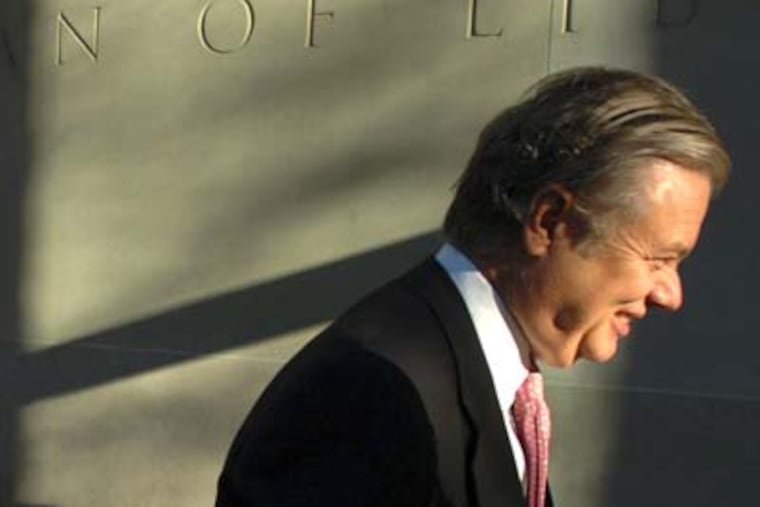
After years of near silence, State Sen. Vincent J. Fumo finally laid out his defense last week to the federal government's sprawling corruption indictment.
After years of near silence, State Sen. Vincent J. Fumo finally laid out his defense last week to the federal government's sprawling corruption indictment.
In the most striking defense argument, Fumo acknowledged that he had received freebies - power tools, consumer goods and much more - from a South Philadelphia neighborhood-improvement charity.
But the defense said Fumo had deserved the gifts from Citizens' Alliance for Better Neighborhoods as thanks for having raised millions for the organization.
"We can't give him a gold Rolex watch for $25,000 because he has a watch," said lawyer Edwin J. Jacobs Jr., who represents former Citizens' Alliance head Ruth Arnao, a Fumo codefendant, at the start of the trial Wednesday.
In their opening statements, defense lawyers did not dispute a lot of the prosecution's factual narrative.
Instead, Fumo's lawyer, Dennis J. Cogan, argued that the case boiled down to a "clash of interpretation" in which the government was trying to convict the Philadelphia Democrat for actions in "gray" areas that were not crimes.
Fumo, 65, and Arnao, 50, his close friend and former top legislative aide, are jointly charged with a $1.4 million fraud of Citizens' Alliance and with trying to cover up their alleged schemes.
Fumo alone faces charges of unlawfully using his Senate staff as personal servants and political operatives - at a cost to taxpayers of $2 million - and with defrauding another nonprofit, a maritime group, by illegally sticking it with the bill for luxury yacht cruises.
John P. Pucci, a former federal prosecutor in Philadelphia who is now a defense lawyer in Massachusetts, said Fumo's approach made tactical sense.
"You're way ahead of the game as a defense lawyer if you can concede, without giving away the case, things the government can definitely prove," Pucci said.
By not staging a fight over the facts, the defense can make a stand on different terrain, he said. It can argue that Fumo and Arnao lacked any criminal intent.
"That gives you an opening to argue . . . [that] much of what they say happened, but it's not a criminal endeavor," Pucci said.
Here is a look at the allegations against Fumo - and his defense, as outlined in detail for the first time in opening statements last week.
nolead begins
Money for a charity - something for Fumo
In the late 1990s, Fumo struck a deal that extracted millions of dollars from Peco Energy in donations to Citizens' Alliance, run by Arnao and set up to improve the senator's Philadelphia district.
Acting both as a Peco customer and as a senator, Fumo asked state regulators to block Peco's business plans of the time.
But he dropped his legal challenge after Peco agreed to freeze electric rates for a decade and, in a secret side deal, make a whopping donation to Citizens' Alliance. Ultimately, Peco gave the group $17 million.
In their opening statements, Cogan and Jacobs readily acknowledged that Fumo had late gotten items from Citizens' Alliance. Prosecutors say the charity paid for, among other things, 3,500 separate Fumo tool purchases worth $100,000.
Cogan put it this way: "He got some consumer goods as compensation in kind."
Jacobs was even more blunt.
"We can call them gifts, favors, comps, perks, compensation," Jacobs said.
"We did it. We felt it was the right thing to do. We felt it was fair. We thought that, if anything, he was entitled to a lot more."
The lawyers noted that fund-raisers for nonprofits often kept a big share of what they raised; Jacobs said a private fund-raiser could have kept as much as 24 percent of Peco's $17 million donation. Fumo received far less than that, Jacobs said.
Asked about this argument last week, Dan Richman, a former federal prosecutor who teaches at Columbia University Law School, said it wouldn't work if the jury decided that taking the gifts was criminal.
"Normally," Richman said, "you don't go far in a criminal case by saying a defendant could have shot two people, but he only shot one."
nolead begins
Alleged fraud on the state Senate
Assistant U.S. Attorney John J. Pease told the jury that Senate employees and taxpayer-paid consultants had cleaned Fumo's house, overseen renovations at his mansion, paid his bills, driven his child home from school, managed his farm, overseen his campaigns - and even investigated his political enemies, his ex-wife, and a former girlfriend.
Pease and his fellow prosecutor, Assistant U.S. Attorney Robert A. Zauzmer, contend such "thievery" helped underwrite a lavish Fumo lifestyle and bolster his political clout.
But when state Senate chief clerk W. Russell Faber took the stand as the government's first witness, Cogan put him through a searching cross-examination - and got him to admit that there are few written rules specifying what Senate workers may or may not do.
"This is really a loosey-goosey thing, kind of murky," Cogan summed up.
And, Cogan said, Fumo was a workaholic, on the job "24/7."
His staff put in equally long hours, Cogan added.
The Senate, he said, "was never shortchanged. If anything, there's a huge credit balance."
nolead begins
Free yacht trips during vacations
The government contends Fumo defrauded the other nonprofit, the Independence Seaport Museum, by using its luxury yachts year after year during his annual vacations at Martha's Vineyard.
For the first time, Fumo explicitly conceded last week that he had used the yachts for free, as the government has alleged. Leasing the boats would have cost Fumo $100,000.
Cogan said, however, that Fumo's guests on the trip had been powerful people whom the senator sought to interest in the museum.
Moreover, Independence Seaport's president approved every trip by Fumo, who was a museum board member.
"There's no fraud here," Cogan said.
nolead begins
A cover-up, or 'business as usual'?
Pease told the jury that the effort to obstruct the investigation had begun once The Inquirer published articles about Citizens' Alliance, and that soon a "systematic effort was put in place" to cleanse computers. That effort, he said, intensified in 2005 as the FBI ratcheted up its investigation.
He told jurors that a former state Senate computer technician, Mark C. Eister, would provide damaging testimony about a conversation with his boss. "He will tell you that he was told by Mr. Fumo to destroy all that e-mail, and all this was done to thwart the FBI," Pease said.
Cogan, however, said it just wasn't so.
He said Fumo had obtained advice from two lawyers before giving his computer staff a green light to remove data from computers.
"They're telling him OK - business as usual," Cogan told the jurors.
In interviews and court papers, however, the two lawyers have disputed any suggestion that they had told Fumo it was OK to destroy computer information.
In any event, Cogan said, Fumo had always been leery of the federal government and had "deep-seated suspicions" about his political opponents.
As a result, Cogan said, Fumo told his staff he wanted a security system "that keeps the federal government out of my business."