Making do, '40s style
A museum, old cookbooks, and our own readers share how thrift and creativity filled home-front bellies during World War II.
When the United States entered World War II, the country's kitchens became ground zero for the war effort on the home front.
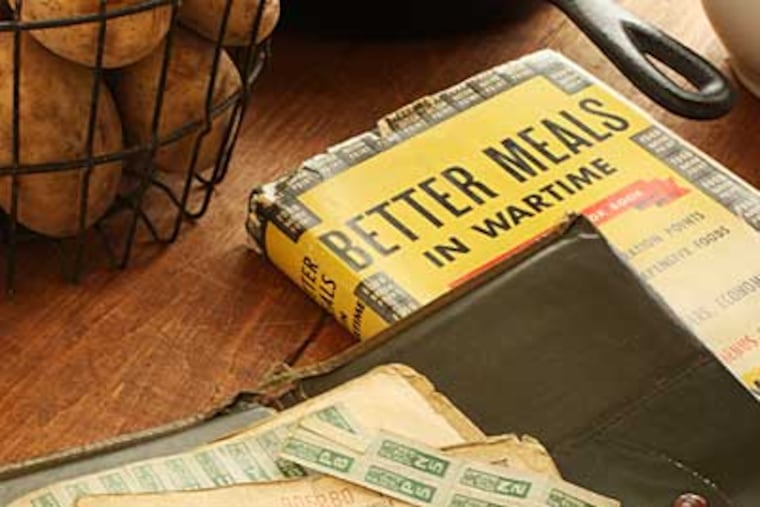
Sugar, cheese, coffee, and meat went to the front lines, and at home, rationing reigned. From about 1942 through 1946, stamps, coupon books, and red, blue, or green tokens were allocated to each individual based on age, height, and weight according to an intricate point system developed by the new government Office of Price Administration.
We can, if it comforts us, look back on those times as the difficult days and imagine that today the economy's impact on the kitchen cupboard is less severe.
But in our own tough times, when home cooking matters more than ever, the National World War II Museum in New Orleans suggests taking a page from our mothers and grandmothers' cookbooks, from the days of backyard victory gardens where fresh and local produce was grown for survival.
In preparation for an online exhibit, "Kitchen Memories," the museum recently put out a call for memories and memorabilia. We passed the word along, and readers in their 80s and 90s (bless their souls) took on the challenge, resurrecting ration coupons, cookbooks, and canning instructions (which we will forward to the museum).
Consider which Depression-era and wartime dishes endured, says Lari Robling, whose 2003 cookbook Endangered Recipes will be released in paperback next month (Stewart, Tabori & Chang Publishers).
We don't have to resurrect recipes for tomato soup, tuna casseroles, or meat loaf, Robling says, because we never stopped making them. These inexpensive meals still symbolize comfort, safety, peace of mind. They are the essence of home.
Many readers said they looked back fondly even at Victory Stew and War Cake. They're proud of their mothers' thriftiness and creativity. And humbled to think of a nation scrimping in union for what was perceived to be a just war.
Dorothy L. Thomas, who grew up in Haddon Heights, remembers her father had plenty of time to tend his victory garden after his work hours were cut. Homegrown corn and apples became corn fritters and apple dumplings for dinner.
"Yes, we were forced to eat 100 percent from our own yard," says Thomas, "but we never went hungry."
Home cooks managed by stretching and substituting, says Robling, who produces A Chef's Table for WHYY. She has updated and refashioned some former favorites such as baked beans made into croquettes and stuffed bell peppers minus the meat, and a buttermilk pie reminiscent of the old Poor Man's Pie (see recipes).
Joyce Bourg, 84 now, says Robling's recipe is similar to the single-crust Pennsylvania Dutch Milk Flotcher Pie her mother made.
"It was delicious," she says.
With sugar in short supply, home cooks relied on honey, molasses, or the juice from beets, carrots, and fresh fruit. Ordinary water left over from boiling potatoes or green beans one day became the basis of soup the next.
Better Meals in Wartime (Crown Publishers, 1943) contained not only a guide to making the most of ration points, but also directions for extending tomato juice by combining one part juice with three parts water left over from cooking vegetables and a bit of lemon.
A quarter pound of butter was doubled by adding water and milk, or stretched with unflavored gelatin and evaporated milk - but not very successfully.
Most homemakers made do with white margarine that came in a block with a bright yellow capsule inside the package. You'd pop the capsule and knead like crazy until you had a blend with the color and consistency of butter, if not the taste. Often this job was relegated to the kids.
Nutrition still mattered, but cookbooks emphasized the filling nature of fats.
Bacon fat and meat trimmings were reused at home and then recycled. Irene Hewitt, 88, says she and her brother used his little red wagon to cart old soup cans full of used fat to the butcher shop, where it would be collected by the government and recycled for munitions.
A tablespoon of fat saved each day would make a pound a month, and a pound from each home would make more than 500 million pounds of gunpowder a year, the government told the nation's housewives.
Whenever protein-rich foods could be found, they were made to last.
If you were lucky enough to get a roast for Sunday supper, Robling says, you'd revisit the meat all week in the form of leftovers. Bits of beef flavored stews and soups, or were mixed with day-old bread and fried as croquettes.
Grandma's Wartime Kitchen (St. Martin's Press, 2000) author Joanne Lamb Hayes says some meat recipes required a heavy dose of imagination.
Emergency Steak, for example, was essentially meat loaf extended with cereal, pressed in the shape of a T-bone steak, and broiled. And Spam, which was not rationed, was disguised as ground beef by grinding it with eggs, rolled oats and rice, and herbs.
There were many Meatless Mondays - times when finely chopped string beans, parsley, basil, thyme, and mayo were combined to make a sandwich spread.
Often, hot dogs and hash took center stage. Eggs were poached, curried, and stuffed au gratin. Baked beans spread on Boston brown bread was a hearty sandwich then and now.
Money was in short supply, too.
"It was a rare treat for us to have a bologna and cheese sandwich," says Barbara Stackhouse, who grew up in Kensington. "You ate bologna or cheese."
Nancy Michelle, 83, who grew up outside Washington, says you felt no shame when everybody scrimped.
"When we went to visit relatives' homes, we had to take our ration books with us so the host could use them to provide food for us."
For Jean Moyer of Medford, now 76, dinner was often just a slice of bread in a bowl with milk and perhaps a sprinkling of sugar.
"But I don't remember it as a sad life," she says. "I had very caring parents. We were just poor."
Florence Pearce, now 88, ate white-bread-and-bacon-grease sandwiches one day a week.
Joyce Bourg, she with the cherished memories of Flotcher Pie, cringes when she remembers her mother's Pennsylvania Dutch Rivel Soup: Beaten eggs mixed with flour to make a thick paste was crumbled in pea-size rivels and dropped into boiling chicken broth.
"Believe me," says Bourg, who grew up in Wernersville, Berks County, "it tasted much worse than it sounds."
"I remember one day turning my nose up and refusing it because it was goopy. And my father told me, 'Well, I was out collecting rents today and I came to one house where they had no food at all for the family, so I gave them 50 cents for bread and milk for the children.' "
"Then I ate the soup," Bourg says. "I got the message. And I loved my father enough to eat it."
Buttermilk Pie
Makes 6 servings
EndTextStartText
2 eggs
1 cup sugar
1 cup buttermilk
1 stick (4 ounces) butter, melted
2 tablespoons flour
1 teaspoon vanilla extract
1 9-inch pie crust
Freshly grated nutmeg for garnish, optional
EndTextStartText
1. Preheat oven to 350 degrees.
2. In a large bowl, beat eggs until smooth. Add sugar, buttermilk, butter, flour, and vanilla. Mix well.
3. Line a 9-inch pie pan with 1 round of unbaked pie crust and pour in filling. Sprinkle with nutmeg if desired.
4. Bake 40 to 45 minutes or until just firm. The filling should be set, but not so firm that it doesn't jiggle a bit in the center.
Per serving: 454 calories, 4 grams protein, 48 grams carbohydrates, 32 grams sugar, 27 grams fat, 111 milligrams cholesterol, 295 milligrams sodium, trace dietary fiber EndText
Neapolitan Stuffed Peppers
Makes 6 servings
EndTextStartText
6 yellow or red bell peppers (about 2 pounds)
6 tablespoons olive oil, divided
2 cloves garlic
1 cup canned chopped tomatoes (or about 2 fresh tomatoes, peeled and seeded)
1/2 cup good black Italian or kalamata olives, pitted and chopped
3 to 4 anchovy fillets, mashed
2 tablespoons capers
1 tablespoon fresh oregano, chopped, plus oregano sprigs for garnish
1/2 pound ditalini (or other small tubular pasta) cooked according to package directions
EndTextStartText
1. Preheat oven to 375 degrees. Slice the tops off the peppers and reserve. Remove seeds and membrane. Set aside.
2. Heat two tablespoons olive oil in a medium skillet. Saute garlic until just golden. Add tomatoes and simmer about 5 minutes. Stir in olives, anchovies, capers, and oregano and mix well. Add pasta and toss well.
3. Stuff peppers with pasta mixture and arrange upright in a shallow baking pan. Put tops back on peppers. Drizzle the remaining 1/4 cup olive oil over the tops. Bake for 50 to 55 minutes or until peppers still hold their shape but are slightly shriveled.
4. Serve warm or at room temperature, garnished with a fresh oregano sprig.
Per serving: 340 calories, 11 grams protein, 38 grams carbohydrates, 7 grams sugar, 17 grams fat, 11 milligrams cholesterol, 347 milligrams sodium, 4 grams dietary fiber EndText
Baked Bean Croquettes
Makes 5 to 6 croquettes
EndTextStartText
1 1/2 cups left-over baked beans or a one-pound can
1 egg beaten with 1 tablespoon water
2 cups panko bread crumbs (or leftover bread, cereal or cracker crumbs)
Oil for frying
EndTextStartText
1. Using a scant quarter cup of beans per croquette, form croquettes into small cylinders, ovals, or rounds.
2. Dip into egg mixture.
3. Coat with bread crumbs and dip into crumbs again.
4. Heat oil to 375 degrees.
5. Fry croquettes a few at a time until lightly golden brown. Drain.
6. Serve with your favorite salsa or white sauce.
Note: Croquettes were a way our grandmothers extended leftovers. Just about any protein (such as salmon or chicken) or vegetable could be rolled into a cylinder. The cylinders are easier to form if beans come straight from the refrigerator. However, if that results in croquettes' being cold in the center, heat the fried croquettes in a 325-degree oven for 10 minutes.
Per serving (based on 6): 212 calories, 9 grams protein, 30 grams carbohydrates, 4 grams sugar, 6 grams fat, 35 milligrams cholesterol, 202 milligrams sodium, 6 grams dietary fiber
EndText