Silent disco: Your own private boogie
As night fell on Abington Art Center, hundreds of guests celebrating the wedding of Shelby and Dan Stamm spread out on the grassy lawn - among the sculptures, on the stage, even in the restrooms - and danced for hours like no one was watching. At the very least, they knew no one was listening.
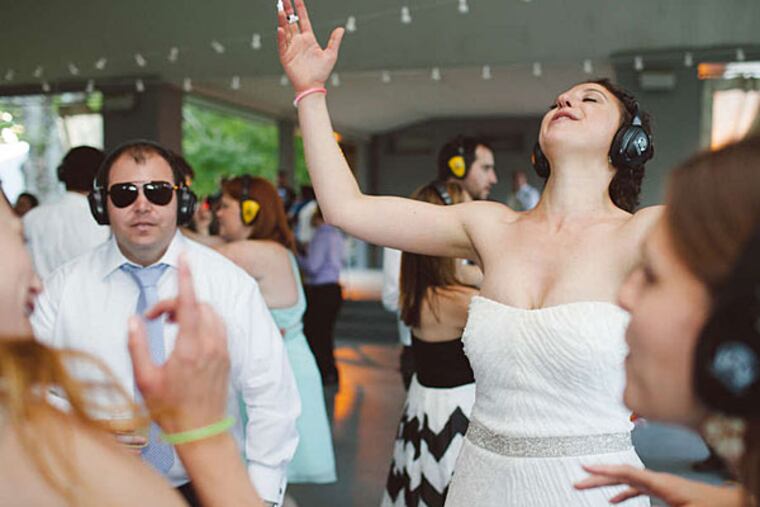
As night fell on Abington Art Center, hundreds of guests celebrating the wedding of Shelby and Dan Stamm spread out on the grassy lawn - among the sculptures, on the stage, even in the restrooms - and danced for hours like no one was watching. At the very least, they knew no one was listening.
This was a silent disco.
Part of a growing phenomenon that started in the U.S. about 10 years ago, the Stamms were hosting a dance with several options of curated music - through headphones. That meant some grooved to Guns N' Roses while others swayed to the Beatles. When Cee-Lo was playing, so was Coolio. In the case of the Stamms' June 1 wedding, the technology also allowed the party to continue long after the area's noise ordinance kicked in, the only outside sounds being heavy breathing and out-of-tune crooning.
Sometimes a lot of out-of-tune crooning.
"I don't know how much the noise ordinance was adhered to when everybody was singing 'Baby Got Back,' " Dan said.
Although different origin stories exist, it seems certain that silent disco comes to the U.S. from across the pond - some say the United Kingdom, while others say the Netherlands. Earliest news reports about the phenomena say it began in 2002.
In 2005, Ryan Dowd was part of a group that enjoyed what is often considered the first Stateside silent disco: at Nashville's Bonnaroo Music and Arts Festival. The technology wasn't perfect - the sound would drop and the quality wasn't great - but Dowd saw potential. He created his own silent disco company, Tennessee-based Silent Events.
"In the beginning, I would try to sell it to people and they would have no idea what I was talking about. They were laughing at it," he said. "Then a year later those people were calling me back."
Countless colleges and universities, including Princeton and Arcadia, and area music festivals, like Bamboozle in Asbury Park and Firefly in Delaware, were early adopters of the technology.
"We'll do freshmen mixers with students from all walks of life, and they like Top 40, hip-hop, country," Dowd said. "We'll broadcast three channels, and you'll have someone listening to Britney Spears and the person next to them is doing a two-step."
The word spread. In 2011, the Oxford English Dictionary added silent disco to its list of words. In 2012, car brand Kia introduced its new Soul during the MTV Video Music Awards with a commercial featuring dancing hamsters enjoying a silent disco. Last month, more than 1,200 headphoned dancers grooved in a Queens park during a three-hour silent disco organized by Lincoln Center, the esteemed performing arts venue better known for offering opera, ballet, and orchestra to the masses.
Now multiple companies are built around organizing silent discos. Among those that Dowd's Silent Events and another company, Philadelphia-based Silent Storm, have arranged: a party for 700 people at the San Francisco Zoo with nary an upset animal, a cruise in New York Harbor around the Statue of Liberty, and a wedding and reception in California's redwood forest where amplified sound was not allowed.
"It's cool to see it go from an underground, kind of rave-y thing that no one knew about to full-on pop-cultural thing," Dowd said. "It's having its moment."
The much improved technology allows for headsets offering multiple channels, either supplied by DJs or on preprepared playlists, with display lights that indicate which channel a user is enjoying. People wanting to host a silent disco also can opt to simply rent the equipment and DJ the music on their own. Silent Storm offers a mobile app that lets one person DJ a silent disco for a group of friends.
There's more traction at weddings for a number of reasons, notes Sarah Thomas, director of business development and public relations for Silent Storm, which has offices on both coasts. Because it's quiet, those who don't want to dance can sit and chat without shouting. Because there are options, different generations can listen to different genres.
"With two channels, you don't have the older crowd running out of the room because Top 40 is playing," Thomas said.
Groom Dan Stamm first encountered silent disco at Bonnaroo in 2005; his wife, Shelby, was introduced to it at private parties in Israel. After enjoying it together at Firefly in 2013, they knew they wanted to incorporate it into their wedding reception.
"It's something that when you look at it from afar, it's 'What are these people doing?' And then you get up close and try it and it's 'Why wasn't I doing that before?' " Dan said.
Keeping things cool with Abington Township was just a bonus.
"Our motivation was just to let our guests have the experience because it's so much fun," Shelby said.
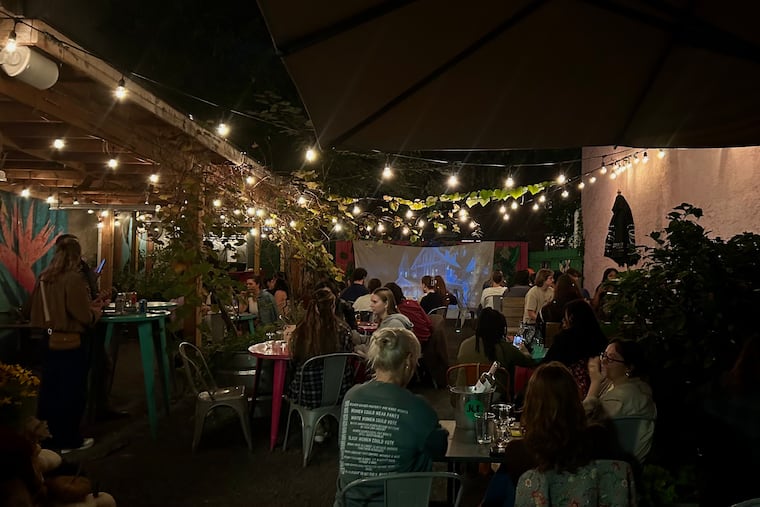
So at 7 p.m., the disc jockey who had entertained the guests with music amplified through speakers plugged into silent disco equipment supplied by Silent Storm. Another DJ, a friend of the Stamms', began spinning his own songs, to be heard on a second channel. With 200 sets of headphones, the couple tutored their guests how to switch channels and adjust the volume.
Then the dancing began, in silence.
"Most people were very skeptical when it started," Shelby said. "And then there were friends who danced for three hours straight. Looking at the pictures, what I love about it is there are so many smiles."