CIRCLE OF LIFE
Former preemie reports for duty
WHEN BABY MELISSA was born 11 weeks premature, she weighed 2 pounds, 6 ounces. She had severe intestinal problems. She wasn't eating. When she fell asleep, she sometimes forgot to breathe.
She came into this world on April 26, 1982, long before the dawn of today's high-tech neonatal care.
Her chances for survival were poor.
Baby Melissa was rushed by ambulance from the hospital in Willingboro, N.J., where she was born to St. Christopher's Hospital for Children on Erie Avenue near Front Street.
Her parents prayed for a miracle.
They got an earth angel named Huffy.
Last July, 25 years after she arrived at St. Christopher's as a
preemie in critical condition, Melissa Wilson walked into the hospital as a healthy young woman.
She reported to Huffy, the nurse who helped save her life - and began her career as a neonatal intensive-care nurse under Huffy's supervision.
Side by side, Wilson and the nurse who saved her will work to rescue the 300 premature babies who arrive at St. Christopher's every year - tiny, underdeveloped, weak, helpless, endangered.
"I always knew I wanted to do pediatric nursing because it's kind of giving back to what was given to me," Wilson said.
"Back then, 25 years ago, that was a lot for me to overcome, being premature and being as sick as I was. My family said I was a miracle child."
Huffy agreed.
This is their story.
When Baby Melissa, newborn at 29 weeks, arrived at St. Christopher's, Mary Anne "Huffy" Hufnagle, a licensed practical nurse, had been at the hospital's neonatal intensive-care unit for seven years, saving preemies with aluminum foil, plastic sandwich wrap, safflower oil, whatever would keep them warm and safe while they fought for their lives.
Huffy has always been part mama lion, fiercely protecting the fragile lives in her care with everything in her, and part pioneer woman, fighting for those lives since the frontier days of neonatal medicine.
"When I first came here, we had no technology but a big, old ventilator and adult-size blood-pressure equipment that made the kids scream because it was painful," said Huffy, who has risen from licensed practical nurse to registered nurse to clinical coordinator in her 32 years at St. Christopher's.
"The Isolettes [incubators] weren't insulated with double walls like they are today, so we wrapped aluminum foil around them to keep the heat in and the babies warm. It was prehistoric. But we saved newborns," Huffy recalled.
Huffy said she and her fellow nurses had to be creative with babies like Melissa, who sometimes stopped breathing in their sleep.
"Every time you opened a porthole in the Isolette to wake the baby and remind her to breathe, you'd lose too much heat and the kid would get cold," Huffy said.
"So you would tie a string to one of their booties and tug on it gently to wake them up when they stopped breathing so they'd remember to start again.
"We had nothing back then to monitor oxygen levels, so we did it by the way the kid looked," Huffy said. "If the kid was staying pink, we'd turn the oxygen down a little. If the kid was turning blue, we'd turn it up."
She remembered when "warming beds," where the babies lay while nurses worked on them, were not draft-free, so "we'd take a diaper box, cut out squares so we could reach the baby inside, and cover the whole thing with Saran Wrap like a tent, because a lot of little preemies can't take any air blowing on them at all."
She remembered when intravenous tubes were too thin to handle lipids - fats for energy and neurological development that preemies needed but didn't have - "so we'd rub safflower oil on the kids' bodies. That's how they got their fats in those days. Some of those kids got so slippery, they slid out of your hands."
She remembered the days when "we'd stick a [rubber] bladder under the kid's mattress and attach the bladder to a ventilator. When you pushed the ventilator button, the bladder would fill with air and pop up, giving the kid a little stimulation. It was like a bouncy seat."
Huffy brought all this nontextbook, make-do knowledge to the bedside of tiny, troubled Baby Melissa in 12-hour shifts.
"She didn't tolerate eating because her bowel had ruptured - just blew up," Huffy recalled.
"In the old days, if they had bad bellies, bad bowels, you couldn't do much with them. Now, we pretty much save every child. We can give the bowels a rest, take parts out, reconnect parts - they'll be fine."
When doctors performed intestinal surgery on Baby Melissa, Huffy said, it was risky.
"Today, we save over 90 percent of the babies," Huffy said. "We have 26-weekers who make it. We have 23-weekers who make it."
A pregnancy of 38 to 42 weeks is considered normal.
"You know they've got to be resilient to come through those canals and be flipped out there and smacked on their butt," she said.
"But we have so many babies who weren't supposed to survive returning here as healthy adults. At our reunions, you stand there shocked that they've all gone home. It's amazing."
Huffy has always had a special place in her heart for the babies who don't go home.
"Those that die were so overwhelmingly sick when they came in, they have used up every system in their body and they just can't fight anymore," she said.
Huffy said that from her earliest days at St. Christopher's, she and her nursing colleagues felt that holding those babies in their final moments was as important as holding the babies who survived.
"I don't care if the kid is off the respirator and on his way to heaven, all those kids need to be held," she said.
But during the normal course of a premature baby's day, Huffy said, too much holding is too much of a good thing.
"The kids don't like over-touching because it overstimulates them," she said. "I remember a kid being so agitated, we had to hold him in a sheepskin. They're like little flowers. Cover them up and leave them in the dark for a while and then let them get some light.
"You can disturb them every three or four hours, which is naturally when they wake up during their sleep cycle. People that are constantly touching babies wouldn't bother their husband or their wife that way, or they'd be hit in the head."
Huffy figured she's taken care of 4,500 babies over 32 years at St. Christopher's.
She's got the down-to-earth warmth of a South Philly waitress asking, "More coffee, hon?" She is openly compassionate toward her tiny charges, whom she always calls "kids," not "babies," as if they're already walking, running, taking risks, driving their parents crazy with fear for their safety - not their survival.
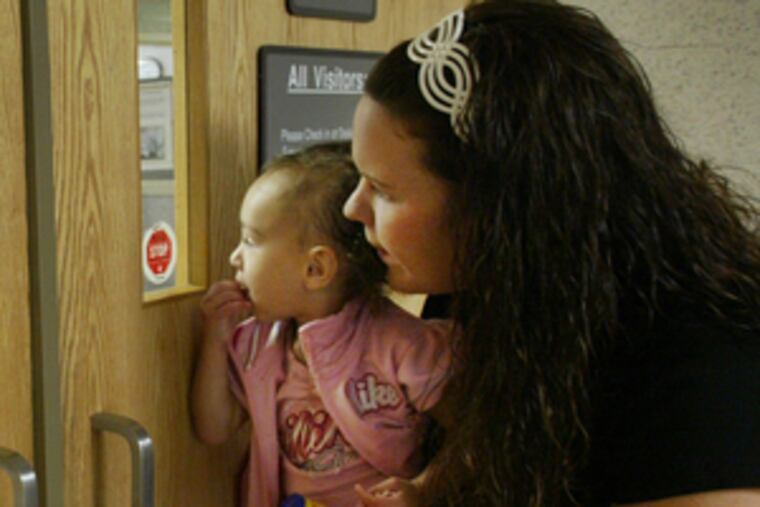
Stephanie Denofa relied on Huffy's homespun honesty after her daughter, Kiera Mary Denofa, was born three months early on Oct. 14, 2005, with the umbilical cord wrapped around her throat, choking her.
The 2-pound baby was rushed to St. Christopher's, where "every day, I sat there and held her, surrounded by all of these other tiny babies hooked up to machines with all of these people working on them whose hands were bigger than the kids," Denofa said, suddenly bursting into tears.
"Every day, the choice seemed to be, 'Do you want to keep your child on these medications or do you want to watch your child die?' And if you decide to keep your child alive, is she going to suffer later on?
"When you are on that roller coaster," Denofa said, "you don't want sugar-coating or false hope. You just want straight answers. You need someone to keep it real. Huffy always kept it real."
Kiera will celebrate her second birthday in October - "skinny as a stick," her mom said, full of energy and fascinated by watching the Phillies.
"Look at her," Denofa said as the bright-eyed, curly-haired little girl gave her mother a huge smile. "She's so fine." The tears came again.
Huffy said she learned compassion from the nuns who raised her at a Scranton orphanage after her mom died when she was 9. She said she briefly considered becoming a nun "but I wasn't holy enough."
At 17, she got her first nursing job - with a veterinarian. "I figured if I could watch dogs get operated on and stand the sight of blood, I could watch people get operated on, too," Huffy said.
"I helped the vet do C-sections. The blood didn't bother me. I figured if I could work with puppies, I could work with kids."
After nursing school at the former Sacred Heart Hospital in Norristown, Huffy came to St. Christopher's in the years when most preemies did not survive.
"I give credit to those nurses because they had their hands on the baby," said Dr. Maria Delivoria-Papadopoulos - called Dr. Delivoria by the staff - who has been saving the lives of preemies since the 1960s and has been St. Christopher's chief of neonatal-perinatal medicine since 1996.
"To be in a neonatal intensive-care unit, you have to be special - and those nurses were," she said.
Delivoria said that at the beginning of her career in 1962, "most babies born prematurely died because they did not have full development of the organs they needed to cope with life.
"If their lungs were underdeveloped, they could not breathe. So most babies born before 36 weeks died within three days."
On Jan. 9, 1963, when she was working in a Toronto hospital, Delivoria remembers "running up 10 stories" to connect a ventilator to the trachea of a premature baby who was struggling to breathe.
"For the first time in this world," Delivoria said proudly, "a premature baby [who couldn't breathe on its own] survived" through inflating the lungs and keeping them oxygenated.
By 1980, Delivoria said, neonatal doctors could save most preemies weighing 2.2 pounds.
Delivoria's respirator skills were honed during a polio epidemic in her native Greece, where "we had to switch from dumb to smart fast because children were dying. We saved some by learning that children had to be made to breathe in order to survive."
Today, she said, most babies born at 28 weeks' gestation develop normally.
"I feel I am the same age I was when I started in 1962 because I still help babies to breathe," Delivoria said.
Melissa Wilson survived because of Delivoria's pioneering techniques and Huffy's triage-driven nursing wisdom.
"I was on a ventilator at St. Christopher's," Wilson said. "My lungs weren't strong enough without it. I spent two and a half months in the hospital. When I went home, Mom had me on a monitor for five or six months. When I stopped breathing, the alarm went off and Mom would wake me up and remind me to breathe.
"Sometimes, it's hard to believe - me being born and having so many complications as a newborn and surviving. It makes me realize you can overcome anything."
Wilson has dedicated her life to helping premature babies overcome the odds. "It is touch and go, day by day, even minute by minute here," she said.
"One minute things can be going fine and the next minute they can be going downhill. I never realized it would be as challenging as it is. I try to stay positive, especially being so new working here, and I hope for the best for every kid."
Wilson says "kid" instead of "baby," just as Huffy, the nurse who helped save her life, has been saying for 32 years - both of them hoping that every preemie they hold and feed and remind to breathe lives to be a
kid. *