As truancy effort ends, parents who powered it hope for revival
Eight months pregnant with twins, Zaira Gonzales still makes her way through the beat-up streets of North Philadelphia to the homes of wayward youth.
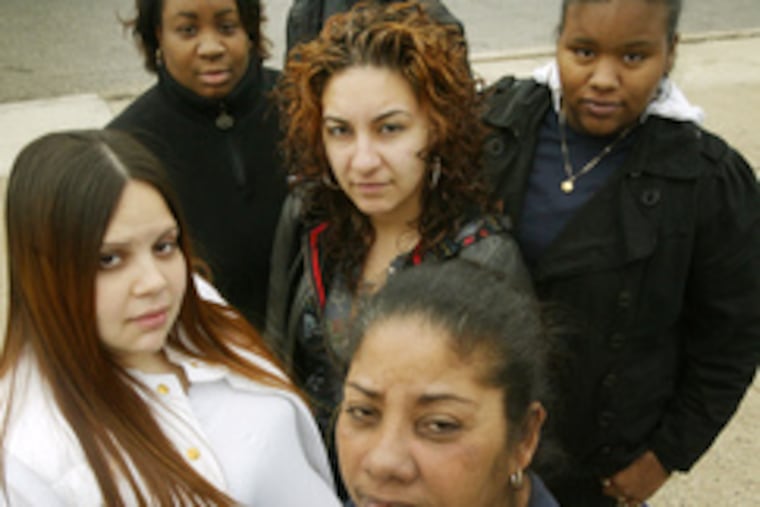
Eight months pregnant with twins, Zaira Gonzales still makes her way through the beat-up streets of North Philadelphia to the homes of wayward youth.
As a parent truant officer, she meets with parents to find out why their children are not in school. Often, Gonzales said, it's as hard to find the parents as it is to find the kids.
"Some of these parents, we have to go far to track them down - we have to go miles. And I do track them down," she said.
Gonzalez, 25, estimated that she has visited 300 homes this school year, convincing most of those students to return to school.
But on Feb. 29, Gonzales will be retiring her truant-tracking shoes.
That's because Philadelphia Safe and Sound, the city-funded, nonprofit agency that manages the anti-truancy program, has been told by Mayor Nutter to cut its budget by $21 million. The agency was expecting to have a $75 million budget this fiscal year.
Along with eliminating the 300 parent truant officer jobs, Safe and Sound is also shutting down 10 Beacon after-school/community programs and 45 other after-school programs, said Anne Shenberger, Safe and Sound president and chief executive officer.
The after-school programs serve 800 children and the parent officers have made 10,917 home visits since September, said Mary-Anne Smith, a Safe and Sound spokeswoman.
"It's a difficult situation to be in. Nobody likes to cut programs, but it's important for the mayor to put the fiscal stability of the city first," Shenberger said last week. "We certainly understand the reason for this."
Nutter spokesman Doug Oliver said the cuts had to be made because former Mayor John Street inappropriately shifted $21 million to Safe and Sound from the city's Department of Human Services in the closing days of his administration.
Street pulled the money from 200 social service organizations serving more than 14,000 children in foster care and related programs. Providing these services, Oliver said, is mandatory.
"The law says that you must fund these programs and that is the underlying reason that we are saying that this money never existed [for Safe and Sound], because of where it came from," he said.
"There are 14,000 children being protected by putting that money back," he said.
Nutter is expected to hold a news conference tomorrow to shed more light on the budget cuts, which caught parents and the parent truant officers off guard.
On Thursday at 2 p.m., City Council will hold a hearing to probe Safe and Sounds' spending and operations.
Gonzales and her fellow parent truant officers are hoping that between Nutter and City Council the funding will be found to save their jobs - and the children whose homes they visit.
"To them I would say, if you can find a way to put out money for police officers, you can find a way to put out money for us to help the schools. We're helping to keep the kids off the streets," said Maria Norales, 31, who has visited nearly 400 homes this year.
Norales, like most of the 300 parent truant officers, is a low-income single mother who learned of the job through a welfare-to-work program. The parents work five days a week, five hours a day, canvasing some of Philadelphia's most dangerous streets.
"When they see the cops out there, the cops are waving at them. The cops are saying, 'These are real troopers. They're right there with us,'" said Gilbert Rodriguez, who supervises a group of parent truant officers for one of the many community agencies that have soon-to-end contracts with Safe and Sound.
Margarita Nieves, 20, a mother of two, has already started looking for another job, with a heavy heart.
"I think it's unfair. Not only to us, the employees, but to the parents, to the schools, to the kids and everybody that we helped," said Nieves, a graduate of Lincoln High School.
"The community liked us around. They felt a little safer that they had somebody out there doing something in the rain, sleet and snow," Nieves added.
Former Philadelphia School District CEO Paul Vallas created the parent truant program in 2002 and funded it with school money. At one point, there were nearly 400 parent officers funded by the district, but budget cuts have eroded that number to under 80.
Last year, Street, citing the need to get children back in school, committed city funds that went to Safe and Sound to hire 400 parent officers. As of this month, 300 remain - until Feb. 29.
Sylvia Perez, 21, who takes nursing courses at Community College of Philadelphia, said she fell in love with her job because it allows her to work with elementary school children.
"I feel really sad because we're like the first warning to the parents," she said. "It's sad to know that parents will not have that warning about what could occur if they don't send their child to school."
While Nutter has questioned the effectiveness of the parent truant officers, Shenberger of Safe and Sound said the program was too new to her agency to have been assessed fully.
Fernando Gallard, a school district spokesman, said of the district's remaining parent officers: "We have seen that where PTOs are part of an extensive outreach effort they do make a difference in bringing students back." *