Detours, detours: Community wants a better bridge
THE 85-YEAR-OLD South Street Bridge has endured its final winter. The vital but dilapidated span connecting Center City with University City is to be torn down as early as August, interrupting the regular flow of urban life for 18 months or more. And many neighborhood groups are unhappy about its proposed successor.
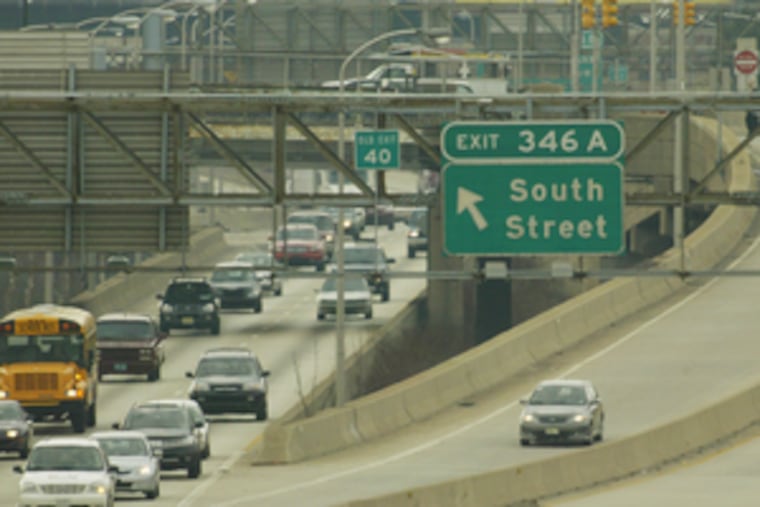
THE 85-YEAR-OLD South Street Bridge has endured its final winter.
The vital but dilapidated span connecting Center City with University City is to be torn down as early as August, interrupting the regular flow of urban life for 18 months or more. And many neighborhood groups are unhappy about its proposed successor.
"The bridge is falling down, it needs to be replaced - nobody is debating that," said James Campbell, a leader of the South Street Bridge Coalition. "The real question becomes one of pedestrian safety and an appropriate image for the bridge.
"Here, we're doing a highway overpass with highway lighting. That's not an urban boulevard, and it's not civil."
But concerns about the bridge project are not confined to pedestrian safety and architectural aesthetics.
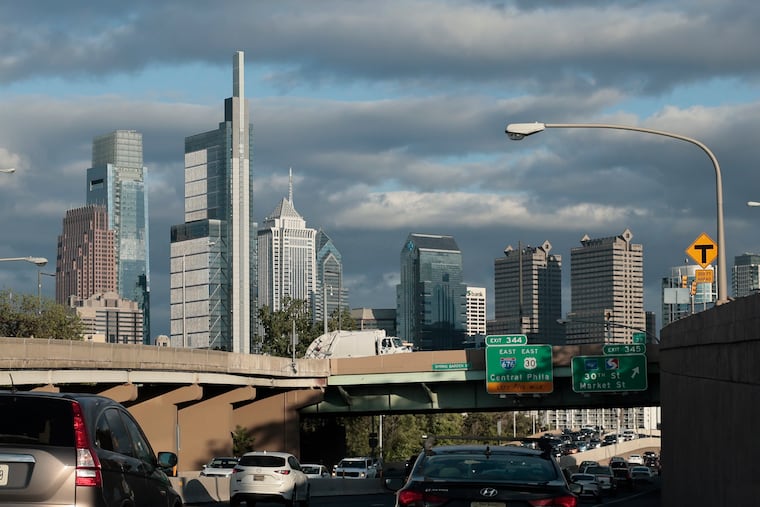
Authorities and civic groups say the proposed construction does not address the most dangerous aspect of the bridge: left-lane merges onto both sides of the Schuylkill Expressway.
"The left-lane merge of the South Street interchange ramp to the Schuylkill Expressway is the location of a significantly higher number of accidents compared to others between South and Spring Garden streets," a 2007 PennDOT report says.
From 2001 through 2006, the left-lane merge points leading onto the expressway - Interstate 76 - from South Street were the sites of 102 accidents, and the ramps leading onto South Street from the expressway were the sites of an additional 45, PennDOT's statistics show. By contrast, during the same period, expressway interchanges at 30th Street and at Spring Garden Street had 11 and 24 accidents, respectively.
But city officials have told the bridge coalition that redesigning or relocating the South Street ramps is not an option.
"The ramps are going to stay, and there is nothing we can do about it," Campbell said. "We have been specifically told that this is off the table."
The PennDOT report says that adding ramp alterations would almost double the cost of the $52 million project and would delay its completion "by several years."
State police, who took over patrolling the expressway in May 2007, declined to comment on traffic conditions at the bridge.
13 years in planning
Campbell and other activists formed the bridge coalition last summer to organize community response to the Streets Department's largest and most complex bridge-construction project.
The project, in planning since 1995, would close the entire bridge, from 27th Street to Convention Avenue, for 18 to 20 months, said David Perri, the department's chief engineer.
The bridge is more than 2,000 feet long, and crosses rail lines on both sides of the river. It connects to I-76 with on- and off-ramps and to the University of Pennsylvania's Hollenback Hall.
The proposed bridge would be built on existing girders that support the structure, but would be expanded from four narrow traffic lanes to five lanes. The new bridge also would have bicycle lanes and 9-foot sidewalks on the north and south sides and pedestrian overlook towers wrapped in stainless-steel mesh.
A pedestrian ramp designed by the Schuylkill River Development Corp. would be built on the north side of the bridge, and a stairway would be built on the south side leading to the Schuylkill River trail and park.
Jessie Frisby, president of the South Street West Business Association and owner of Jessie's Ladies Shop on South Street, said businesses on the street would struggle while the bridge is out of commission.
"I'm happy about the bridge, but there is pain in growth," she said. "Now I'm wondering how much longer we can hold out and how we can get funding to help the businesses. This is a crisis for us as business people. Two years is going to be a long time for us."
Joseph Syrnick, president of the Schuylkill River Development Corp., said the closure would be tough for anyone who uses the bridge regularly.
"I think it's going to be a nightmare," said Syrnick, a former chief engineer and surveyor in the Streets Department. "We're silly to think that it's going to be anything but a major inconvenience."
Perri agreed that the closure would greatly inconvenience travelers, but said that the city has instituted a $5 million detour route and traffic-signal-improvement project, which includes posted detour signs and remote traffic-signal controls that can be changed to adapt to traffic patterns.
The new signals are being installed on Market Street from 17th to 38th, on Chestnut and Walnut streets from Schuylkill Avenue to 38th Street, and on 38th Street from Spruce to Market.
Syrnick commended the city for contracting with the architecture firm H2L2, which traces its beginnings to Philadelphia architect Paul Cret, who designed the Rodin Museum and the Benjamin Franklin Bridge in Philadelphia and the Duke Ellington Bridge in Washington, D.C.
Syrnick said that although he's unhappy with some of the design, the city did a good job overall.
"Do I wish the sidewalks would be wider?" asked Syrnick. "Sure. Do I want the bikes to be at a safe space? Sure. I think that the city did the best they could do to accommodate all of those things."
At least, he said, the proposed bridge would have a unique look.
"I think it would be a very different look than what was there before," Syrnick said. "I don't think it would look like any of the city bridges. Having said that, I think it would look very sharp in contrast with the rest of the city."
A community meeting
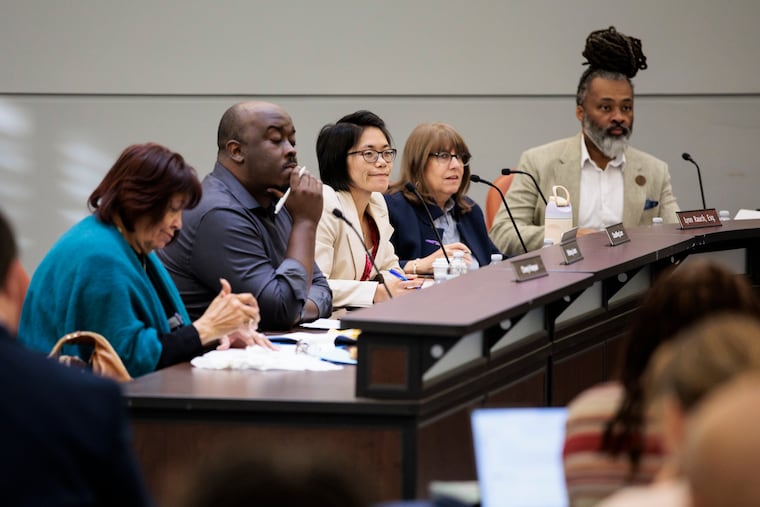
Last Saturday, about 75 community activists gathered at the Philadelphia School, at 25th and Lombard streets, to discuss changes they would like to see in the city's bridge plan.
Also at the meeting, organized by the bridge coalition, were Perri and Charles Denny, the Streets Department's chief traffic engineer.
Perri said that 80 percent of the funding for the project would come from the federal level, 15 percent from the state and about 5 percent from Philadelphia, giving the city a $2.7 million investment in the construction.
The funding makes the process longer and more complicated because of federal and state standards, Perri said. He expects to start advertising for bids in April and said he is anxious to start construction because the bridge cannot survive another winter.
Attendees' greatest concern was proposed pedestrian crosswalks at the ramps to I-76 and the lack of crosswalks at the pedestrian ramp and stairway leading to Schuylkill River Park.
"The biggest issue is to have a pedestrian-friendly, cyclist-friendly intersection at the ramp and the stair. Right now, there's no crosswalk there," said Perry Benson, an architect and board member of the Schuylkill River Park Alliance, who lives on Naudain Street near 22nd.
Perri called the crosswalk and potential stoplight at the ramp and stairway a "leading candidate" for revision in the plan. He assured attendees that the I-76 crosswalk would have separate pedestrian cross times with a visible timer so pedestrians can see when the light will change.
Richard Huffman, an architect, told attendees that bicycle traffic had increased by 58 percent since planning for the bridge began in 1995. He said the proposed bridge does not balance the needs of drivers, cyclists and pedestrians.
Alex Doty, executive director of the Bicycle Coalition of Greater Philadelphia, agreed.
"We're happy that, unlike when the Walnut and Chestnut Street bridges were put in, there's a bike lane planned in this bridge," Doty said. "I think if this bridge were to be designed today, you'd see something much different out of the city, particularly out of the Nutter administration."
Huffman said the proposal to replace the asphalt deck with concrete would make the road noisier and give drivers the impression that they are still on the highway, leading to increased speeds.
Mary Mullins, a University of Pennsylvania faculty member who lives on 26th Street near Lombard, says that cars already are traveling too fast on the bridge.
"I walk and I bike. I often feel like I take my life into my hands when I bike across the bridge," Mullins said. "The cars come right off the highway and still think they're on the highway."
Emlen Smith, a Penn grad student who lives on Catherine Street, said he's hopeful that the bridge will be closed for as short a time as possible.
"I don't have a car, so I'm always walking across," he said, while walking east on the bridge. "I wouldn't want it to be closed for any extended period of time. That's the main thing for me."
Huffman said that the city's historical and art commissions had both signed off on the project, and that the University of Pennsylvania also had approved the design.
But many attendees questioned Penn's absence from the meeting. Penn spokesman Ron Ozio said in an interview that the university had no official position on the bridge project.
In any case, some issues are no longer negotiable, the Streets Department's Perri said.
"I have to keep this on schedule and keep it on budget," he said. "That's an absolute, and I can't compromise on that position."