Weekend heat kills 2 older women as city bakes
As a heat wave gripping Philadelphia and the Mid-Atlantic stretched into a third day, city health officials said Saturday that there had been two heat-related fatalities, both of them older women suffering from cardiovascular disease.
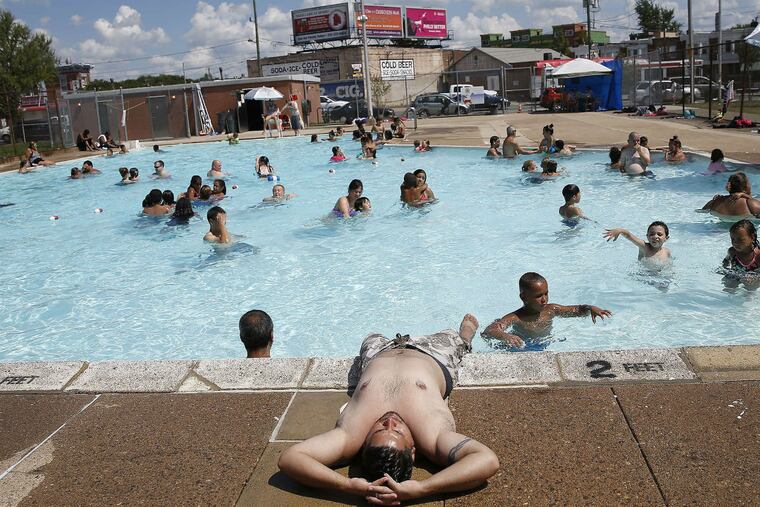
As a heat wave gripping Philadelphia and the Mid-Atlantic stretched into a third day, city health officials said Saturday that there had been two heat-related fatalities, both of them older women suffering from cardiovascular disease.
The city, along with the National Weather Service, extended its heat warning through Sunday evening and urged pregnant women, the elderly, and children at risk to avoid strenuous activities and working or playing in the hot sun.
The two heat-related deaths, of a 67-year-old woman from Brewerytown and a 82-year-old woman from the Port Richmond area, brought the total number of heat-induced fatalities in Philadelphia this summer to six, according to the city's Department of Public Health.
As temperatures remained in the mid- to high 90s, city residents were forced to take various precautions to keep the heat at bay, or, if trips were needed out into the sweltering cauldron that the city had become, help them cope.
Weather forecasters said Saturday there was no prospect for relief until Monday or Tuesday, when daytime temperatures were expected to drop back into the low 90s as cooler weather moves in from the northwest. Until then, the weather service said, periodic thundershowers might bring brief periods of lower temperatures.
The weather service also warned of the "moderate risk" of weekend riptides along the Jersey Shore from north of Atlantic City south to Cape May, and along the Delaware coast.
Because of the heat, organizers of the Philly Mayor's Cup running events Saturday moved up morning start times for various races.
"In spite of some really tough conditions, the runners did great today," said the race's chief operating officer, Johanna Goode. "We are lucky to have had a lot of experienced runners; collectively, they did a great job hydrating and recognizing when they needed to slow down or drop from a race early."
'Not well'
Others chose a more low-key approach.
"Sweat" was the one-word answer Mark Nixon gave at the apex of afternoon heat, when asked how he was coping.
Nixon, from rural Cumberland County, Md., is in town to work on a construction job in West Philadelphia. But the renovation job was shut down midday Saturday once the thermometer hit 97.
"I'm trying to stay out of it," said Marie Turner, of North Plainfield, N.J., as she walked down Eighth Street toward Market. Turner was in town to apply for a job accompanied by her mother, Glenda Turner, but said she planned to stay inside once she got home.
"Not well," Katie Greaves said when asked how she was handling the heat. Greaves was visiting Philadelphia with a friend, Kelly Quigley, for an overnight stay. The heat was taking some of the fun out of it, but they soldiered on, planning a visit to SugarHouse Casino later in the afternoon.
Even the animal kingdom felt compelled to institute special coping mechanisms.
Bob Schoelkopf, founder and director of the Marine Mammal Stranding Center in Brigantine, said much higher ocean temperatures were causing sea turtles to move closer to shore, following small crabs, jellyfish, and other food.
"Their food is more plentiful in the shallow water now," Schoelkopf said.
Greenish Kemp's ridley turtles the size of dinner trays, loggerheads weighing a couple of hundred pounds, and half-ton leatherbacks have been spotted by recreational boaters and by sightseeing and whale-watching boats off Cape May, some as close as a few hundred yards out, which is unusual, he added.
Turtles have been spotted a quarter-mile off Atlantic City, which is also closer than usual. Loggerheads are fond of whelk, the conchlike crustaceans with the tapered spiral shells beloved by beachcombers.
Fisheries observers have blamed warmer waters in recent years for driving lobsters away from southern New England - while populations off Maine have reached record levels, though researchers question whether the popular crustaceans have been reproducing fast enough to prevent the population from crashing.
Cooler climes
Not every part of the country, nor even the East Coast, was smothered by stifling heat. Indeed, most of the country, except for portions of the Southwest, enjoyed lower temperatures.
National Weather Service data show the New York-Philadelphia-Washington metropolis has been an island of higher heat, with daytime highs approaching 100 this weekend - compared with highs in the 80s, not just to the north in New England and the mountain resorts of Pennsylvania and New York, but also to the south, in typically sultry South Carolina and Georgia.
In Philadelphia, the weather service said that heat-index levels, a measure of the combined severity of heat and humidity, would read from 107 to 112 on Saturday and from 102 to 107 on Sunday. Overnight lows both days were expected to be about 80 degrees.
215-854-5957@cmondics