Atlantic County installs world’s first commercial microplastic filtration system
The silicon-filters capture nano and microplastics ranging from sub-millimeter in length up to about the size of a grain of rice.
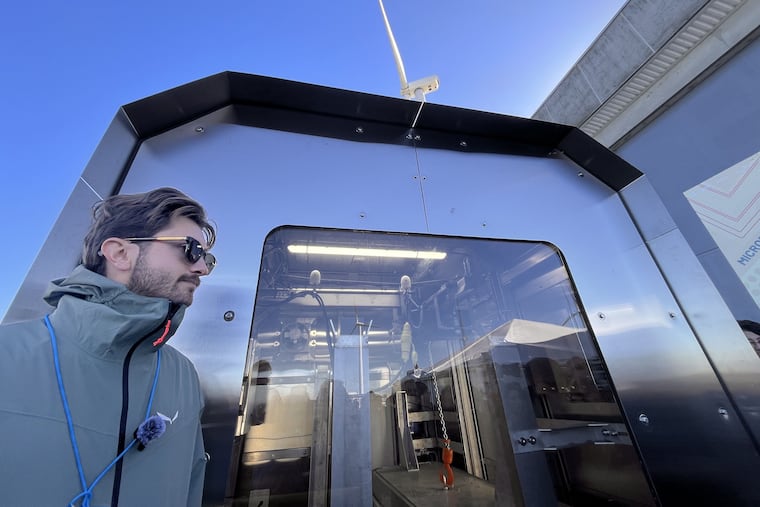
Winds whipped as a team from PolyGone Systems demonstrated what they and their Atlantic County partners say is the world’s first permanent installation of a machine designed to intercept microplastics at wastewater treatment plants.
In this case, they trap the particles before they reach the ocean.
Windmills, driven by those same winds, towered over the team’s stainless steel pod perched at the edge of the Atlantic County Utilities Authority’s (ACUA) wastewater treatment plant in Atlantic City.
Inside the chamber, known as a PolyPod, manifolds clutching specialized filters dropped into water below, attracting microplastics before they are released into the nearby Atlantic Ocean.
“Underneath that very simple, sleek design, there’s layers of engineering work,” said Yidian Liu, one of PolyGone’s founders.
The ACUA was a pioneer with its land-based windmills installed two decades ago to generate power.
» READ MORE: Once opposed, A.C. wind farm has become a landmark 20 years later
The authority believes it is at the forefront again by installing the microplastics removal system in partnership with PolyGone Systems, which was founded in 2021 by Princeton University graduates Liu and Nathaniel Banks.
From pilot to program
Matthew DeNafo, president of the ACUA, said PolyGone had sent letters several years ago to treatment facilities about what it was trying to accomplish.
The ACUA was one of the only organizations that responded positively and began a pilot project with PolyGone in 2024.
That pilot project captured 580 million plastic particles a year from a facility that processes 40 million gallons of water per day, according to the ACUA.
Tuesday marked the announcement that the pilot had moved into a full-time operation.
The ACUA says the system will safeguard water quality for over 200,000 residents, beach visitors, and marine ecosystems along the New Jersey coast.
Simple design
DeNafo praised the unit’s simplicity.
“This is really a self-contained unit passive where we’re not having to pump anything,” DeNafo said. “We’re not having to worry about a lot of moving parts.”
The PolyPod is an enclosed filtration system built with silicon-carbon filters that attract microplastics — less than a grain of rice long — before they can make their way into the nearby Atlantic Ocean.
The project was funded by a $2 million loan with principal forgiveness from the New Jersey Infrastructure Bank to improve water quality.
The pod’s minimalist design stands out against the large concrete building and open tanks that filter out other contaminants and treat the water with chlorine.
It represents the final filtering before treated wastewater is released into a holding pond before eventually being released into the ocean.
» READ MORE: ‘Forever chemicals’ found in nearly all waterways of Philly, its suburbs, and South Jersey
Yueyu Yao, lead scientist for PolyGone, said the filters are silicon based. They are designed to attract microplastics, unlike filters using carbon, mesh, or sand.
“That’s how we’re able to get the smallest microplastics,” Yao said.
She said the filters are capable of capturing 98% of microplastics, but the team will monitor the ACUA project to see what it captures.
How it works
Ariel Blumenberg, an electrical engineer at PolyGone, explained that the PolyPod works essentially like this:
The automated unit, housed in weatherproof-stainless steel, sits directly over water flowing from the treatment facility into the holding pond, without requiring complex piping.
Water flows naturally through the system, as a four-layer manifold drops the filter down into the wastewater flow.
The silicon-filters capture nano and microplastics ranging from submillimeter in length up to about 5 mm, or the size of a grain of rice.
An automated winch hoists up the filter once a day, or more frequently during storms for cleaning.
Jets from a high pressure wash dislodge trapped plastics. An evaporation unit reduces the extracted plastics so they can be safely incinerated or recycled.
The filter, which needs to be replaced about once per year, is then redeployed back into the channel.
“All this is done right here from this handy operator panel,” he said motioning to a digital screen.
The unit is built to last about 10 to 15 years.
Doug O’Malley, director of the nonprofit advocacy group Environment New Jersey, was on hand to watch Tuesday’s demonstration, as were officials from various other utility authorities.
“Every water department in the region, including the Philadelphia Water Department, should look at what PolyGone has done and figure out how to scale it,” O’Malley said.