Commissioner: 'Stop-and-frisk' risks unrest
As Sylvester Johnson wraps up his job, he calls Michael Nutter's strategy a disaster.
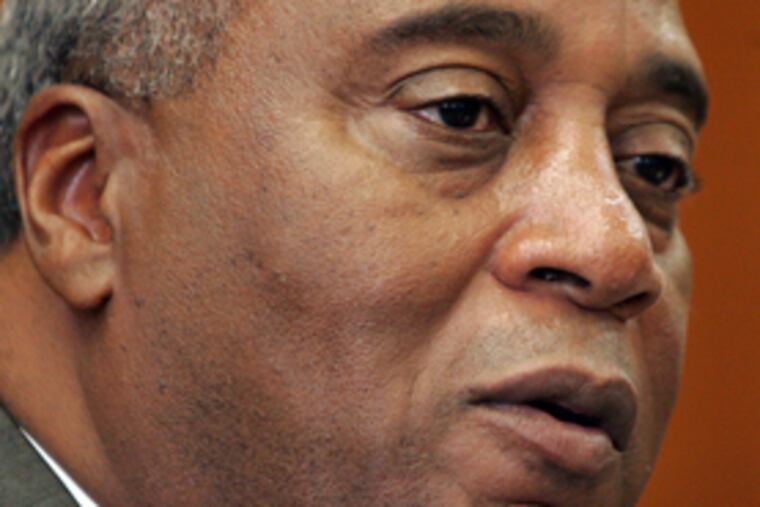
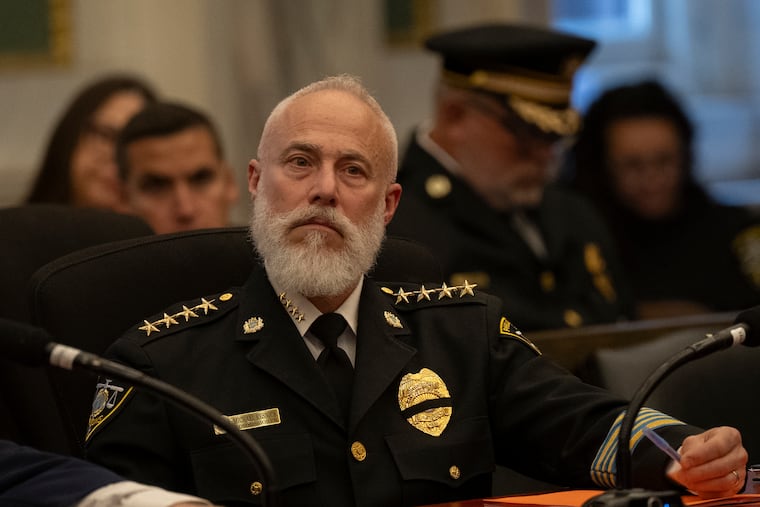
The city's top law-enforcement officer says Michael Nutter's proposed "stop-and-frisk" policy would be a "disaster."
Departing Police Commissioner Sylvester M. Johnson said the presumptive mayor's promise to invoke the more aggressive law enforcement strategy would undermine the community rapport that Johnson feels he has developed in six years on the job. He said the next commissioner "is going to have a problem" with discontent - or worse, civil unrest - if that goodwill is undermined.
"What Nutter is saying - this stop-and-frisk is going to be a disaster," Johnson said in an interview with The Inquirer. "What he's saying, too, is that he wants a police commissioner to be harder. Well, harder on what? . . . Do you think locking people up is making a difference?
"I mean, and he gives the opinion that he's going to run the Police Department, not the police commissioner. He will run the Police Department - 'I will do deployment.' Well, how are you going to deploy? He's never been a police officer in his life, yet he knows more about deployment than we do."
The 64-year-old Johnson's remarks amounted to his most pointed rebuke of Nutter's effort to make a campaign issue out of the Police Department's response to the increase in the city homicide tally, which went from 288 in 2002 to 406 last year.
Nutter, who is expected to win next Tuesday's election against Republican Al Taubenberger, disputed Johnson's argument that more aggressive policing would trigger a public backlash. Nutter has promised to declare an emergency on his first day in office and direct more police to "targeted enforcement zones" in crime-plagued neighborhoods.
Nutter also has embraced a controversial strategy in which officers can stop, question and frisk people they suspect of carrying illegal weapons. Criminologists say such strategies have reduced violent crime in other cities - but almost always at the cost of increased hostility from civilians.
"I start with the premise that well-trained, well-supervised Philadelphia police officers can implement this plan legally and successfully and ultimately the citizens of this city will appreciate it because fewer of them will be shot or killed," Nutter said.
"I think we have to move beyond this automatic knee-jerk assumption that somehow aggressively going after illegal weapons with people who are shooting and killing innocent bystanders is somehow going to create problems in the community. What is creating problems in the community is that on average . . . one person a day is killed and five people are shot."
The soft-spoken police commissioner, a 43-year department veteran who will retire in January when Mayor Street ends his term, maintains that crime is influenced largely by factors outside the control of law enforcement - poverty, unemployment, poor education.
He seemed particularly bothered that his department was being judged on the basis of an increase in violent crime that is affecting many cities with large populations of poor people. He noted that violent crime had shown recent signs of leveling off after four years of increases. In Philadelphia, the homicide rate is currently running about parallel with last year's rate; Violent crimes and shootings are both down, however.
Johnson said he was concerned that tactics such as stop-and-frisk would open the police to accusations of racial profiling and alienate the population. He said such animosity might destroy the connections that he cultivated with minority communities that have only begun to bear fruit.
"Unless the community buys into some of these things, it's going to be an adversarial relationship," he said. "Again, it's going to be the police against the community. And I think that would be a disaster."
He argued that under his leadership the police had not experienced any civil disorder. He said one reason the public has remained calm - even in the face of a large number of civilians shot by police - was that he visited nearly every family of a person killed by police in an effort to defuse community anger.
As evidence of the improved relations, he cited last week's turnout in response to the call for 10,000 men to participate in community patrols and to defend their neighborhoods against crime.
"To have 10,000 men show up - Afro-American men - to join partnership with the Police Department has to show you that there's not that much dissension between the police and the community," he said.
"Our relationship that we have with the community, it took years to build, but it could be only a matter of months to destroy it," he said.
He also said that criticism of his leadership style was unfair.
"It's not that I'm easy on crime," he said. "I'm fair and compassionate toward people. I have been that way my entire life, and have no intention of changing."
The former head of the city's police union, who credits Johnson for making "great strides" to improve police-community relations, said he did not believe Johnson and Nutter stood as far apart on the issue of community policing as Johnson might believe.
"We don't need to go backwards in this city," said Robert Eddis, departing president of Lodge 5 of the Fraternal Order of Police. "We know the pain of not having a good relationship between the police and the community. We don't want that."
Eddis praised Johnson for being fair to the officers - "the kindest" and "most responsive" commissioner he has ever dealt with, he said.
Indeed, though Johnson said some of his predecessors took pride in the number of officers they disciplined, he regards such duty regretfully.
"I have fired police officers, I don't know the number - don't keep a scorecard because I don't think it's a positive thing," Johnson said.
Johnson's identification with police officers is also a point of criticism from outside the department. Law enforcement experts say strong police leaders can dramatically reduce the number of civilian shootings by police officers by imposing firm discipline and training. Police shot and killed 20 people last year and at least 14 more this year.
But Johnson, in the interview, said there was little a commissioner could do to reduce police killings of civilians. He said his department had not given an implicit green light to officers to use deadly force. The number of shootings, he said, was a direct result of the number of guns on the streets and criminals' willingness to use them against police.
"It doesn't matter who the police commissioner is," he said. "The fact is that this country is very, very violent."
Johnson also said six years "is too long to be police commissioner," but he said he remained in office out of loyalty to an embattled Mayor Street.
Though his relations with the mayor have been described as prickly, he declined to criticize Street, even for turning down his requests to hire more police officers.
"He's done a lot of positive things, and he's always supported me," Johnson said of the mayor. "Did we agree on everything? No. But did we disagree in public? No."