In space, a cluster of health dangers
Space shuttle commander Christopher Ferguson and his crew took a small but crucial step for space travel in the last two weeks, enlarging the International Space Station so it can house six astronauts instead of three.
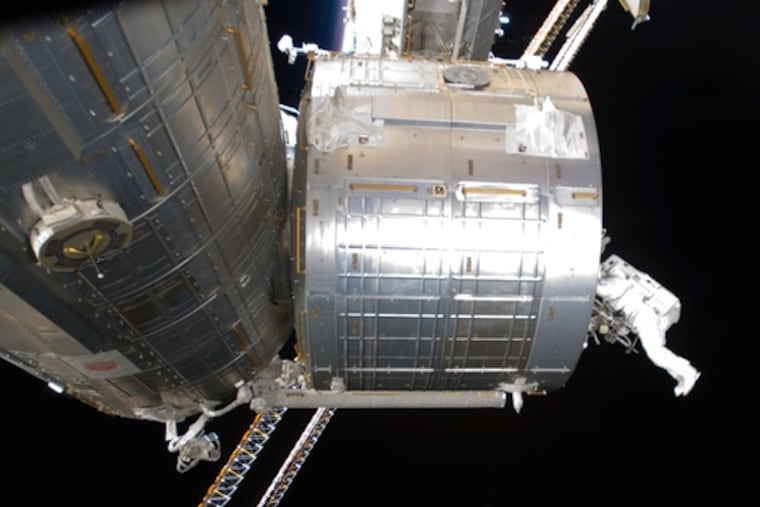
Space shuttle commander Christopher Ferguson and his crew took a small but crucial step for space travel in the last two weeks, enlarging the International Space Station so it can house six astronauts instead of three.
But a bigger leap is needed for humans to survive weightlessness, exotic forms of space radiation, and the loss of the earthly rhythms of light and darkness, scientists say.
In orbit about 200 miles from the ground, the space station pushes mankind just a baby step into the cosmos. Even going that far can put astronauts at an elevated risk of cataracts, bone loss, and possibly heart problems.
A Mars mission would take at least six months each way, during which the crew would face unknown dangers - cancer, depression, dementia, cardiovascular disease, accidents associated with sleep deprivation, and possibly premature aging.
Before its scheduled landing today, the crew of the space shuttle Endeavour completed a challenging 16-day mission, delivering what Ferguson, a Northeast Philadelphia native, called "the most jam-packed logistics module we have ever carried up there."
They added two bedrooms, a new refrigerator, a toilet, a water-recycling system, and an exercise apparatus. Once the station starts housing more astronauts, as soon as mid-2009, NASA will finally have the manpower to begin doing controlled medical experiments.
In the meantime, the Bush administration's 2004 directive for manned moon and Mars missions has channelled money to ground-based scientists to better understand the risks of space travel. "The uncertainty is the real problem," said Frank Cucinotta, chief scientist for NASA's Space Radiation Program.
Astronauts may be willing to face, say, a 3 percent risk of fatal cancer, but would they accept a 50 percent risk?
Trouble on Earth
It first became clear that NASA had a problem back in the 1970s, when astronauts started spending weeks at a time aboard the space station known as Skylab. Upon return, many suffered atrophied muscles, thinned bones and weakened hearts.
Less well-understood is the danger of space radiation. The space shuttle and International Space Station are still somewhat protected by Earth's magnetic field. Farther out, astronauts are bombarded with particles from the sun and deep space.
Scientists believe this radiation explains why astronauts suffer a disproportionate number of cataracts - more than they would have expected from the radiation doses these astronauts were exposed to.
Jonathan Clark, a former flight surgeon for NASA, said that three astronauts in the U.S. program needed lens implants.
The radiation that comes from the sun can lash out dramatically during solar flares, making the risks to astronauts difficult to predict. To better understand the problem, NASA awarded a $10 million grant to the University of Pennsylvania last month.
Radiation biology professor Ann Kennedy said she and her team would expose cells and mice to radiation from several facilities, including a proton source at Penn.
Deep-space radiation
Astronauts going beyond Earth's magnetic field are also steadily pelted with more exotic radiation from deep space - nuclei of iron and other heavy elements that pass through walls and space suits and tear up DNA.
"These [particles] are the bigger problem because they're the most different from anything we experience on Earth," said NASA's Cucinotta. The solar flares can be compared to atomic-bomb exposures, but the deep-space radiation has no such precedent.
So Cucinotta and other scientists are taking advantage of a particle accelerator at Long Island's Brookhaven National Laboratory.
Using heavy nuclei created there, Cucinotta has discovered that this type of radiation can damage microscopic structures called telomeres. These cap the ends of the chromosomes, keeping them from fraying, similar to the end pieces on shoelaces.
Telomeres appear to shorten as animals grow older, and the speed of that shortening has been linked to maladies of aging. So it's possible that long stays on the moon or Mars will make astronauts get old before their time.
Cucinotta said some researchers were investigating drugs that would stave off this process by encouraging radiation-damaged cells to die off rather than propagate.
NASA doctors and biologists say the biggest hazard, next to radiation, is sleep deprivation. Some astronauts sleep well in space, but many get significantly less than their normal amount, said George Brainard, a professor in Thomas Jefferson University's neurology department.
In space, astronauts can suffer an extreme version of jet lag. Those on the International Space Station see a new day every 90 minutes. On the moon, they'd see 14 days of light followed by 14 days of darkness.
"That would provide a profound change in the normal stimulation of the circadian system," said Brainard. Chronic sleep deprivation can hurt an astronaut's hand-eye coordination, cognitive abilities, and judgment.
And a little-known fact: Nearly half of all the medications astronauts take to space are sleep aids, said Brainard, and they carry a litany of possible side effects.
Light adjustment?
A few years ago, Brainard and his colleagues at Jefferson got NASA's attention by discovering that the eye contains not only rods and cones but also a third type of light-sensitive cell, located in a different part of the retina.
These cells don't help us see, said Brainard, but use light to regulate the hormone melatonin, which in turn regulates our sleep-wake cycles.
In his laboratory at Jefferson, Brainard has found that the shorter wavelengths of visible light - those near the blue end of the spectrum - are more effective at stimulating these sleep-related receptors and regulating melatonin. So perhaps tweaking the wavelength of light could help astronauts adjust.
While not all astronauts have sleep problems, they all lose bone and muscle given enough time in weightlessness. That could put astronauts arriving on Mars at risk of breaking bones or suffering other serious injuries.
Muscles atrophy and bones thin in space because they need a certain amount of stress to regenerate. Exercise seems to help mitigate the damage some.
In one study just getting under way, volunteers will lie in bed for 90 days at a time to simulate the wasting effects of a long flight, some of them using exercise to try to regain their losses.
Experience on the Russian and International Space Stations has shown that without any artificial gravity, astronauts need to exercise several hours a day to keep from deteriorating. Experts say that when cosmonaut and physician Valeriy Polyakov made his record-breaking 437-day stay on Mir, he devised his own grueling regimen.
Flight surgeon and researcher Yvonne Cagle of the Johnson Space Flight Center said that the Russians use an even more rigorous exercise program than the Americans, and that astronaut Shannon Lucid adopted the Russian regimen when, at 53, she lived on Mir for 183 days. After her mission, she managed to regain all the bone she had lost, said Cagle.
The mythology says astronauts have the right stuff, said Jefferson's Brainard, but that can go only so far in the hostile reaches of space.
"They're heroes," he said, "But they're still human with the same physiological frailties as the rest of us."