Philadelphia Orchestra's European holiday
LISBON, Portugal - It may not be sunny in Philly, but wherever the Philadelphia Orchestra goes on its current tour of the Canary Islands and Europe, rain stops, snow melts and clouds part.
LISBON, Portugal - It may not be sunny in Philly, but wherever the Philadelphia Orchestra goes on its current tour of the Canary Islands and Europe, rain stops, snow melts and clouds part.
The sun shines figuratively as well. Ticket sales for the three-week, 14-concert tour of the Canary Islands, Iberia and Central Europe so far have been excellent. Although other U.S. orchestras are forgoing overseas tours (and lack of sponsorship forced Philadelphia to cancel this summer's round of European festivals), Orquesta de Filadelfia touched down in the picture-postcard Canaries on Jan. 28 for the tour's first leg, which by all accounts bordered on the sublime.
This week, successive days of miserable weather in Barcelona ended the very hour that the somewhat sunburned musicians landed there Tuesday. Wednesday, in previously soggy Lisbon, the same thing happened. And Madrid's freakish snow and heavy rains were history by the time the orchestra arrived yesterday afternoon.
Audiences are giving tour violin soloist Leonidas Kavakos rock-star ovations. And though the famous Philadelphia sound has been compromised by some acoustically questionable auditoriums, there was plenty of it to go around even in the worst of them, such as Lisbon's cavernous, circular Coliseu dos Recreios, where Holiday on Ice has been a more comfortable visitor.
As for glitches, the tour gods insist on at least one: Double-bassist Henry Scott collapsed during the second movement of Bruckner's Symphony No. 6 on Sunday in Las Palmas - an incident that looked more serious than it was. His bass broke his fall (which also broke the bass), and the performance was halted for a very long 15 minutes.
Tour physician Glenn Newell hauled Scott offstage, feet dragging along the floor, as a Spanish anesthesiologist in the audience called ahead to a hospital, where Scott was diagnosed with a routine virus.
"I knew that he was OK, and most people backstage knew," Newell said. "But when the announcement was made that the show was going on, it was only in Spanish. So nobody in the orchestra knew.. . ."
Scott's ailment was so short-lived that he was released from the emergency room after four hours, and soon was up, cracking jokes, and able to play Tuesday's Barcelona concert. (The bass, however, has been retired for the rest of the tour.)
Newell cautioned against future stoicism, saying: "In general, people are waiting until they're really sick and not telling me until late afternoon. The show goes on, I guess."
Time for anything, illness included, is short: The orchestra had only 20 hours in Barcelona on Tuesday, but players managed to prowl record stores, snap pictures of cathedrals, and walk along the beach. They stayed at the Barcelona Arts/Ritz Carlton, which offered a sea view that prompted the orchestra's oldest member, 89-year-old violinist Jerome Wigler, to describe it as the best hotel he has seen outside of Atlantic City.
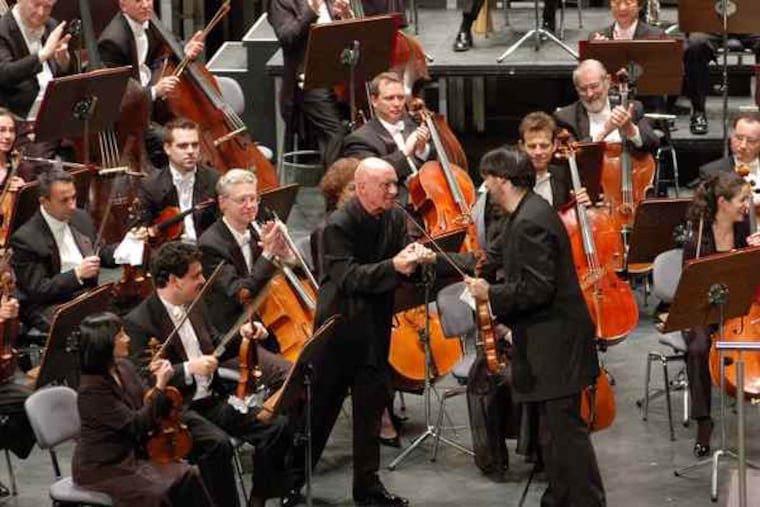
This tour - its $2 million cost covered by funding from Pennsylvania and fees from concert venues - is being led by Christoph Eschenbach, who stepped down as the orchestra's music director last year. Some musicians say they have never seen him in such good spirits - or, for those who encountered the slim, trim maestro on a Canary Islands beach, in a typically European Speedo.
The islands were a surprise - more rugged and volcanic than lush - highlighted by the inspiring oceanside Alfredo Kraus Auditorium in Las Palmas. Some musicians likened it to a classical-music lighthouse, with its huge window behind the stage overlooking the waves. That meant little to the players during the nighttime performance, but principal clarinetist Ricardo Morales joked during daylight rehearsals, "Whoever screws up gets thrown in the water!"
The Barcelona Palau de la Musica Catalana, opened in 1908, was also singular, its narrow dimensions made even cozier by florid decor suggesting Jean Cocteau on some sort of art-nouveau acid trip. Three-dimensional plaster statues of angelic musicians surround the stage, but only from the waist up - from the waist down, they are flat mosaics that pulsate with color. Overhead, the auditorium ceiling is a masterpiece of leaded glass.
"It gives us something to look at other than each other," violinist Paul Arnold said.
Tuesday's audience in Barcelona, like those in the Canaries, was quiet and attentive (in contrast to a recent symphonic concert conducted there by Christian Thielemann, who lectured listeners on their incessant coughing). And that's saying a lot, given the challenges presented by Matthias Pintscher's enigmatic work Osiris, which has grown more cogent than when last heard in Philadelphia. It sets up an almost cathartic sense of release when followed by the uncomplicated C-major key of Schubert's Symphony No. 9.
Acoustically speaking, Eschenbach talked of having to "police" sections of the orchestra during the Barcelona performance of the Schubert. The Lisbon difficulties had the orchestra beginning Prokofiev's Symphony No. 5 with various sections alternately tentative or overcompensating, to adjust. By the second movement, however, all was in balance. Audience response in the packed 3,000-seat Coliseu was extravagant.
But last night's Madrid audience in the Auditorio Nacional de Musica, a clean, modern structure with 10 seating areas clustered around the orchestra, got a lot more Prokofiev for its money - not just due to the thunderous total effect but because of the fine detailing from the principal players.
As much as the latest signs of economic downturn are all over the European media (unemployment in Spain is said to be nearing 14 percent), the orchestra seems to be playing in a protective bubble. Canary Islands concerts were nearly full. While Barcelona had 400 empty seats in the 2,000-seat hall, curiously, they were not on the main floor, where prices were as high as 175 Euros ($225).
There is talk of the current vacuum in the Philadelphia Orchestra's leadership (president/CEO James Undercofler recently left; board president Hal Sorgenti just stepped down), even in such exotic settings, but it's not noticeable in the tour's day-to-day life, which is organized by the outside firm Classical Movements.
One encouraging economic indicator: Neeta Helms, president of Classical Movements, which works with major orchestras as well as tours by youth orchestras and choirs, says 2009 looks to be its busiest year ever.
But Helms works hard for that business. The Wednesday flight from Barcelona to Lisbon had the most stringent bag restrictions yet, with hefty fines for those deemed too heavy. But the loaded-down musicians were allowed to board unimpeded. "Neeta worked her magic," murmured one.