Camden rethinks renewal, foiling Bergen Square
The Rev. Al Stewart walks past a group of middle-aged men and women drinking away the day in a shaded junkyard near his church in Camden's Bergen Square neighborhood.
The Rev. Al Stewart walks past a group of middle-aged men and women drinking away the day in a shaded junkyard near his church in Camden's Bergen Square neighborhood.
Then he smiles.
Looking to the future, "I don't see a ghetto," he says. "They can jerk us around downtown, but we're not going to let them steal our hope."
For a year, Stewart says, he has attended city-sponsored meetings where government officials have promised to turn Bergen Square into a thriving neighborhood with mixed-income housing, new parks and a shopping center.
Now Stewart will need to temper his optimism with patience.
In a change of direction, the city's state-appointed chief operating officer, Theodore Z. Davis, says he has no intention to move plans for other neighborhood renewals forward until Camden's most recently approved project - for the Lanning Square neighborhood near Cooper University Hospital - is "implemented."
Lawsuits filed over Lanning Square last week could further delay action for blighted sections of the city.
Officials consider redevelopment key to the revival of Camden, where 38 percent of people lived in poverty last year. The goal is to tackle all 22 of the city's neighborhoods.
About half have approved plans, according to the Camden Redevelopment Agency. Three more - Bergen Square, Dudley and Cramer Hill - have drafts that could be introduced to the planning board for approval within six months, city planners say.
Under past city leadership, the board considered numerous plans simultaneously. Previous plans for Bergen Square, Waterfront South and Cramer Hill were approved about the same time, but all were thrown out in court because of procedural problems.
Now the city plans to take a slower, more cautious approach, said Davis, who is also chairman of the Camden Redevelopment Agency and became chief operating officer 20 months ago.
"My directive is: 'You're going to take one at a time,' " Davis said last week.
"I'm sort of lineal," the retired Superior Court judge said. "Let's get this done right before we start to worry about another community. . . . I'd like to claim this success before we move on to the next one."
Complicating matters are the two lawsuits filed against the city over the Lanning Square plan, which City Council approved in July.
One was filed by residents who fear losing their homes to eminent domain during the 25-year life of the plan, and the other by businesses whose property stands to be acquired immediately.
Calling the suits "devastating," Davis said that next time he'd like to find a neighborhood that accepted redevelopment, because the city couldn't afford any more protracted court fights.
The decision to put new redevelopment on hold frustrates activists like Stewart, who said he had promises from former city leaders. Stewart sent a petition to the governor with more than 400 signatures from Bergen Square residents asking for redevelopment.
"What's hard to communicate is the hope we got after doing this plan for a year. It drives your spirit," he said. "At some point, you get converted."
The situation is confusing, activists say, because there are no criteria for determining which project goes next.
Manuel Delgado, executive director of the Cramer Hill Community Development Corp., said he had been told that the planning board would soon put a new Cramer Hill plan up for a vote.
"Every year that they come in and say, 'We're doing this redevelopment plan,' and then they disappear and never come back again, that harms the trust in the neighborhood," he said.
Council first voted to study Bergen Square redevelopment five years ago. After a judge rejected the initial plan in 2006, meetings were held with developers, residents and city officials, and a new plan was written.
It calls for 132 occupied properties to be acquired in 250-acre Bergen Square, which stretches from I-676 to Third Street and from Atlantic Avenue to Pine Street.
There would be stores and construction jobs for city residents, said developer Glen Fishman, who was part of the group designated the neighborhood's "conditional developer."
But Fishman is being pushed aside. Davis opposes the concept of conditional developers, another remnant of previous leadership. He doesn't believe city officials should line up developers before learning what the community wants, he said.
There are other changes in redevelopment policy, too. Davis wants all plans to have a "human capital" component, with job training and other social assistance. Plans in the queue without this will have to be modified.
And he frowns on projects that must acquire properties and that grant powers of eminent domain, which he said were politically difficult and a magnet for lawsuits.
So Bergen Square will wait.
"And the problems of Bergen Square, the crime rate and the poverty index, will continue to rise," Stewart said. "It's a direct result of the judge not understanding how redevelopment works."
Stewart worries that other plans could get priority because they're "politically connected." For example, the chairman of Cooper University Hospital, the driving force behind the Lanning Square plan, is Democratic political organizer George Norcross.
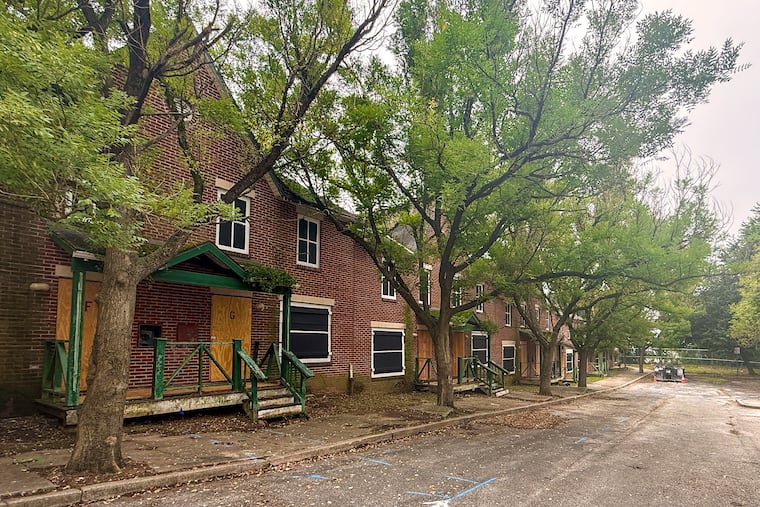
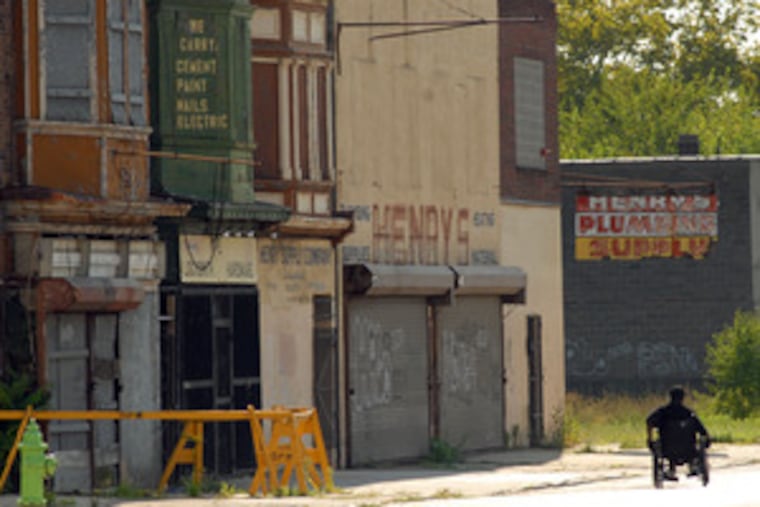
In the meantime, steady traffic flows down Broadway, but Bergen Square's sidewalks are ghostly. Stores are shuttered, and theater marquees now bear the names of churches.
Along Kaighns Avenue east of Broadway, there are barely buildings anymore. Toward I-676, two huge empty industrial buildings sit on about five acres.
A single home stands sentry on some blocks, spared by the socioeconomic bomb that has leveled properties in every other direction.
"There's nothing down here," said Raymond Gramenzi, owner of Harry's Plumbing Supply, a Bergen Square business for 75 years. "We're forgotten."