Indians blast seven home runs and pummel Phillies
CLEVELAND - Roy Halladay sat alone on the dugout bench at Progressive Field. He placed his glove and cap there before whipping a white towel through the air to his sweat-soaked face. He crawled into his puffy jacket, put his hand on his chin, and sulked in the fourth inning of a 14-2 Phillies loss to the Indians.
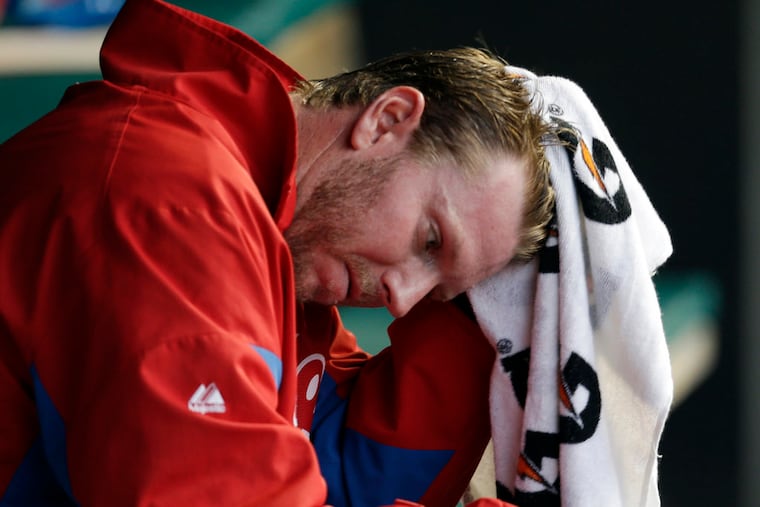
CLEVELAND - Roy Halladay sat alone on the dugout bench at Progressive Field. He placed his glove and cap there before whipping a white towel through the air to his sweat-soaked face. He crawled into his puffy jacket, put his hand on his chin, and sulked in the fourth inning of a 14-2 Phillies loss to the Indians.
Eleven of the 21 batters he saw Tuesday reached base. Eight of them scored. Three of them hit two-run homers.
"The best thing about that was we got through it," Charlie Manuel said. The manager paused. "I guess."
Halladay's evolution is constant. Electricity does not flow from his right arm the way it once did. The line between success and failure is finer with diminished ability. Halladay's cutter did not dart Tuesday. His curveball hung. His sinker floated across the heart of home plate.
The momentum of a weekend sweep in New York deflated before the first inning ended. Once Halladay departed, the game devolved even further. Those who still watched in Philadelphia possessed a sick sense of humor.
Cleveland slugged seven home runs, five of which were two-run blasts. It was the fourth time since 1916 that the Phillies had allowed seven or more home runs in a game. Six Indians hit home runs. This was complete destruction.
Halladay could not locate his pitches and was ripe for an ambush. In the first inning, Carlos Santana smashed a curveball for a two-run homer inside the foul pole. The ageless Jason Giambi walked, and Mark Reynolds smoked a cutter for another home run. Both homers were hit with Halladay behind in the count.
"I had to be spot-on today, I really did, and I just wasn't," Halladay said. "You catch any other team any other time and you're OK. I'm not discouraged at all. I feel like we've really come a long ways, and I feel good about where I am. The location could be better at times, and I think that's been coming."
He required 33 pitches to complete the first inning. A mere 18 were strikes. Twenty-four of his first 33 pitches were fastballs - either a cutter or a sinker - which represented a different strategy than Halladay had employed in his last three outings.
Halladay had permitted four runs in his previous 21 innings (a 1.71 ERA) after a nightmarish beginning to 2013. This was his first start with Carlos Ruiz catching. Halladay said his plan was to attack the Indians hitters with hard stuff inside. Just 22 of his 76 pitches were off-speed.
The pitcher cited a Cleveland lineup even without Michael Bourn and Nick Swisher as the reason for his downfall.
"It's a fine line with them right now," Halladay said.
Halladay has failed to pitch more than four innings in three of his six starts. He made a total of 90 starts with the Phillies from 2010-12, and just three of those lasted four or fewer innings. His 2013 ERA ballooned to 6.75.
The parade of Phillies relievers fared no better. Chad Durbin allowed four runs on two homers in 11/3 innings. Raul Valdes served up two more in his two innings.
Delmon Young, making his Phillies debut, provided the lone bright spot. He homered on the third pitch he saw and reached base three of four times.
Halladay dug much too deep a hole for anything else to matter. In the fourth inning, after another two-run homer and two subsequent singles, Halladay knew a two-run Asdrubal Cabrera single to right was the final blow. He sauntered toward the mound as Manuel crept up the dugout steps.
Halladay bent over, saw Manuel approaching, and juggled the rosin bag. Before Manuel made it to the pitching rubber, Halladay descended the mound. He handed his manager the ball. No words were needed as Halladay lowered his head for the agonizing walk.
Serving 'em Up
The Phillies allowed seven or more home runs in a game for the fourth time since 1916.
Date Opp. HRs
Sept. 4, 1999 Reds 9
April 19, 2005 Mets 7
Aug. 13, 1939 Giants 7
EndText