Camden County voters will decide whether to pay more taxes to prevent sewage from entering the Cooper River
Camden County voters will decide whether to increase their open space tax to contribute to a $400 million effort to improve waterways in part by fixing Camden and Gloucester sewers.
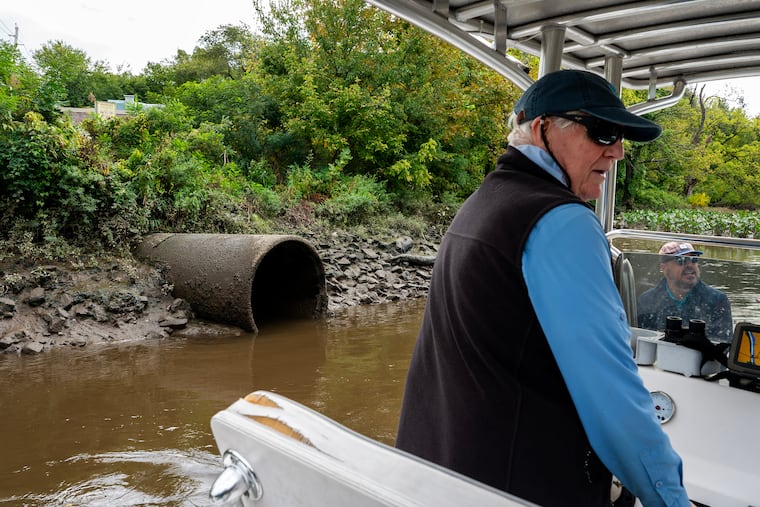
The temperature was in the low 70s with a light breeze and clear skies. It was perfect boating weather. A group of students from Philadelphia’s Maritime Academy were excited to paddle out onto the Cooper River.
But Don Baugh from the Upstream Alliance had to cancel the trip. The water was still too dirty from heavy rain over the weekend, which can cause sewage to spit out into the river from old pipes in Camden.
“Our goal is that we don’t have to cancel at all … we’d be able to say anybody can recreate, play, swim on this water 365 days of the year, whether it rained or not,” Baugh said from his motorboat on Tuesday, surrounded by greenery and mud-colored water.
That’s why Baugh hopes voters will support a ballot referendum in Camden County that will increase the open space tax by one cent per $100 of property owned. That one-cent increase would go towards the county’s ambitious plan to rehabilitate its sewers and waterways through a multifaceted initiative that’s slated to cost about $400 million across the next 10 years. It’s become more urgent, county officials say, as powerful storms and flooding become more commonplace due to climate change.
The nonprofit Upstream Alliance provides free kayaking to the public, but the organization has had to cancel about 20% of its programming due to concerns about water cleanliness, Baugh said. His rule of thumb is to wait 48 hours after half an inch of rain falls before allowing people in the water, so the bacteria from the sewage can die. But even that wasn’t enough time following the weekend’s storm.
Put frankly, the water still looked “yucky,” Baugh said, so he wasn’t going to expose people to it.
What is the referendum?
Camden County Voters have already been receiving their mail ballots for the Nov. 3 election. One of the decisions they’ll need to make is whether to raise the county’s open space tax by one cent — bringing it to $0.03 per $100 of property value. If it passes, the tax will still be one cent lower than neighboring Burlington and Gloucester Counties.
This means that someone with property assessed at $500,000 would pay $150 a year toward open space, up from $100 at the current $0.02 cent rate.
The county’s open space tax is used to preserve parks, farmland, and historic sites. But the one-cent increase would be dedicated to the county’s $400 million clean water plan which includes sewer repairs along the Cooper River, green infrastructure, water dredging local lakes, and recreation programs.
“The county is making a very bold step doing this now, and frankly, nobody wants a tax, right? But everybody wants a higher quality of life,” Baugh said. “Everybody wants a safe and clean environment today and for tomorrow.”
Scott Schreiber, the executive director of the Camden County Municipal Utilities Authority (CCMUA) — the entity overseeing the project — believes the county could raise about $7 million from the tax increase, which could result in approximately $100 million worth of project funding through the New Jersey Water Bank, which offers the entity very low interest rates and principal forgiveness.
The existing user rate that residents pay to the CCMUA will go toward the projects, Schreiber said, and the county will also seek out funds from the state and federal government, as well as philanthropies.
“It’s not one entity that can fix this,” Schreiber said. “This is going to take a combination of local government, state, federal government, advocacy groups, and the regular public to make this work. Without that combination of people and funding, it’s going to be really impossible to fix any of this stuff.”
Here’s what the $400 million effort entails, which the tax increase would go toward funding.
The sewer problem
Camden and Gloucester cities still have an antiquated sewage system that combines stormwater and sewage in the same pipes. The pipes are designed to carry the combined liquid to the wastewater treatment plant, but when there’s heavy rain, they can overflow and the contaminated water spits into the Cooper and Delaware Rivers. The overflow from the combined pipes can cause flooding — and then residents are subjected to sewage-infested waters in their streets and homes.
“These are the old stone pipes that were built before the current technology,” Camden County Commissioner Jeffrey Nash said.
“But as both cities grew, and the storms have become more violent, and rain has become more excessive … flooding has been a large problem,” he added.
On top of the risks to humans, the nutrients from the human waste are harmful for aquatic life.
There are 30 combined sewage overflow spots in these two cities, Schreiber said, that dump waste into the river when there’s heavy rain and the system can’t handle it. Just one of the larger combined pipes pours out about 200 million gallons of sewage-filled water a year, he said, and the two cities dump out about 800 million gallons on average altogether.
The county wants to spend $200 million to upgrade this system.
The rest of the county has separate stormwater and sewage pipes, but they still need to be maintained. Leaky pipes can also cause sewage to spill into the river.
The county plans to spend about $50 million for the rehabilitation of these sewer systems across multiple municipalities. The county has already begun design for lining some of these pipes, Schreiber said.
The bottom line is, the Cooper River — which runs from Gibbsboro and Voorhees out to the Delaware River — does not meet state and federal water quality standards, he said, so the county is taking a “holistic approach” to fix the waterway that flows through multiple municipalities.
Green Infrastructure
The plan also includes $25 million for green infrastructure, like rain gardens or bioswales, which are typically sloped channels covered with vegetation.
Green infrastructure gets water directly into the ground, which helps with flooding and decreases the amount of water going through the pipes to the treatment plant, overall alleviating the system. This infrastructure, however, requires expensive and ongoing maintenance, Schreiber said.
“The more that you contain the water on the land, the better it is for the water,” Baugh said.
Dredging
The project also includes $75 million for dredging and other methods that remove sediment from public waterways. This sediment includes toxins that end up in the water from residential and business areas, and if it’s not removed, waterways can become defunct. It’s part of what makes Camden County’s waterways brown after heavy rain, because “a lot of not good stuff on the bottom” gets stirred up, Schreiber said.
“We really want to make sure that we’re taking that sediment out, so that even if it does get disturbed and move, it’s moving clean sediment and not polluting or contaminating,” he added.
Cleaning up Evans Pond and Wallworth Lake, Cooper River Lake, and Kirkwood Lake, are priorities for the county.
Newton Lake Park, which runs through Haddon Township, Collingswood, and Oaklyn, finished a two-year and $23 million dredging process in 2023 that rehabilitated the lake after it became clogged. And just on Tuesday, the county unveiled the results of a $1.3 million project to improve fishing piers at the rejuvenated lake.
Parts of Camden’s waterways are littered with lead and arsenic that was used in apple orchards decades ago in places like Cherry Hill and Voorhees, as well as toxins from the Sherwin-Williams/Hilliards Creek Superfund site, a former paint manufacturer in Gibbsboro.
Recreation
Baugh said local families who don’t have experience on the water and don’t always know how to swim show up to his free Saturday kayaking disappointed that they can’t go out on a nice day. As the county gradually addresses its sewage issues, he expects to feel better putting people out on the water under his 48-hour rule and one day get rid of it completely.
And the county’s plan would give more options for residents to enjoy their local waters, with $50 million allocated to restoring recreational lake areas. This effort aims to bring more fishing piers, kayak rentals, boat launches, and water trail systems, Schreiber said. The county is prioritizing rehabilitating Atco Lake, Lake Worth, and Audubon Lake, according to its planning document.
Nash described exploring the county’s urban waterways as a “great thrill.” He wants more residents in Camden to enjoy it, too.
Each of the plan’s components have distinct advantages, but taken together their benefits amplify, Schreiber said.
“And if you do that holistically from the top of the county all the way down, you’re going to have a much more clean and friendly park system and river water system,” he added.