Philly Mayor Cherelle Parker wants big tech companies to pay up. With the clock ticking, she’s meeting resistance.
Philadelphia City Council must give preliminary approval to a budget plan by Thursday. Parker's proposed tax hikes are shaping up to be the biggest sticking points.
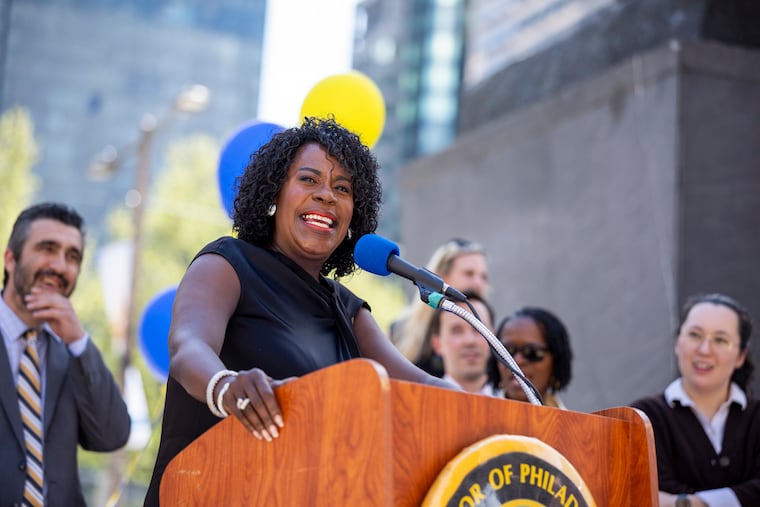
With the deadline looming to fund Philadelphia’s city government, Mayor Cherelle L. Parker and some of her top aides huddled last week with leaders of the city’s hotel industry to try to hammer out a deal.
She wanted to raise the city’s hotel tax by 2% to fund homelessness prevention programs. But hotel industry leaders had a different idea: tax their competitors more.
On Wednesday, Parker proposed just that. She now wants to increase the tax on hotels by 0.6% and jack up the tax on short-term rentals — like those reserved through services like Airbnb and Vrbo — by 10 times that amount.
It is one of several ways that Parker is resting her city budget and, by extension, her third-year agenda on the backs of big tech companies. She also wants to levy a 25-cent fee on some retail delivery orders from companies like Amazon to help fund pothole repair crews. And, perhaps most controversially, the mayor is adamant that the best way to help the Philadelphia School District avoid planned staff cuts is to place a $1-per-ride surcharge on rideshare services like Uber and Lyft.
None of that will happen without the support of a majority of City Council, which must give preliminary approval to a budget plan by Thursday in order for it to be fully passed by July 1, the start of the new fiscal year.
As the clock winds down, Parker is meeting resistance to all three tax proposals from both inside and outside City Hall — and the fees remain the biggest sticking point in her budget plan this year.
The city’s three largest tourism organizations said last week that they are strongly opposed to increasing taxes on both hotels and short-term rentals, especially Parker’s plan to use the funding for homelessness programs. In the past, the money has funded tourism promotion, and an increase in that tax would require approval from Harrisburg that is far from certain.
At the same time, DoorDash and other delivery services are lobbying against the mayor’s proposed retail delivery fee. In communications with Council members, the businesses are claiming the fee violates state law that preempts the city from certain forms of taxation, according to memos obtained by The Inquirer.
And as Uber escalates an aggressive campaign to oppose the rideshare tax, Council members who want to ax the $1 fee are floating alternatives to generate about $50 million this year for the schools to help the district stave off hundreds of planned staff cuts.
According to sources familiar with the private negotiations, some members have said they support increasing an existing fee on rideshares, which would require approval from the state. Others have proposed redirecting money that is already in the city budget or dipping into the city’s “rainy day fund.”
That bucket of money, called the budget stabilization reserve, is intended for emergencies and economic downturns. The fund has nearly $240 million in it, according to city financial records, and its health has improved in recent years amid concerted efforts to grow the city’s reserves.
“If it’s not rainy now, I don’t know when it’s rainy,” said Councilmember Jim Harrity, a Democrat who represents the city at-large and is often aligned with Parker. “I support our teachers and our kids, but we don’t have to keep taxing our citizens who are already struggling.”
» READ MORE: Mayor Cherelle Parker unveils ‘economic mobility agenda’ in $7 billion city budget proposal
The opposition does not mean that the mayor’s plans are doomed. She has plenty of powerful allies herself, including labor leaders, the teachers union, and public school advocates.
In response to a request for comment, Parker administration spokesperson Joe Grace provided a list of advocacy organizations and unions that support the rideshare tax, which he called a “tax on billionaire tech companies.”
He said that funding for schools, homelessness prevention, and streets improvements are interests shared by Council, and that the administration “won’t let naysayers or lobbyists pit Council members against one another or the administration.”
“The Parker administration knows that finding consensus and common ground can be challenging,” Grace said. “However, the only way to achieve those goals and meet the moment is by meeting with legislators, hearing their concerns, and finding compromise in the best interests of every Philadelphian. That’s what we will continue to do.”
Parker and her top aides will likely spend much of the next few days negotiating directly with Council President Kenyatta Johnson and his team. The Council president traditionally handles the bulk of the negotiations and advocates on behalf of the 16 other members.
On Thursday, Johnson — a centrist Democrat who is typically politically aligned with the mayor — was characteristically tight-lipped about the status of the backroom dealmaking.
Asked about the rideshare tax proposal, Johnson said that discussions are ongoing, and that he is confident an agreement can be reached with the administration this week.
“That’s the game plan,” he said.
An intense lobbying effort against tax hikes
Since Parker took office in 2024, Council has generally been deferential to the ways that she wants to fund her priorities.
In her first year, Council gave the green light to her plan to borrow $100 million to construct a city-owned recovery house, despite complaining that there were few details. In her second year, Parker got largely what she asked for again, and lawmakers approved business tax cuts and a massive housing plan that was a cornerstone of Parker’s campaign.
Now in her third year, Parker’s $7 billion budget unveiled in March does not have one centerpiece proposal. Instead, she proposed an “economic mobility agenda” that includes establishing several smaller new programs and a handful of targeted tax increases to fund existing initiatives.
Those tax hikes are seeing the most skepticism in Council. Despite the 17-member legislative body being made up of a supermajority of Democrats — some of whom have previously railed against out-of-town corporations like the ones targeted by Parker’s tax plans — many are concerned that the proposed tax increases will ultimately fall on their constituents.
The rideshare tax has proven particularly politically toxic. No member has said publicly that they support the $1-per-ride proposal, which would generate about $48 million a year to help the school district plug its own $300 million budget deficit. And much of Council is still incensed that the district has simultaneously advanced a plan to close 17 school buildings.
Meanwhile, the mayor’s administration and others in favor of the rideshare tax are turning up the pressure. School advocates were planning to rally outside City Hall on Tuesday alongside labor leaders “to demand Council members prioritize students over billion-dollar rideshare corporations like Uber,” according to a news release.
Council members are also being subjected to intense lobbying to vote against the tax increases.
Uber officials and lobbyists have argued that the company is already taxed in the city by the Philadelphia Parking Authority, and have told Council members that the city is opening itself up to a lawsuit by advancing a “double tax.”
» READ MORE: Uber pitches alternative to Mayor Parker’s $1-per-ride tax as City Council searches for an exit ramp
Other companies that could be affected by Parker’s separate 25-cent retail delivery tax are making similar arguments on legal grounds, according to memos obtained by The Inquirer.
The Pennsylvania Retailers’ Association is circulating a letter to lawmakers that says the retail delivery tax, estimated to generate $7.1 million for pothole remediation, violates state preemption law, which says the city cannot tax transactions already taxed by the state without approval from the General Assembly.
And last week, DoorDash sent a letter to Council members making a similar argument that the city faces legal exposure related to preemption.
More broadly, the company argued that the fee “creates significant pressure to raise prices on everyday goods.”
Under Parker’s proposal, food, medicine, and baby products are exempted, but DoorDash — whose drivers deliver everything from power tools to cleaning products — says the tax “would fall disproportionately on Philadelphia residents who rely on delivery because of cost, convenience, or necessity.”
‘Extraordinary’ agreement or ‘hotel handout’?
When Parker last week announced her plan to reduce the proposed hotel tax increase and bump up taxes on short-term rentals, she thanked the hotel industry in a statement and called it an “extraordinary proposed agreement.”
The administration estimates that the plan would bring in about $15 million in additional annual revenue to address rising rates of homelessness in the city.
Ed Grose, executive director of the Greater Philadelphia Hotel Association, did not respond to a request for comment Monday. He told KYW Newsradio last week that he was on board with the mayor’s plan to modestly increase taxes on hotels and more substantially bump fees on short-term rentals.
The rest of the city’s tourism industry is not as supportive.
The city’s existing 15.5% hotel tax, now one of the highest in the nation, was established decades ago specifically to fund the city’s tourism agencies. Over the last fiscal year, the tax brought in nearly $90 million for tourism and convention promotion and operations, according to city financial records.
Last week, the Pennsylvania Convention Center Authority, the Philadelphia Convention and Visitors Bureau, and Visit Philadelphia released a joint statement saying that increasing the hotel tax and diverting some of the revenue to support homelessness initiatives would set a “concerning precedent.”
“Hotel tax revenues have long been intended to support efforts that drive visitation and overnight stays, not fund municipal services that already benefit significantly from the economic activity visitors generate,” the agencies said in the statement.
A spokesperson for the tourism groups said they were not involved in the discussions that led to the mayor’s revised proposal currently under consideration.
Neither was Airbnb, which has also vehemently opposed the new tax plan. The company has called Parker’s proposal a “hotel handout” and said that Philadelphia already has some of the nation’s strictest regulations on short-term rentals.
New rules that took effect in 2023 require operators renting out their primary residence to obtain a rental license. Those who rent out properties that they do not live in must get a hotel license, and most must seek a zoning exception, a process that can be cumbersome.
Nearly 250 Airbnb operators signed a letter to Council members last week expressing opposition to the tax and writing that they are being “singled out.”
“If Mayor Parker genuinely wanted to fund homelessness initiatives, she would have asked every part of the hospitality sector to contribute equally,” the letter reads. “Instead she slashed the hotel increase to almost nothing and loaded everything onto homeowners.”
Still, Parker’s administration thinks there is likely to be some support in City Council for her proposal to increase taxes on those short-term rentals. Council members who represent geographic districts have said that they see the growth of the short-term rental market as a burden on long-term residents and homeowners.
Councilmember Curtis Jones Jr., a Democrat who represents parts of West and Northwest Philadelphia, said the short-term rental levy is a “a tax I can get behind.”
“Every tax lands on someone,” he said. “This would be more on visitors.”
Staff writer Kristen A. Graham contributed to this article.