Kenneth Houseknecht murdered his 12-year-old Deptford neighbor 38 years ago. A new recording sheds light on the killing.
Kenneth Houseknecht, who was 14 at the time of Kim Anderson's death, recently spoke out extensively for the first time since the 1988 killing.
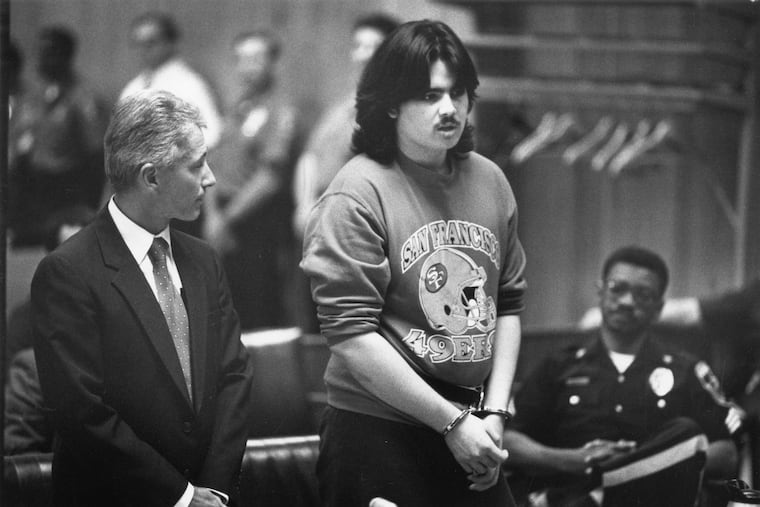
Nearly four decades after a 14-year-old boy killed his 12-year-old neighbor by stabbing her 95 times in one of South Jersey’s most infamous crimes, the killer spoke extensively for the first time about that day, according to a newly released recording.
“I am truly sorry,” Kenneth Houseknecht, now 53, said of the events in April 1988, when he attacked Kim Marie Anderson as she was getting ready for school in her family’s home in Deptford.
“Years ago, when I first got incarcerated, I didn’t take responsibility at all for what had happened. I was going back and forth between no, it didn’t happen, this is a dream. It couldn’t have happened. It wasn’t me. All I can say is that I am sorry, not only to the Andersons, but to my family.”
Houseknecht’s comments came during an unusual May 28 hearing in Gloucester County Superior Court.
After serving 38 years, Houseknecht was seeking a reprieve from a life sentence under a 2022 New Jersey Supreme Court decision that declared mandatory minimum 30-year prison sentences without parole unconstitutional for juvenile offenders.
The ruling allows juveniles serving lengthy prison sentences to seek a review after 20 years of incarceration. Describing it as “the most gruesome homicide of my time,” Superior Court Judge Kevin T. Smith ultimately affirmed the original sentence, stating that Houseknecht continues to be a danger to the community.
No media was present during the nearly two-hour hearing. A succinct news release issued by the Gloucester County Prosecutor’s Office confirmed Smith’s ruling.
However, an audio recording of the proceeding, obtained through an open public records request, offers a compelling window into Houseknecht’s imprisonment since he was a student in junior high school, his family’s pledge of support for his potential release, and the continued anguish and anger of Anderson’s parents, Stephen and Esther.
In 1991, Houseknecht was sentenced to life in prison, meaning he would have to serve a minimum of 30 years before becoming eligible for parole.
If Smith ruled in Houseknecht’s favor, he could be released without relying on the discretion and supervision of a parole board.
The crime
In the early morning of April 19, 1988, Kim and another girl were expected for breakfast at a friend’s house across the street before all three girls boarded their bus for school. Esther Anderson would normally be home to see Kim and her brother, Stephen Jr., off to school, but because of an issue at the family’s catering business, she was already at work, assisting her husband.
Houseknecht was a friend of Stephen Jr., who left the house before his sister because his bus came earlier. Other than the family’s boxer, Bo, Kim was home alone.
It was supposed to be a simple robbery. Houseknecht owed money to an older friend for pornographic magazines. He didn’t expect anyone to be inside the Anderson home. He had with him a small knife he had stolen from the Ames department store.
Confronted by Kim, Houseknecht, who was 6 feet tall and weighed 200 pounds, attacked the 5-foot-3, 120-pound seventh grader. He stabbed her nearly 100 times. The ferocity of the assault was so intense that the tip of the knife broke twice, leaving pieces in her head. Houseknecht also beat her repeatedly with a French-style telephone.
“All I can say is that I am sorry, not only to the Andersons, but to my family.”
One of Kim’s friends discovered her battered body lying on the floor just inside her bedroom, next to a blood-soaked Cabbage Patch doll.
Investigators immediately focused on Houseknecht as a suspect. While they were scouring the neighborhood for clues shortly after the murder, he approached them and made a bizarre revelation.
“You know my fingerprints are all over the house, even in Kim’s room,” he told them, according to sworn statements at the time.
Investigators also discovered a note on Houseknecht’s bed to the Andersons featuring sexually explicit drawings.
“This is your daughter’s killer. I hope you know I used gloves. The next one to get it is Mrs. Anderson,” the note read.
When a judge ordered Houseknecht tried as an adult, Houseknecht pounded furiously on the table, shouting, “Kill me, kill me,” and “I didn’t kill that girl purposely.”
A jury convicted him of murder following an emotionally charged trial that was moved from Gloucester County to Salem County because of extensive pretrial publicity.
Over the years, attorneys with the state’s Office of the Public Defender have exhausted most appeals to have his sentence reduced, contending, among other things, that Houseknecht’s lawyers provided ineffective counsel.
The May hearing before Smith appeared to be the best chance for Houseknecht to be released, barring any potential future parole board decision.
Houseknecht’s courtroom appearance
Dressed in an orange prison jumpsuit, Houseknecht stood for most of the 17 minutes he addressed the court, trying to convince the judge that after being in prison since he was a teenager, he was ready to reenter society. At one point, he became emotional and told Smith he would be more comfortable sitting down.
“It was a robbery that turned tragic,” Houseknecht read from notes. “I had forgotten about somebody being there. I hated that. I hate it today. I fully understand the pain that I caused the Andersons, especially Kim. I know their family can’t be whole.”
He said he regretted writing the note threatening Esther Anderson, describing it as a “stupid attempt to avert attention” from what he had done.
He noted that he had since earned his GED certificate, taken college-level courses, and was a model prisoner who helped tutor other inmates.
“I’ll just end it here with this,” Houseknecht said. “What you see, what you read about me, all that I’ve learned is genuine. I do want to give you my word that I will continue to be the same way on the streets.”
Houseknecht’s sister, Katrina Andreen, testified on her brother’s behalf via Zoom. An actress who goes by the name Katrina Law, she appears on the show NCIS.
“It took many years for him and us to figure out why he did what he did, and then even more years to address it properly, which Ken has done,” she read from a statement. At the time of the murder, she was 11 years old and went by the name Joyce Houseknecht.
A former Miss New Jersey Teen USA pageant winner, Andreen said, “Ken does not shy away from taking full responsibility for his past mistakes and actions. Ken has had almost four decades in prison to think about and reflect on what he did as a troubled 14-year-old, and now, as a grown man, he takes full responsibility and is truly sorry.”
She said her family was prepared to help her brother transition to a life beyond prison.
“Our family will be there for Ken every step of the way, offering moral support, encouragement and most importantly, love,” she said. “I look forward to our family being whole again. I ask that we please believe in forgiveness. I ask that we please believe in rehabilitation. I ask that we please believe in second chances, and I ask that we believe in my brother.”
The Andersons respond ‘it’s just not fair’
Over the decades, Stephen Anderson, now 76, has attended numerous court proceedings in support of justice for his daughter. When it was his turn to speak, he chose not to read from a statement. Instead, he spoke extemporaneously about how his family’s life was forever upended on that April morning in 1988.
He described Houseknecht as a monster who is “not even human to do what he did.” He explained that his wife was not with him in court because she remains fearful of Houseknecht because of the threatening note found on his bed after he killed Kim.
He was extremely skeptical of Houseknecht’s profession of remorse, calling it a lie.
“It took him all these years to become remorse, the doctor said he wasn’t, and now all of a sudden he has it because his lawyers are telling him to say it,” Anderson said.
He said not only is his family fearful of Houseknecht’s release, but the community who remembers the crime is also frightened of the possibility.
“It’s just not fair that not just my family has to live in fear,” he said. “There are a lot of people still living in Gloucester County, and they are going to be fearful of what they have to face when he gets out.”
He asked the judge to “see it the right way” and keep Houseknecht behind bars.
“We’re not gun people, but we’re going to apply for gun permits because we’re scared,” he said.
Assistant County Prosecutor Michael Mellon argued that the original sentence remains intact. He cited expert opinions that found Houseknecht had failed to accept the reality of what occurred and his role in it.
He also reminded the court that Kim Anderson never got to experience high school, college, relationships, or a career.
“Regardless of the outcome here today, no one that can hear my voice should forget Kim Anderson,” he said. “No one in this room, no one that reads this transcript, because Kim matters today, she matters tomorrow, and she matters always.”
The judge’s ruling: ‘The deep-down demon that brought about this crime’
Before sharing his opinion, Smith pointed out that while the hearing focused on Houseknecht’s future, Kim would be 51 today if not for that fateful encounter with her neighbor when both were young.
“We don’t know whether she would be the first woman president,” Smith said. “We don’t know whether she would give birth to the next man on the moon. We don’t know what 12-year-old Kim would have to offer, as 20-year-old Kim, 35-year-old Kim, or 50-year-old Kim. We don’t know that, so we can’t lose sight of the absence of this particular person in this equation.”
He acknowledged Houseknecht’s positive experiences while in prison and his efforts to better himself, saying he has not “gotten into the unproductive behavior of many of his fellow inmates of just playing cards all day.”
But he sided with prosecution experts who believe Houseknecht still poses a risk of violence. Smith also noted that an expert had suggested there was a sexual component to the crime, though that was never addressed at trial.
“There are a lot of people still living in Gloucester County, and they are going to be fearful of what they have to face when he gets out.”
In affirming the original sentence, Smith said to reduce it and allow Houseknecht to be freed with no supervision, would be derelict on his part.
Despite having spent decades in prison and his efforts to improve himself, Houseknecht, Smith said, has never addressed the fundamental issues and “the deep-down demon that brought about this crime.”
Houseknecht remains in custody at the South Woods State Prison in Bridgeton. When he first became eligible for parole in 2018, he refused to cooperate with the hearing process and a hearing was not scheduled.
Nicole Swiderski, a spokesperson for the New Jersey State Parole Board, said in an email that Houseknecht’s status has not changed.