Marie Kondo’s new book on tidying up at the office can work from home, too | Book review
A slim yet efficient guide geared toward white-collar workers with a desk job.
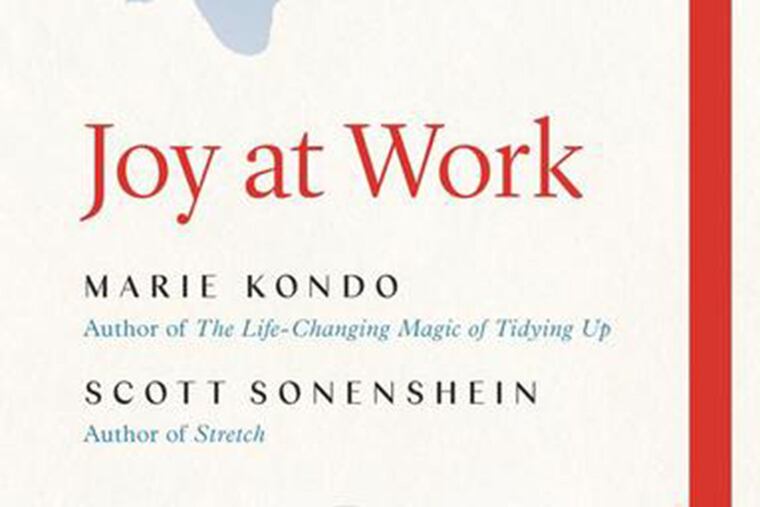
Joy at Work: Organizing Your Professional Life
By Marie Kondo and Scott Sonenshein
Little, Brown Spark. 320 pp. $26
Reviewed by Angela Haupt
The joy of cleaning at work is that, even before the coronavirus pandemic upended normal work life, I never had to do it: The last time I tidied my desk, my boss assumed I was quitting.
My company generously supplied me with an extra shelving unit — a safety precaution given my leaning tower of books; rumor had it the stack was edging toward collapse. I began sharing my desk with a stuffed companion dog. And I opened a coffee shop, which is to say I kept a French press and its required accoutrements beside my keyboard.
So it was inevitable that, one morning in February, I arrived to a miniature avalanche of things — probably the opposite of what Marie Kondo imagines when she asks readers what greets them at their desk each morning. That’s one of the first questions in Joy at Work, Kondo’s new collaboration with organizational psychologist and Rice University business professor Scott Sonenshein.
In the book — a slim yet efficient guide geared toward white-collar workers with a desk job — Kondo declares that "we can only truly spark joy in our work life when we have put every aspect of it in order, including e-mails, digital data, work-related tasks and meetings." With joy on the line, I decided to give it a go.
Day 1, 6:30 a.m.: I arrived in my office shortly after sunrise, on an undercover mission to uncover my desk. Kondo suggests tidying at work early in the morning, or perhaps in the evening, when you have the place to yourself. This is a good idea; not all colleagues will remain straight-faced as you thank your old papers for their service before shredding them. (Of course, I embarked on this endeavor when I still saw my colleagues every day — before my company, like many others, implemented a mandatory work-from-home policy because of the pandemic.)
» READ MORE: Marie Kondo, and the joy-sparking magic of watching other people tidy up.
Kondo continues to promote tidying by category, which in this case meant tackling books, papers, komono (miscellaneous items), and then sentimental items. The rules: Do it all at once, and only keep “things that directly spark joy, those that provide functional joy, and those that lead to future joy.” (If you struggle with equating your work items to joy, Kondo allows such variations as “Will this help my company prosper?”)
I have a propensity for taking notes, which means I had records from every meeting I attended for the past 10 years — none of which I referred to afterward. These were easy to ditch. Other paperwork was more meaningful or necessary, so I scanned it onto my computer and saved it in a folder. I also employed an upright file organizer. So far, it's been wildly successful at keeping my folders from "disintegrating into an anonymous heap" in a drawer.
While sorting through my komono, I unearthed fancy calendars I could have used in 2017 and 2016, and a garden care kit for a garden I don't have. I discovered my Silly Putty had frozen over. Coins tumbled to the ground, and I was so busy practicing my free throw into the trash that I stopped thanking each item for what it had done for me.
By 8:30 a.m., I had emptied my trash and recycling bins into a larger outpost 17 times — and was buzzing with what felt suspiciously close to joy. I was liberated, I was buoyant, and I could see the whites of my desk again.
Day 2, 8 a.m.: I turned to the less physical parts of my work life: Kondo and Sonenshein dedicate half of Joy at Work to tidying digital data, time, networks and decisions. Accomplishing that, I smirked to myself, would require nothing short of some “life-changing magic.”
Four hours later, my inbox had come up for air for the first time in a decade. I had cut more than 1,200 e-mails marked as unread to fewer than 200. The barometer for whether an email stays is familiar: Do you need it to get your job done now or in the future? Will reading it again provide knowledge, inspiration or motivation? And does it spark joy? The coauthors recommend processing e-mails daily: “Shift from thinking everything gets kept to thinking everything gets discarded,” they recommend. (Kondo’s inbox never exceeds 50.)
Each chapter is packed with advice and supporting case studies. These are applicable wherever you are: a newly finagled home office, or your temporarily off-limits workplace.
There’s a lesson on reducing activity clutter — the much-welcomed notion of eliminating unnecessary meetings and other tasks. (According to the book, a worker wastes two and a half hours a week on average in ineffective meetings. Shocking.) And consider this revelation: “If you don’t think the outcome of a decision will make a difference, don’t invest a lot of time making it.” It’s a liberating thought. Does it really matter if you use a line graph or a bar graph in that PowerPoint? Just pick one and move on.
By tidying your drawers, inbox, and Outlook calendar, Kondo and Sonenshein reason, you’ll tidy your career. Not all their advice is realistic, and it’s far more likely you’ll heed a few of their tips than all. I’ll never have a completely empty desk, and good luck persuading your supervisors to cancel the meetings you consider “ineffective.” But the duo’s promise is seductive: “Any place where things are treated with respect and gratitude, whether a home or an office, becomes a relaxing and energizing power spot.” It’s a worthy pursuit.
Haupt is a freelance writer and full-time health editor in D.C. She wrote this for the Washington Post.