The 102-year-old artist who painted out of a refurbished horse stable in Bryn Mawr
While John Costanza finds it harder to make the labor-intensive metallic sculptures he once used to, he still paints and was the subject of a recent exhibition.
On a quiet street in Bryn Mawr, a wondrous backyard holds a curious collection of art. Orbs are stacked on top of one another, getting smaller as they reach toward the sky. Another tower consists of metallic discs. Some stand as tall as 20 feet, huddled together in the grass, not far from a large stone bust and other geometric sculptures.
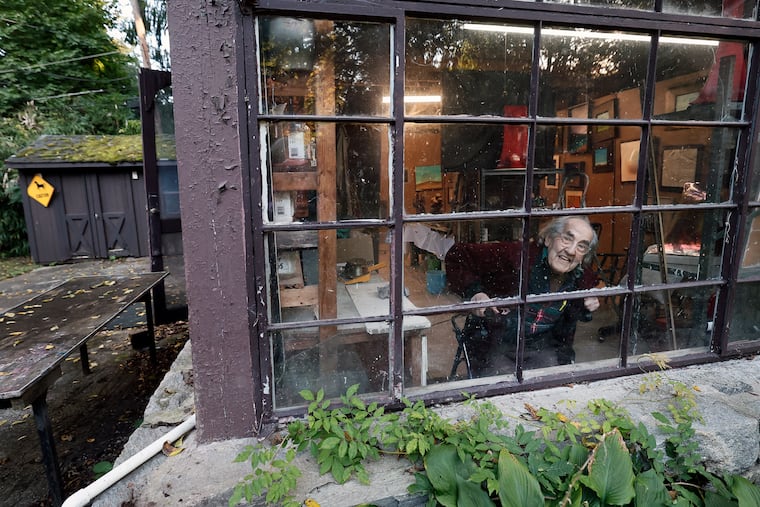
A few feet away, artist John Costanza waves hello from inside his refurbished pony stable, once a flourishing art studio that he shared with his late wife, Mary Scarpone Costanza. He sculpted on the first floor, she painted on the second.
For decades, they cultivated creativity in their backyard studio and their home, where the couple hosted regular parties with local artists, writers, and art students from nearby universities. Generations of artists in Philadelphia learned from the Costanzas.
Costanza, 102, still makes art regularly. Painting is his primary focus at this stage in his life as it’s less labor-intensive than his metallic sculpture work. He’s moving a little slower now, but the artists’ gatherings still continue: Earlier this year he hosted an exhibit at his home to showcase his and Mary’s paintings and statues, a retrospective spotlighting their talented partnership.
The Italian American couple met as students at Temple University’s Tyler School of Art and Architecture (then called Tyler School of Fine Arts) in the late 1940s, Costanza said, sitting on his walker in the stable.
“It’s a little corny,” he begins, chuckling. “Well, she wanted me to help her with her etching. We were in the etching studio, and she would ask me if I would help her. And I did, for the rest of her life.”
They both shared a goal to make the world better through their artwork.
Mary Costanza, who died in 2000, grew up in Berwyn and developed a passion for using painting as a platform for social commentary, where she could voice her opinions about injustice. Following the Ku Klux Klan’s 1963 church bombing that killed four Black girls in Birmingham, Ala., she painted a tribute to the victims called Four Little Girls on the Way to Heaven Stopped in Birmingham. In addition to writing poetry, teaching art, and exhibiting her work, she later became a Holocaust scholar who lectured at universities and published a book about art in concentration camps.
Before they met, John Costanza was drafted into the Navy and sent to the South Pacific to serve as a radio operator during World War II; the G.I. Bill helped him pursue his bachelor of fine arts degree at Tyler. The son of an immigrant mason, he was raised on New York’s Lower East Side with a large family crowded into a tenement building, where he shared a bed with his four brothers. The city sights were artistic inspirations for him as a 12-year-old kid, when he began learning from his mentor Edward Glannon, a landscape painter who encouraged him to paint the world around him.
Teaching was a great way for Costanza to fund his artistic career as he continued expanding into ceramics and sculpture. After they graduated, it was Mary who led John to move from New York to the suburbs of Philadelphia. Eventually, he became chair of the ceramics department at Moore College of Art and Design.
“I just knew I had to make a living. To sell art was not easy. It was difficult, and particularly the kinds of things that I was doing were not appealing,” said Costanza. “Most people would buy landscapes and pretty paintings, and I did things that had to do with my life, making commentaries, and I was expressing myself … so I stayed in teaching and loved it.”
His work did wind up selling, reaching permanent university collections at Temple and the University of Delaware as well as private collections, including those of Vice President Walter Mondale, famed Italian conductor Riccardo Muti, and novelist/playwright Edna Ferber, according to his daughter, Nina Costanza, who lives with him at their family’s cozy home in Bryn Mawr.
A shed in their backyard once held an active kiln where Costanza fired his pottery and ceramic works. Today, its exterior wall features a series of small square tiles, color tests for glazes he experimented with, while inside holds part of a mural that was almost destroyed in 2014.
It was one of Costanza’s most meaningful artworks in Philadelphia: A ceramic mural celebrating Black history that he created with students at University City High School in the 1970s. The names of significant historical figures such as Shirley Chisholm and Booker T. Washington were inscribed into the piece alongside portraits of the participating teens, who made casts of their faces. Costanza said more than 100 faces were included in the textured artwork, and the collaborative effort was partly aimed at preserving their legacy as well.
But when the high school closed, the mural was at risk of demolition along with the rest of the building — and Costanza had no idea, until he happened to visit West Philadelphia one summer day.
“Luckily I was driving by and I saw the high school locked up and I wondered what was going on. I found out that they were tearing down the building,” he recalled. “Nobody told me about it, but I called the superintendent [of the School District of Philadelphia] and we managed to save the mural.”
His son, Jon Costanza, helped him carefully remove each of the mural’s 8,000 ceramic tiles. In 2021, the mural was retitled Black Lives Matter and acquired by Moore College for its permanent collection (though a portion still resides in Costanza’s shed).
Sadly, not all of his rescue efforts were successful: A mural he had created for the Miller Theater (then called the Sam S. Shubert Theatre) was removed from the lobby, despite Costanza’s protests, for renovations. The artist couldn’t find another home for it or afford storage, but the company that dismantled the artwork held it safely for years as a favor — until one day they refused to keep it any longer.
“They took the mural and dumped it in the Delaware River,” said Costanza. “I should have persisted and insisted that I would sue, but I didn’t, unfortunately.”
Thankfully many more of his artworks have survived. His home and his outdoor studio — which bears the name Costanza Art Gallery, a nod to the couple’s former gallery — are filled with dozens of paintings and sculptures by John and Mary. And beyond their retrospective, Costanza continues to have his artwork shown; this past spring his painting, craps, appeared in a juried exhibit at Abington Art Center.
For now, he’s staying sharp, continuing to paint and even innovate. His latest works incorporate a fun contribution from his grandkids — glitter.