How did the Philadelphia Museum of Art become home to the world’s largest Duchamp collection?
Recognizing the French modernist’s boundary-busting potential, the museum offered what Marcel Duchamp wanted: space and control. Lots of it.
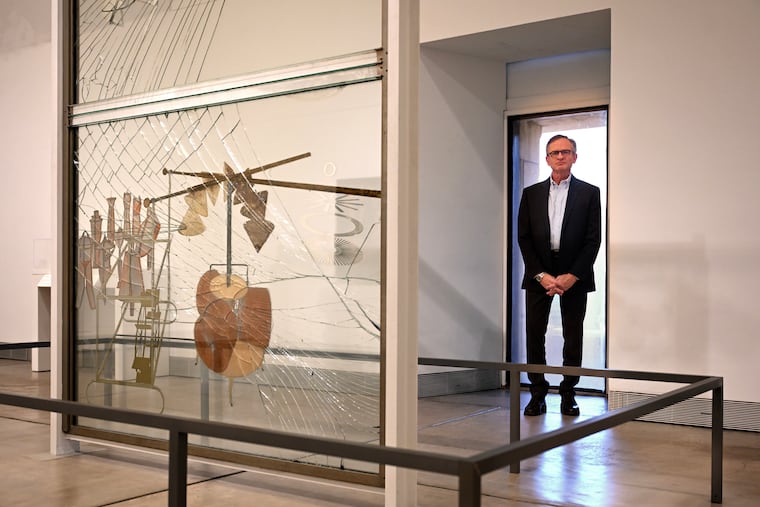
When the Philadelphia Museum of Art debuts its expanded Marcel Duchamp exhibit in October, it will be part of the first major U.S. retrospective of the mysterious forefather of modern art in more than a half century.
Exploring the arc and range of the pioneering French American artist, who died in 1968, the show features 300 of Duchamp’s paintings, sculpture, film, photography, printed matter, design, and his unclassifiable works known as “readymades.”
After showing at New York’s Museum of Modern Art, the PMA show will run from Oct. 10 through Jan. 31, 2027. It includes Duchamp’s most celebrated creations, including his 1912 painting, Nude Descending a Staircase (No. 2), and his avant-garde masterpiece created between 1915 and 1923, The Bride Stripped Bare by Her Bachelors, Even. On hand will be Duchamp’s last major art piece, Étant donnés, a 1966 experiential assemblage he had been working on in secret and intended for the Philadelphia Museum of Art.
“This is a once-in-a-50-years project,” said Philadelphia Museum of Art curator Matthew Affron.
‘Greatest collections’
The monumental show also marks an opportunity to celebrate the museum’s preeminent relationship with Duchamp — and its lasting legacy and impact on the modern art world. No other art institution in the world has deeper Duchamp roots than the PMA, where the artist first helped install his works in 1954.
Questioning the very definition of what art could be — he believed any ordinary object could be recontextualized as art — Duchamp broke the rules. But the artistic anarchist also maintained a decidedly rigid belief that his work should remain together on permanent display — in a monumental museum.
Duchamp played a critical role in making Philadelphia that home.
After leaving Paris and its WWI-era artistic repression and moving to New York in 1915, the artist befriended patrons Louise and Walter Arensberg. With Duchamp’s careful guidance, the couple would amass the most fulsome collection of his works, and those of his contemporaries, anywhere.
By the 1950s, Duchamp and his patrons had negotiated with museums, from the Museum of Modern Art in New York to the National Gallery in Washington, before being wooed by the PMA’s forward-looking director, Sidney Fiske Kimball.
Recognizing Duchamp’s boundary-busting potential, Kimball offered what Duchamp wanted: space and control. Lots of it.
“By the 1950s, Duchamp was becoming a forefather for modern artists,” said Affron. “Fiske was determined to be able to place a major section of modern art within the building.”
Kimball displayed the Arensbergs’ gifted collection in a wing of the still-unfinished museum building on the Parkway, which he helped open in 1928.
Along with other abstract and cubist works, the Arensberg collection helped form the foundation of the Philadelphia Museum of Art for 75 years.
“It’s one of the greatest collections of modern art in an art museum,” Affron said.
Legacy shaping pairing
The unusually intimate relationship between artist and institution — the museum’s permanent display includes 200 Duchamp works and extensive archives — helped shape the artist’s legacy and established the Philadelphia Museum of Art as an essential destination for modern art pilgrims.
Under Duchamp’s direction, the museum initially displayed his works alongside those of contemporaries, like Picasso, Juan Gris, Piet Mondrian, Georges Braque, and Francis Picabia. Many of those works, also amassed by the Arensbergs, were on display at the museum’s temporary show, “Marcel Duchamp, Curator,” which ran through July 12.
Curating the forthcoming retrospective with MoMA collaboration with the Centre Pompidou, Affron said he strove to present a faithful chronology of Duchamp’s work, including replica versions of his own art that he produced later in life.
“One of the game-changing things Duchamp did was put into the question the value of original works of art,” Affron said. “He found a way of working between the originals and copies and when you lay his work out, you start to get a very interesting echo effect.”
It only makes sense for it all to be back at Duchamp’s spiritual home — the Philadelphia Museum of Art, he said.
“We are doing our job of taking care of his legacy,” the curator said.
“Marcel Duchamp” runs Oct. 10 through Jan. 31, 2027, at Main Building, Dorrance Galleries and Galleries 281-283, Philadelphia Museum of Art, 2600 Benjamin Franklin Parkway, Philadelphia, philamuseum.org